
Pergola vs. Retractable Awning: Which Is Right for You
These two get compared as if they are competing for the same job, and they are not. A retractable awning is shade you deploy and put away. A pergola is a room you build and keep. Once you see the choice that way, the decision usually makes itself, because you are not picking a better product. You are deciding whether you want flexible overhead shade or a permanent outdoor space.
In short: a retractable awning starts around $542 and installs as a unit, while a motorized pergola, a louvered-roof structure with electronically adjustable blade angles, starts around $6,400 to $7,263 depending on configuration and installs as a structure. Value Blinds Direct carries both categories, and the choice comes down to whether a shopper needs a shade or a room.

Pergola versus retractable awning: quick comparison
| Retractable awning | Motorized pergola | |
|---|---|---|
| What it is | Deployable overhead shade | Permanent outdoor structure |
| Starting cost | About $542 to $581 motorized | About $6,400 to $7,263, structure only |
| Shade control | Extend or retract overhead | Adjustable, side screens enclose the room |
| Wind | Retract to protect it | Engineered structure, screened |
| Permanence | Low, removable | High, fixed |
| Resale impact | Modest | Higher, adds a usable room |
| HOA | Usually simpler | More likely to need approval |
Cost and installation: awnings win upfront, pergolas add a room
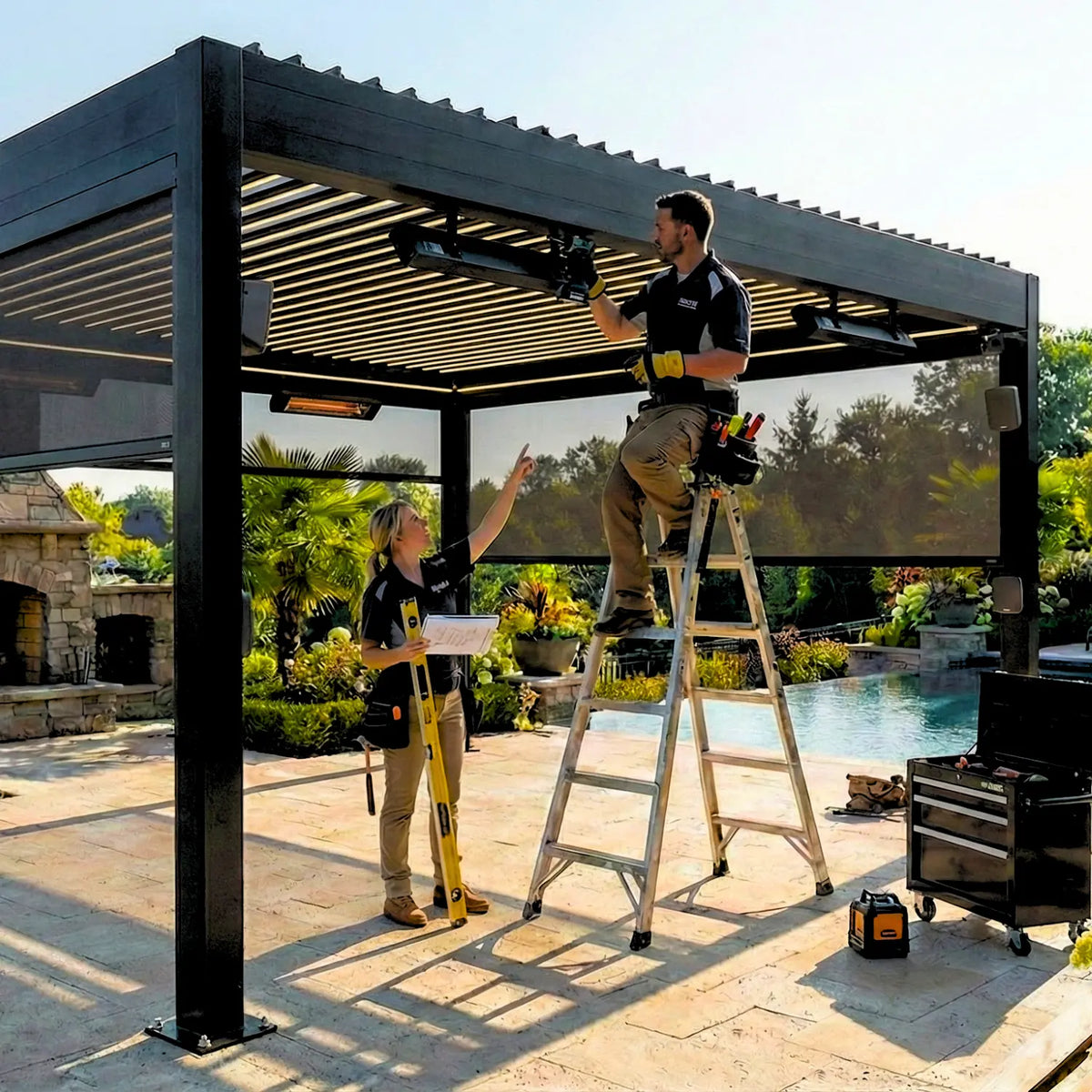
A motorized retractable awning starts at roughly $542 to $581 and installs as a unit mounted to a wall or posts, which is a manageable job, often a professional half-day. Budget for an exterior outlet for the motor if one is not already in place. A motorized pergola starts at roughly $6,400 to $7,263 for the structure, and on top of that you plan for site preparation, footings, electrical runs, professional installation, and any permit. The awning is the lighter financial and physical commitment by a wide margin. The pergola costs more because you are buying a room, not a shade.
Shade control and coverage
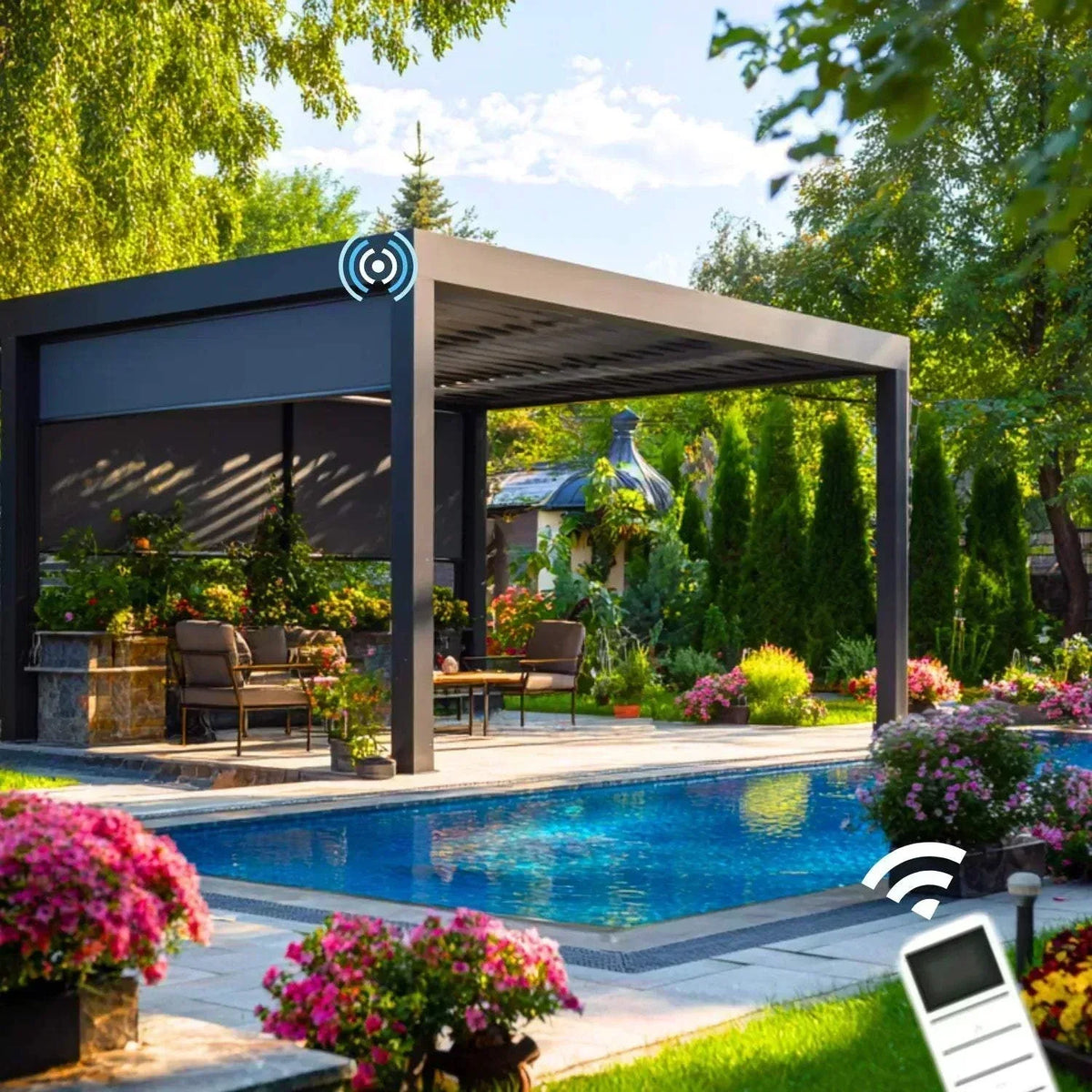
An awning gives you overhead coverage that you extend against midday sun and retract for open sky. Its limit is the angle: an awning over the top does little against low sun from the side late in the day. A motorized pergola manages shade with an aluminum frame and motorized zip-track side screens that close the space against sun, wind, and bugs from the sides, not just overhead. If your problem is overhead sun and you like the option of clear sky, the awning wins. If you want to control the whole envelope of an outdoor room, and especially to beat that low side sun, the pergola with side screens does more.
Wind, weather, and durability
A retractable awning handles wind by getting out of it; you retract it, and under a full cassette the fabric and mechanism are protected when stowed. A pergola handles wind by being built for it, as a fixed aluminum structure with corrosion-resistant hardware and zip-track screens captured in their rails. Both are durable when specified correctly. The difference is philosophy: the awning survives weather by retreating, the pergola by standing.

Permanence, resale value, and HOA considerations
This is where many decisions turn. An awning is removable and low-profile, which makes it the flexible choice for renters, for homeowners who do not want a permanent change, and for strict neighborhoods, because it is far less likely to trigger an approval process. A pergola is a permanent structure, which gives it a stronger resale story, since it adds a defined, usable outdoor room. That same permanence is why a pergola is more likely to require HOA approval or a permit. In HOA-governed areas such as parts of California and North Carolina, check your covenants before committing to a pergola, and budget time for approval.
Which to choose by use case
Choose a retractable awning if you want overhead sun control, a lower cost, an easy install, removability, or the smoothest path with an HOA. Choose a motorized pergola if you want a year-round outdoor room, full control of sun and wind from the sides, and the resale value of a permanent structure, and if your budget and covenants both allow it. If you are still split, the deciding factor is almost always whether you want shade or a space.
Other outdoor shade alternatives
If neither fits, two alternatives are worth a look. Exterior side-track shades give wind-stable shade across a specific opening at a lower cost than a pergola, which suits a single problem elevation. And for large walls of glass, motorized exterior shades block heat at the source. The complete outdoor shades buyer's guide covers the full set.

Frequently asked questions
Is a pergola or awning better? Neither outright. An awning is better for flexible, lower-cost overhead shade you can retract. A pergola is better for a permanent, year-round outdoor room with side-screen control. Match it to whether you want shade or a space.
Which is cheaper, a pergola or a retractable awning? A retractable awning is far cheaper, starting at roughly $542 to $581 motorized, versus about $6,400 to $7,263 for a motorized pergola structure. The awning is also the lighter install.
Do pergolas or awnings add more home value? A pergola generally adds more resale value because it creates a permanent, usable outdoor room, whereas an awning is a removable accessory. The pergola is also more likely to need HOA approval for that same reason.
Is a pergola or awning better?
This depends on the intended use. A motorized pergola functions closer to an outdoor room, with adjustable louvers for shade and airflow control, while a retractable awning functions as a simpler, lower-cost shade for a patio or deck. Value Blinds Direct carries both, so the better option depends on budget and how the space will be used.
Which is cheaper, a pergola or a retractable awning?
A retractable awning is the lower-cost option, starting around $542, while a motorized pergola runs from about $6,400 to $7,263 depending on size and configuration. The price gap reflects the difference between a shade attachment and a full standalone structure.
Do pergolas or awnings add more home value?
A motorized pergola, being a permanent structure, generally contributes more to home value than a retractable awning, which is a shade attachment rather than a built structure. Buyers considering resale value should weigh this structural difference alongside the higher upfront cost of a pergola
What happens next
- Decide whether you want retractable shade or a permanent room.
- Check your HOA covenants if you are leaning toward a pergola.
- Browse the retractable awnings collection or the motorized pergola collection.
- Request free samples or book a professional measure, then place your order. Outdoor builds run about 4 to 5 weeks.

Value Blinds®
Trusted window treatments provider
Value Blinds® is a trusted provider of Greenguard, OEKO-TEX, and FSC-certified window treatments based in Portland, Oregon. Specializing in sustainable, motorized, smart-controlled, and outdoor-ready blinds and shades, the company is built on a foundation of simplified shopping, premium eco-friendly materials, and transparent pricing without the inflated cost.