
Fire Rated Window Shades: Safety and Compliance Guide
TL;DR:
- Fire rated window shades are made from fabrics that resist ignition and reduce flame spread, enhancing fire safety. They comply with standards like NFPA 701, with inherently fire resistant fabrics offering permanent protection. Proper documentation and maintenance are essential for compliance and long-term effectiveness.
Fire rated window shades are window coverings made with fabrics that resist ignition and slow the spread of flames, protecting occupants and property during a fire. The industry standard term for these products is “fire resistant window coverings,” though “fire rated shades” is the widely accepted shorthand used by builders, inspectors, and property managers alike. NFPA 701 is the primary North American compliance standard governing these products, and most commercial building codes legally require all window treatments to meet its testing criteria. For homeowners, builders, and property managers, understanding what separates a compliant shade from a standard one is the first step toward genuine fire safety.
What are fire rated window shades and how are they made?
Fire rated window shades are window treatments constructed from fabrics that resist ignition, limit flame spread, and reduce toxic smoke output during a fire. The term “fire rated” signals that the fabric has passed a recognized test standard, not just that it contains a fire-resistant material. Two broad fabric categories exist: inherently fire resistant textiles and chemically treated textiles.

Inherently fire resistant fabrics are engineered at the fiber level to resist burning without any added coating. Common examples include vinyl-coated fiberglass and high-density polyethylene (HDPE) fabrics. HDPE fabrics meet multiple fire safety standards including NFPA 701, ASTM E-84, and California Title 19, making them a strong choice for both commercial and residential applications. These materials do not rely on a surface treatment, so their fire resistance does not degrade over time.
Chemically treated fabrics start as standard textiles, typically polyester or blended weaves, and receive a flame-retardant coating or chemical bath during manufacturing. Treated fabrics can lose their fire resistance over time, particularly if washed incorrectly or exposed to prolonged moisture. This distinction matters enormously for long-term compliance, especially in commercial spaces that require periodic re-inspection.
Key fabric types used in fire resistant window coverings include:
- Vinyl-coated fiberglass: Durable, inherently resistant, and commonly used in commercial roller shades
- Treated polyester: Widely available and cost-effective, but requires careful maintenance to preserve fire retardancy
- HDPE fabrics: Lightweight, UV-stable, and compliant with multiple fire standards
- Fiberglass mesh: Used in solar shades where light filtering and fire resistance are both required
Pro Tip: Always ask your supplier whether the fabric is inherently fire resistant or chemically treated. The answer directly affects your long-term maintenance plan and re-inspection schedule.
How do fire rated window shades work to enhance building safety?
Fire rated shades work by slowing the rate at which a flame can ignite and travel across a window covering. Standard untreated fabrics can catch fire quickly and spread flames to nearby surfaces, walls, and furnishings within seconds. A compliant fire resistant shade resists ignition long enough to give occupants more time to evacuate.
The mechanism works in three stages:
- Ignition resistance: The fabric resists catching fire when exposed to a direct flame or radiant heat, buying critical seconds before combustion begins.
- Flame propagation delay: If the fabric does ignite, it burns slowly and often self-extinguishes once the flame source is removed, limiting how far fire travels along the window covering.
- Reduced toxic output: Fire retardant shades emit fewer harmful gases during combustion compared to untreated fabrics. Smoke inhalation causes the majority of fire-related fatalities, so reducing toxic fume output is as important as slowing the flame itself.
Fire rated shades are not a standalone fire suppression system. They work best as one layer within a broader fire safety strategy that includes sprinklers, smoke detectors, and fire-rated doors. In schools, hospitals, and high-occupancy office buildings, window coverings near exits and corridors receive the most scrutiny during fire safety inspections. Placing compliant shades in these locations directly supports evacuation safety by keeping escape routes clear of rapid flame spread.
What are the main fire safety standards for window shades?
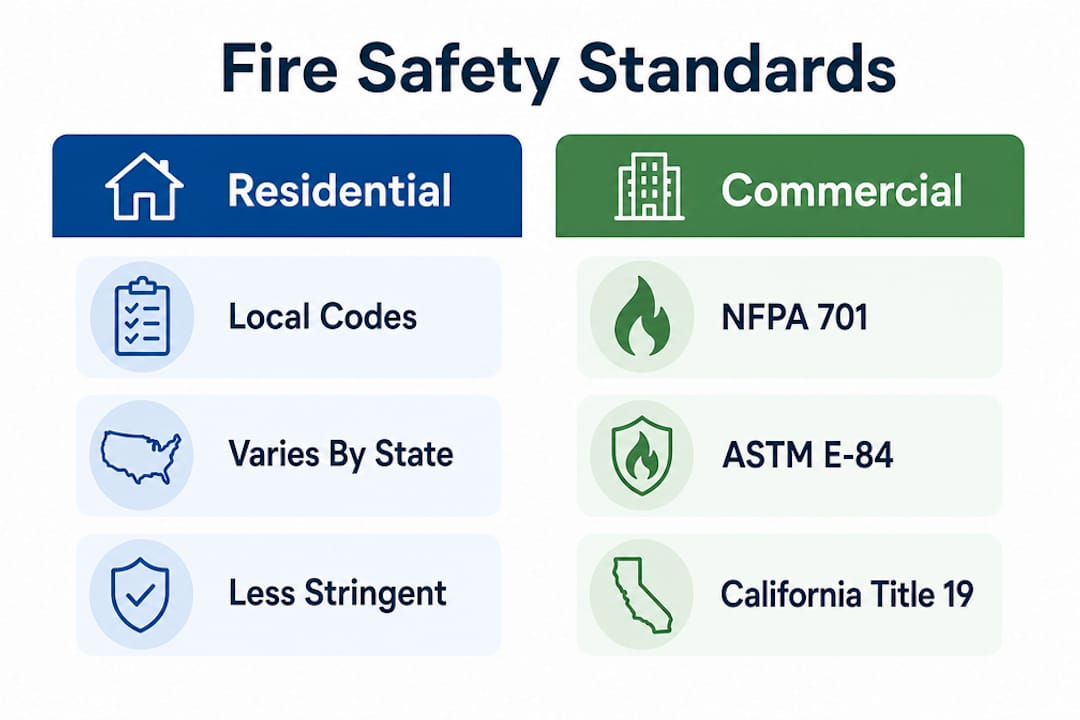
Fire safety standards for window shades vary by occupancy type, location, and building use. Understanding which standard applies to your project prevents costly procurement errors and failed inspections.
NFPA 701 is the dominant North American standard. Most commercial building codes legally mandate that all window treatments in commercial and public buildings meet NFPA 701 testing. The standard uses two test methods: a small-scale test for lightweight fabrics and a large-scale test for heavier or layered materials. A fabric must pass the applicable test method to carry an NFPA 701 certification.
ASTM E-84 measures surface burning characteristics, including flame spread and smoke development. It applies to a wider range of building materials and is often required alongside NFPA 701 for window treatments installed in corridors, stairwells, and other high-risk zones.
California Title 19 applies specifically to public buildings in California and sets flame resistance requirements for draperies, curtains, and similar textiles. Products sold for California commercial use must meet Title 19 in addition to NFPA 701.
The table below outlines the key differences between residential and commercial fire standards for window coverings:
| Factor | Residential | Commercial |
|---|---|---|
| Governing standard | Local building codes (varies by state) | NFPA 701 (legally mandated in most states) |
| Testing requirement | Often voluntary or insurance-driven | Mandatory; documentation required before installation |
| Fabric type accepted | Treated or inherently resistant | Inherently resistant preferred; treated accepted with documentation |
| Re-inspection frequency | Rare | Regular, especially in high-occupancy buildings |
| Documentation required | Typically not required | Formal test reports submitted before procurement |
Residential and commercial fire standards differ significantly, and using a residential-rated fabric in a commercial setting leads directly to non-compliance. This is one of the most common and expensive mistakes builders make during procurement.
Pro Tip: Request the actual NFPA 701 test report from your fabric manufacturer, not just a product label claiming compliance. Test reports include the specific test method used, the fabric weight tested, and the pass/fail result. Labels alone do not satisfy documentation requirements during inspections.
What benefits do fire rated shades offer homeowners, builders, and property managers?
The benefits of fire rated shades extend well beyond passing an inspection. For homeowners, the primary gain is reduced fire risk near windows, which are common entry points for flames during exterior fires such as wildfires or neighboring structure fires. For builders and property managers, compliance directly affects occupancy permits, insurance premiums, and liability exposure.
The practical advantages include:
- Occupant protection: Slower flame spread near windows gives residents and building occupants more time to evacuate safely.
- Reduced property damage: Limiting how quickly fire travels across window coverings reduces the total area of damage during a fire event.
- Lower toxic fume exposure: Compliant shades emit fewer harmful gases, reducing the risk of smoke inhalation injuries during evacuation.
- Insurance and code compliance: Many property insurers offer favorable terms for buildings with documented fire-resistant window treatments. Compliance also protects builders from liability during post-incident investigations.
- Aesthetic flexibility: Modern fire resistant window coverings are available in a wide range of colors, opacities, and styles. Fire safety treatment does not require sacrificing design quality.
- Building marketability: Commercial properties with documented fire safety compliance are easier to lease and sell, particularly in regulated sectors like healthcare and education.
For property managers overseeing multiple buildings, standardizing on fire rated window treatments across a portfolio simplifies re-inspection cycles and reduces the risk of a single non-compliant installation creating a code violation across an entire property.
How to select, install, and maintain fire rated window shades
Selecting the right fire rated shade starts with confirming the compliance standard your project requires. A residential renovation in a wildfire-prone area has different needs than a hospital corridor in a state with strict NFPA 701 enforcement.
Follow these steps to select, install, and maintain compliant fire resistant window coverings:
- Confirm the applicable standard. Identify whether your project requires NFPA 701, ASTM E-84, California Title 19, or a combination. Check local building codes and consult your general contractor or fire marshal if the requirement is unclear.
- Request test documentation from your supplier. Documentation from fabric manufacturers confirming NFPA 701 compliance is required as part of product submittal for commercial projects. Ask for the full test report, not a summary sheet.
- Choose the right fabric type for your use case. Inherently fire resistant fabrics suit high-traffic commercial spaces where washing or wear could degrade a chemical treatment. Treated fabrics work well in residential settings where maintenance is controlled.
- Consider motorized vs. manual operation. Commercial motorized shades carry stricter technical requirements than residential systems, including power source specifications and control integration. Verify that motorized options meet both fire and electrical code requirements for your building type. You can explore motorized shade options that combine fire-rated fabrics with modern control systems.
- Schedule installation with inspection readiness in mind. Keep all test documentation on-site during installation. Inspectors may request fabric compliance records at any point during a commercial build-out.
- Maintain treated fabrics correctly. Follow the manufacturer’s care instructions precisely. Incorrect washing can strip flame-retardant coatings from chemically treated fabrics, voiding their fire rating.
Pro Tip: For renovations, check whether existing window coverings carry any fire rating documentation. Older installations often lack records entirely, which creates compliance gaps during re-inspections. Replacing non-documented shades with certified fire retardant options resolves the gap cleanly.
Key Takeaways
Fire rated window shades are a non-negotiable safety layer in commercial buildings and a high-value upgrade in residential spaces, with NFPA 701 certification serving as the definitive compliance benchmark across North America.
| Point | Details |
|---|---|
| NFPA 701 is the key standard | Most commercial building codes legally require window treatments to meet NFPA 701 testing. |
| Fabric type determines durability | Inherently fire resistant fabrics outlast chemically treated options without maintenance degradation. |
| Documentation is mandatory | Suppliers must provide formal test reports before installation in commercial projects. |
| Residential and commercial standards differ | Using a residential-rated fabric in a commercial space causes non-compliance and failed inspections. |
| Benefits go beyond compliance | Fire rated shades reduce toxic fume output, limit property damage, and support occupant evacuation time. |
Why I think most buyers underestimate the documentation problem
The conversation around fire rated window shades almost always focuses on fabric type and test standards. That is the right starting point, but the real failure point I see repeatedly is documentation. Procurement errors happen most often when project teams assume a residential fire rating satisfies a commercial code requirement. The fabric may genuinely resist flames. The problem is that without the correct test report for the correct occupancy type, the installation fails inspection regardless of how the fabric actually performs.
I have seen builders source what they believed were fully compliant shades, only to discover during a final inspection that the test documentation referenced a different fabric weight than what was installed. The inspector does not care that the fabric looks identical. The report must match the product exactly.
The other underestimated issue is long-term maintenance of chemically treated fabrics. A shade that passes NFPA 701 on installation day may not pass two years later if it has been cleaned with the wrong detergent. Inherently fire resistant materials solve this problem entirely, and the price difference is often smaller than the cost of a failed inspection and replacement cycle.
My honest recommendation: treat fire rating documentation the same way you treat structural permits. Keep every test report, every product submittal, and every installation record in a physical file on-site. If you are a property manager overseeing multiple buildings, build a compliance calendar that tracks re-inspection dates alongside shade maintenance schedules. The upfront effort is minimal compared to the liability exposure of a non-compliant installation.
— Sunny
Valueblindsdirect fire-rated window treatments for your next project
Choosing a compliant window shade does not mean settling for a plain or industrial look. Valueblindsdirect offers a fire retardant collection that covers residential and commercial needs, with fabrics tested to meet recognized fire safety standards.
The Window Treatment Design Studio makes it straightforward to select shades by fabric type, opacity, and style while keeping compliance requirements in view. Whether you need a motorized roller shade for a commercial corridor or a cordless cellular shade for a residential bedroom, the catalog includes options with fire-rated fabric choices. Expert support is available to help you match the right product to your specific code requirement, so you arrive at installation day with the correct documentation already in hand.
FAQ
What are fire rated window shades?
Fire rated window shades are window coverings made from fabrics that resist ignition and slow flame spread, tested against standards like NFPA 701. They are used in both residential and commercial buildings to improve fire safety and meet building code requirements.
How do I know if a window shade meets NFPA 701?
Ask your supplier for the full NFPA 701 test report, not just a product label. The report must identify the specific test method used and confirm the fabric weight tested matches the product being installed.
Do homeowners need fire rated window shades?
Homeowners are not always legally required to use fire resistant window coverings, but they are strongly recommended in wildfire-prone areas and for homes with open-plan layouts where flame spread near windows poses a higher risk.
Can fire rated shades look stylish?
Yes. Modern fire resistant window coverings are available in a wide range of colors, textures, and opacities, including motorized and cordless options that meet both design and compliance requirements.
What is the difference between inherently fire resistant and treated fabrics?
Inherently fire resistant fabrics are engineered at the fiber level and retain their fire resistance permanently. Chemically treated fabrics can lose their fire resistance over time, especially if washed incorrectly, making them less reliable for long-term commercial compliance.
Recommended
- Easy Install Window Shades: Step-by-Step Guide for All Homes
- Fire Retardant Blinds Explained: Safety and Selection
- Privacy Shades for Windows: Enhancing Home Security
- Privacy Light Filtering Shades: Style and Safety

Value Blinds®
Trusted window treatments provider
Value Blinds® is a trusted provider of Greenguard, OEKO-TEX, and FSC-certified window treatments based in Portland, Oregon. Specializing in sustainable, motorized, smart-controlled, and outdoor-ready blinds and shades, the company is built on a foundation of simplified shopping, premium eco-friendly materials, and transparent pricing without the inflated cost.