
5 Checks to Order Wind Rated Outdoor Shade Blinds
For sun and glare while keeping your view, go with solar or mesh roller screens. For total privacy or nighttime shading, pick blackout or retractable systems. For overhead coverage on a bare patio, an awning or pergola shade wins, and PVC roll-up screens are the budget privacy fix. Your real decision hinges on sun exposure, wind exposure, how much light you want blocked, your mounting surface, and whether motorization is worth it to you. ☀️
TL;DR:
- Fabrics with lower openness percentages provide better heat and glare reduction but restrict views, so choose based on whether visibility or privacy is the priority.
- Wind-rated outdoor shades require declared ratings (EN 13561) and proper hardware, with retraction in high winds being essential for durability and safety.
- Regular maintenance, including cleaning, checking fasteners, and testing motorized units, significantly extends the lifespan of outdoor shades.
- Costs range from around $100 for basic manual solutions to several thousand dollars for large, motorized, windproof systems; warranties typically cover fabric UV fade, motors, and hardware corrosion.
- Manual operation or cordless systems are suitable for occasional use, while motorized shades benefit high-frequency or hard-to-reach applications for greater convenience.
Table of Contents
- What Are the Main Types of Outdoor Shade Blinds?
- How Do You Choose Fabric Openness for Heat, Glare, and View?
- Should You Choose Motorized, Cordless, or Manual Controls?
- How Do You Measure and Install Outdoor Shade Blinds?
- What Wind Rating Should Outdoor Shade Blinds Have?
- How Do You Maintain and Care for Outdoor Shade Blinds Seasonally?
- What Do Outdoor Shade Blinds Cost, and What Should the Warranty Cover?
- Value Blinds’ Perspective: Matching Real Jobs to Real Products
- Ready to Order Swatches or Get a Quote?
- Sources
- FAQ
What Are the Main Types of Outdoor Shade Blinds?
Not every outdoor shade blind does the same job, and that’s exactly why so many people end up buying the wrong one. Picking blindly (pun intended) usually means you’re either squinting through a screen that’s too open or sitting in the dark behind one that’s way too heavy for a sunny afternoon hangout. Here’s the breakdown of what actually exists and where each one shines.
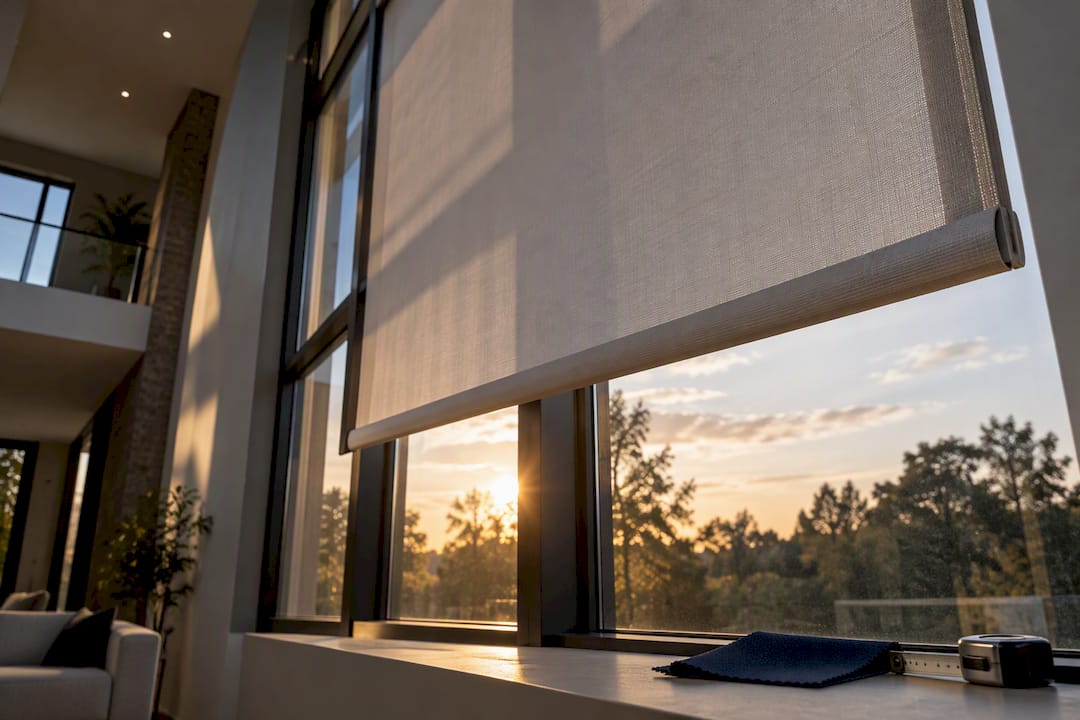
Exterior solar or mesh roller screens mount on tracks or a headrail above a window, doorway, or patio opening and roll down a tightly woven fabric with small perforations. They cut glare and block a big chunk of solar heat while letting you still see the yard, the pool, or the street. Exterior shades stop sunlight before it ever reaches the glass, which is a big reason they outperform interior blinds for heat control.
Blackout outdoor blinds use a tightly woven or coated fabric with zero (or close to zero) openness. These are the ones you want for a home theater setup on the patio, a nursery window that faces west, or any spot where you want it dark and private, full stop.
Retractable awnings and pergola shades cover overhead space instead of a vertical opening. An awning bolts to your exterior wall and extends outward; a pergola shade slides across an existing structure’s beams. Both give you shade without blocking your sightlines at all, which makes them the go-to for open patios and decks with no walls to mount a roller screen against.
PVC roll-up and privacy screens are the workhorse, budget-friendly option. They’re vinyl or reinforced PVC sheets that roll up and down manually, usually on a porch or gazebo, and they deliver solid opacity at a lower price point than a motorized fabric system.
Here’s how they stack up when you’re trying to match a product to a problem:
- Want daylight and a view, but less heat and glare? Solar/mesh roller screens.
- Want zero visibility in or out, day or night? Blackout roller shades.
- Have an open patio with no vertical structure to mount to? Retractable awning or pergola shade.
- Need privacy on a budget and don’t mind manual operation? PVC roll-up screens.
- Living somewhere with real seasons? Retractable and roll-up styles let you put shade away for winter; fixed screens stay up year-round.
The trade-off that trips people up most is view versus opacity. The fabric that blocks the most heat and light is also the fabric you can’t see through, so if you want both an unobstructed view and serious heat control, you’re better served by a lower-openness solar screen than a blackout panel.
How Do You Choose Fabric Openness for Heat, Glare, and View?
Openness factor is the single number that tells you how a fabric will behave, and most buyers never ask about it. It’s the percentage of a fabric that’s actual open weave versus solid material. A 1% openness fabric is nearly opaque; a 10% openness fabric lets in a lot more light and view, but sacrifices heat and glare control to get there.
ASHRAE’s fenestration guidance ties this directly to visual comfort: the tighter the weave, the more glare and light you cut, and the choice should follow the room’s actual use, not just personal preference.
Material matters as much as openness. Here’s what you’re actually choosing between:
- Woven solar fabrics (usually PVC-coated polyester) resist UV breakdown, come in a wide range of openness percentages, and hold up well outdoors for years.
- Solid PVC/vinyl delivers maximum opacity and weather resistance, ideal for full privacy screens, though it won’t breathe or flex like a woven fabric.
- Blackout textiles block essentially all light and are often layered or coated for extra durability, but they’re heavier and put more strain on hardware.
- Aluminum or metal slats (used in some exterior blind systems) offer excellent durability and a cleaner architectural look, though they don’t flex with high wind the way fabric does.
Color plays into this too. Darker fabrics absorb more heat on the outward-facing side, but from indoors they typically cut glare better since they reflect less light back at your eyes. Lighter colors reflect more heat outward but can wash out with glare if you’re facing a bright yard.
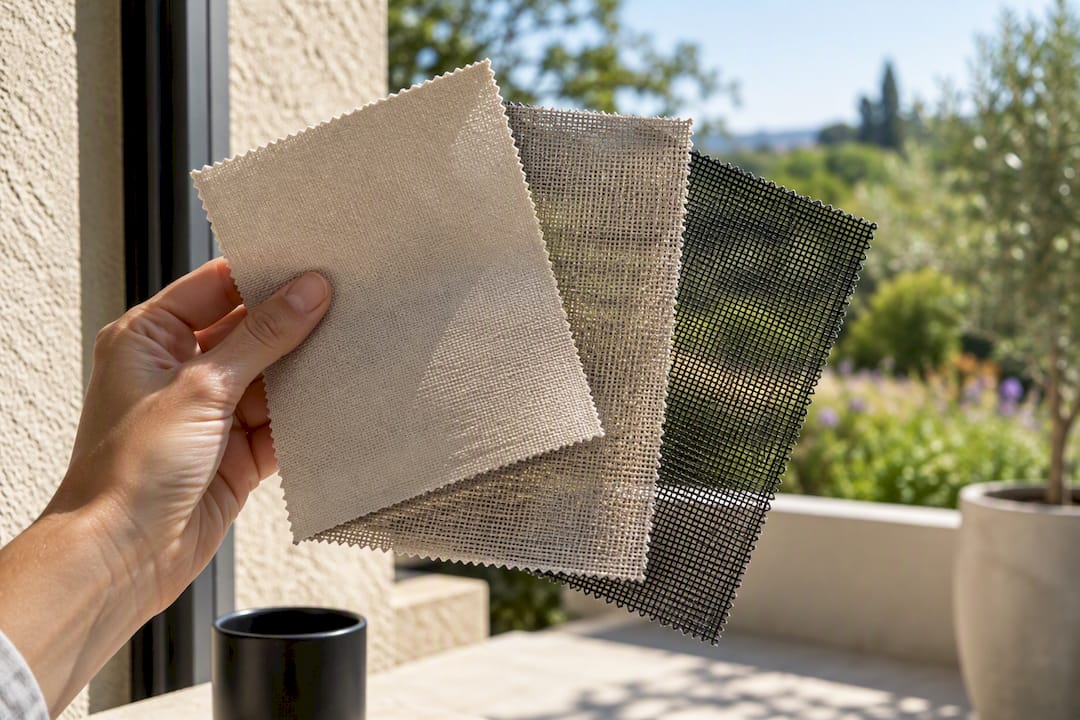
Pro Tip: Never pick fabric off a screen image alone. Order swatches and hold them up outside at the actual time of day you’ll use the space most, not around 4 p.m., and the only way to know for sure is to see it in your own light.
Should You Choose Motorized, Cordless, or Manual Controls?
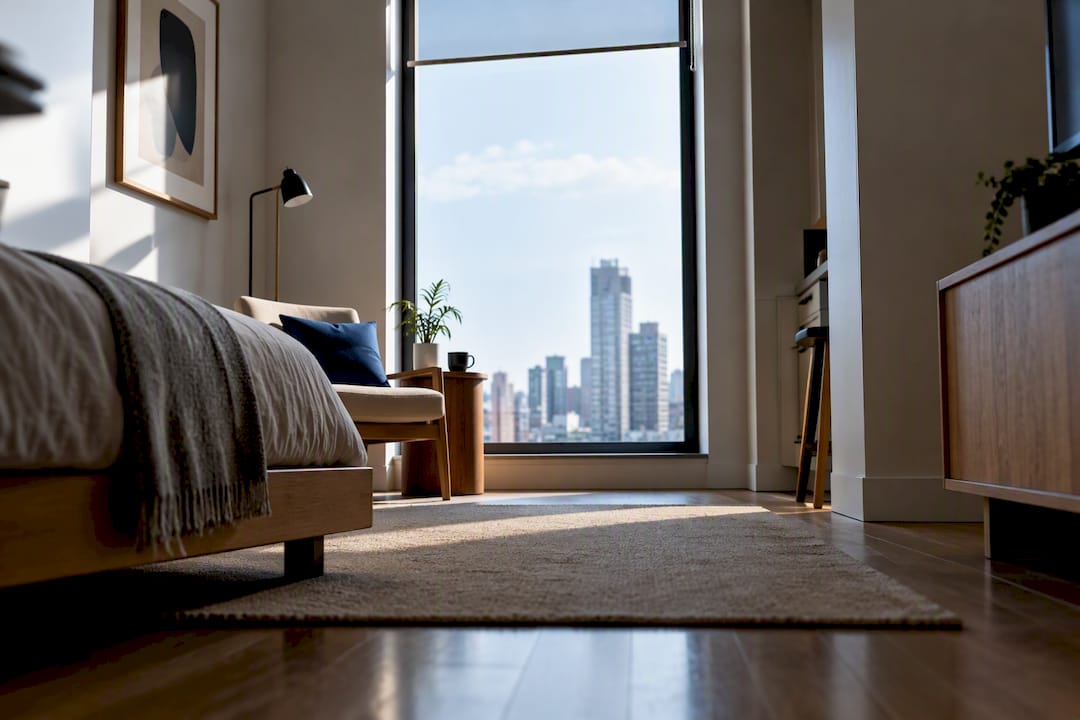
The control system you pick affects how often you’ll actually use your shade, and that matters more than it sounds. ASHRAE has pointed out that exterior shading only delivers on its promise if people actually operate it, and a shade that’s a pain to lower stays up, sun or no sun.
Motorized drives let you set schedules, trigger shades by remote, or tie them into a smart home system. Some run on solar-charged batteries or USB-rechargeable packs, which means no electrician visit for most installs. The upside is real convenience, especially for large spans or hard-to-reach mounts. The downside is a higher upfront cost and a motor that eventually needs servicing or battery swaps, so factor that into your warranty research before you buy.
Cordless lift systems are the middle ground. No dangling cords (a real win if you’ve got kids or pets around), and they’re simpler mechanically than a motor, which usually means fewer things to break. Give the lift mechanism a firm test tug in the showroom or on delivery. A cordless system that feels sticky or uneven out of the box will only get worse.
Manual crank or pull systems are the most basic and the most bulletproof. Fewer parts, nothing to charge, and usually the cheapest option, though they demand more physical effort for wide spans.
For anything mounted in a windy or exposed spot, controls are only half the equation. You also need:
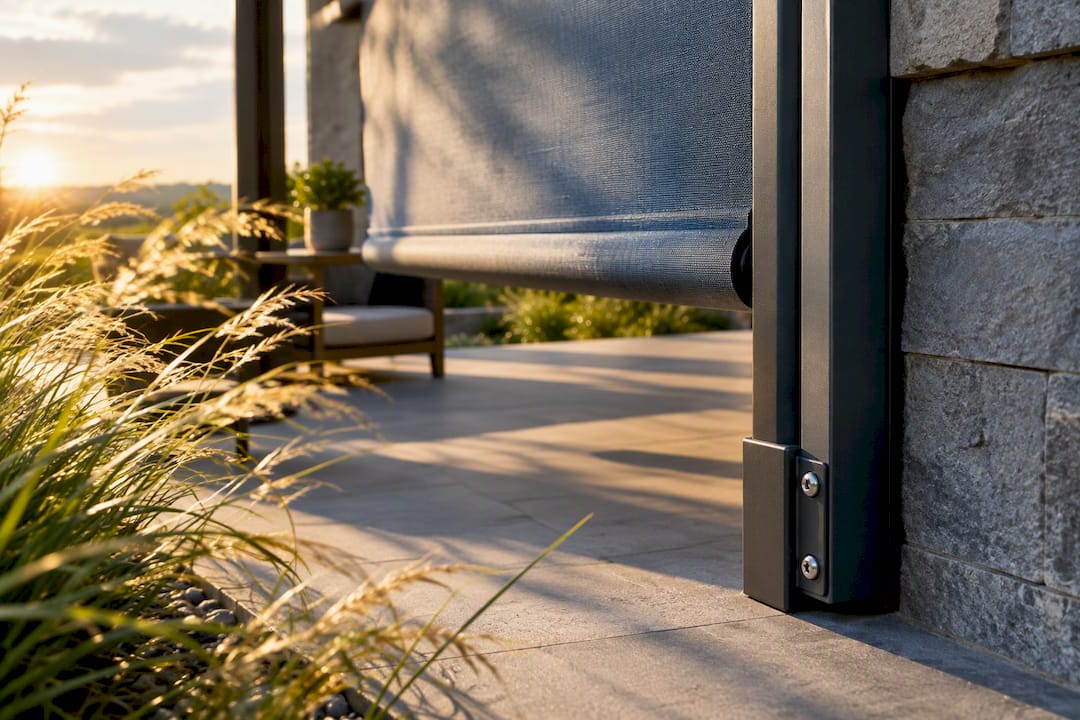
- Side rails or guide cables that keep the fabric tracking straight and stop it from ballooning in gusts.
- Hold-down brackets or tension systems at the base to anchor the shade when it’s extended.
- Automatic retraction settings on motorized units, so the shade pulls itself up before wind or solar load hits a preset threshold, which is a genuinely underrated feature for commercial properties that can’t have staff babysitting the weather all day.
For high-use commercial spaces, restaurants with patio seating, or apartment complexes with shared balconies, smart scheduling takes the guesswork off your staff entirely. The shade goes down before the lunch rush gets hit with glare and comes up on its own after sunset.
How Do You Measure and Install Outdoor Shade Blinds?
Getting the measurement right the first time saves you a returned order and a second round of shipping. Here’s the checklist to run through before you order anything custom:
- Measure width in three places (top, middle, bottom of the opening) and use the smallest number if they differ even slightly.
- Measure height in three places (left, center, right) for the same reason, taking the largest number this time since you want full coverage top to bottom.
- Account for mounting hardware clearance. Headrails, brackets, and side rail channels all eat into your usable opening, so leave room in your measurement for the hardware itself, not just the visible gap.
- Check for obstructions, gutters, light fixtures, outlets, or structural beams, that might interfere with a face mount or a pergola mount.
- Note your structure type (wood beam, stucco wall, metal frame, vinyl siding) since that determines what fasteners and anchors will actually hold long term.
Mount type changes both how well water sheds off the fabric and how the whole system handles wind:
- Face mount attaches directly to a wall surface above the opening, which is the most common and generally the sturdiest for wind resistance since it’s bolted straight into structural material.
- Soffit mount attaches to the underside of an overhang, keeping the headrail tucked out of sight, though it depends on the soffit itself being solid enough to hold the hardware securely.
- Pergola mount attaches across existing beams, and while it’s a clean-looking option, it’s only as strong as the pergola’s own construction, so a shaky or aging pergola isn’t a great candidate for a heavy motorized shade.
DIY measuring and installation works fine for smaller, single-opening jobs on a straightforward wall mount. Where you should hire a professional: large spans (anything over roughly 10 to 12 feet), openings with unusual angles, mounts that require structural reinforcement, or any installation where a declared wind-performance rating depends on exact anchoring specs being followed to the letter. Professional measure and install services also typically protect your warranty, since a lot of manufacturers tie coverage to correct installation, and a self-install gone wrong can void that protection before you’ve even used the product once.
What Wind Rating Should Outdoor Shade Blinds Have?
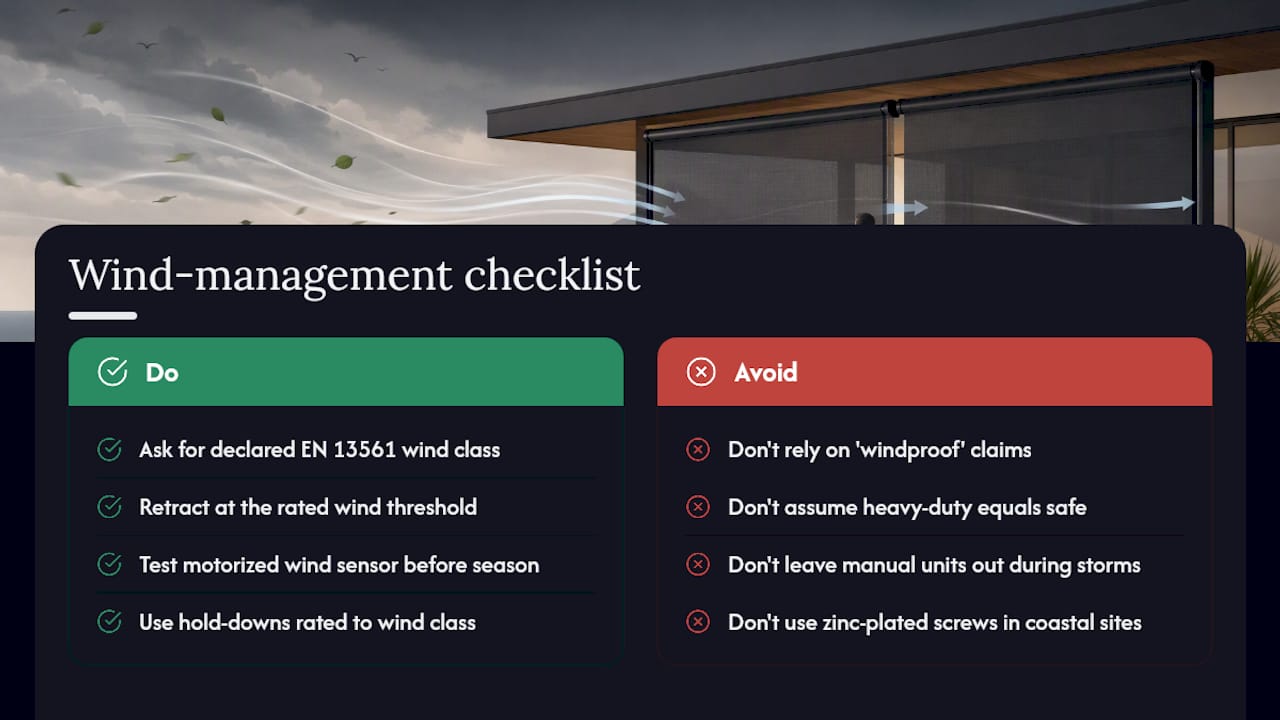
“Windproof” is a marketing word, not an engineering spec, and that distinction matters when you’re spending real money on a custom exterior shade. The wind resistance of external blinds and awnings is classified under EN 13561, a European standard that assigns nominal and safety wind pressure ratings to specific product classes. Ask your supplier for the declared wind class on the exact configuration you’re ordering, not a generic claim about the product line.
Wind management isn’t a one-time spec, it’s an operating rule you commit to. Side rails and guide cables help keep fabric tracking straight, but they don’t replace a site-specific policy: retract the shade once wind hits its rated threshold, every time, no exceptions. Never assume a shade is safe in high wind just because the listing calls it “heavy duty.”
That means a few practical habits for anyone running an outdoor shade blind day to day. Retract manual units before storms roll in rather than after the wind picks up. If you’ve got a motorized system, set the automatic wind sensor retraction feature and actually test that it works before the first real storm of the season. Use hold-downs or tension anchors rated for your specific wind class, since mismatched hardware is one of the most common reasons a shade fails early.
Hardware corrosion resistance is worth checking too, especially for coastal or high-humidity sites. Look for coated aluminum or galvanized steel components and stainless steel fasteners. Salt air and cheap zinc-plated screws are not a good combination, and it’s the kind of failure that shows up as rust streaks and a stuck mechanism about eighteen months in, right after most basic warranties have expired.
How Do You Maintain and Care for Outdoor Shade Blinds Seasonally?
Exterior shading needs more upkeep than the blinds inside your living room, simply because it’s out in the weather every day. ASHRAE notes that exterior systems demand more frequent maintenance than interior devices, and honestly, the best shade is the one you’ll actually keep clean and operating, not the fanciest one collecting grime in a closed position.
Here’s the routine that keeps a shade working for years instead of months:
- Clean fabric with mild soap and water, never harsh solvents or pressure washers on close range, which can degrade coatings and seams.
- Wipe down tracks and side rails every few months to clear dust, pollen, and grit that cause sticking.
- Check fasteners and brackets twice a year for looseness, rust, or hairline cracks in the mounting surface.
- Test motorized units regularly, including the wind sensor retraction if you have one, so you’re not discovering a dead battery mid-storm.
- Retract fully during storms and clear any snow load immediately rather than letting weight sit on extended fabric.
Pro Tip: Keep a simple seasonal reminder, spring cleaning, fall retraction check, on your phone calendar. It takes five minutes and it’s the single easiest way to avoid a warranty claim down the road.
If something’s not tracking smoothly, the motor is unresponsive, or fabric shows unusual wear, contact your manufacturer’s support line before attempting a repair yourself. Most warranties require documented issues reported through official channels, not a DIY fix that voids coverage.
What Do Outdoor Shade Blinds Cost, and What Should the Warranty Cover?
Price swings widely based on size, fabric choice, and whether you’re adding motorization. On the low end, simple exterior-mounted shading solutions can run around $100 per window for basic setups. Larger custom systems, especially wide motorized patio shades with side rails, cost considerably more once you factor in fabric yardage, hardware, and professional installation.
Energy savings are real but shouldn’t be treated as a fixed number. Depending on your climate, orientation, and how consistently you actually deploy the shade, window attachments including exterior shading can produce savings anywhere from roughly 3% to 30%. That’s a wide range, and it tells you the honest answer: your results depend on your habits as much as the product itself.
Warranties vary by manufacturer, but there are a handful of things worth confirming before you buy:
- Fabric fade and UV degradation coverage, since sun exposure is the number one cause of premature fabric wear.
- Motor warranty length, separate from the fabric warranty, since motors are the most likely component to need service.
- Hardware corrosion coverage, particularly important if you’re near salt air or high humidity.
- What voids the warranty, usually improper installation, which is exactly why professional measure and install services matter for larger or complex jobs.
Before you place an order anywhere, run through this quick checklist: request fabric swatches, confirm the declared wind-performance class for your exact configuration, ask about lead time on custom orders, get professional installation pricing if your span or mount is complex, and read the warranty terms in full before checkout.
Value Blinds’ Perspective: Matching Real Jobs to Real Products
The outdoor lineup is designed around custom sizing, motorized drives for frequently used shades, and windproof side-rail systems for exposed patios that require a declared wind class. Free swatches let you test openness and color in your own light before committing, and a Pro Measure & Install service exists specifically for large-span, tricky-mount jobs where a DIY error can void a warranty. If your project matches any of the scenarios above, that’s exactly the range we designed for.
— Sunny
Ready to Order Swatches or Get a Quote?
Once you know which category fits your space, solar screen, blackout, awning, or roll up, the fastest next step is seeing the fabric in person and getting real numbers for your exact opening. This business is built for custom, made-to-order projects: no guessing at standard sizes and no settling for a fabric seen only on a screen.
Start by browsing the full collection of custom outdoor and window shading options to see what fits your space, then order free fabric swatches so you can check openness and color against your own patio light before you commit to anything. If your project involves a wide span, a pergola mount, or a motorized windproof system with side rails, take a look at the motorized outdoor windproof solar shades built for exactly that kind of exposed, high-use installation. Custom orders typically come with warranty coverage on fabric and hardware, and a support team is available for questions about sizing, wind ratings, or installation timing before checkout. For installations beyond straightforward wall mounts, professional measuring and installation services are recommended to ensure correct setup the first time.
Sources
A few references back the technical claims in this guide, and they’re worth a look if you want the underlying detail:
- CHAPTER 15 Fenestration (ASHRAE Handbook)
- Regulation on external blinds and awnings (EN 13561 reference)
- Saving Lives Through Affordable Shading: Shielding Communities from Excessive Solar Heat (LBNL/DOE)
Always confirm declared wind class and energy guidance directly with your supplier for the specific product configuration you’re ordering.
FAQ
What Is the Best Type of Outdoor Shade Blind for a Sunny Patio?
Exterior shading blocks solar heat before it reaches the glass or seating area, making it more effective than any interior-only solution.
How Do I Know What Wind Rating My Outdoor Blind Needs?
Ask your supplier for the declared wind-performance class under EN 13561 for your exact product configuration, not a general marketing claim. Site exposure, mount type, and side-rail accessories all affect the safe operating threshold.
Is Motorization Worth the Extra Cost for Outdoor Shades?
Motorization pays off most on large spans, hard-to-reach mounts, and shades used daily, since automatic scheduling and wind-sensor retraction mean the shade actually gets used and protected without manual effort. For smaller, occasional-use openings, a cordless or manual system is often just as practical at a lower price point.
How Much Do Custom Outdoor Shade Blinds Cost?
Simple exterior shading solutions can start around $100 per window for basic setups, while larger custom motorized systems with side rails cost more depending on size, fabric, and installation. Value Blinds’ current pricing for custom outdoor shades and motorized options is available directly on the product pages.
Can Outdoor Shade Blinds Really Lower Cooling Costs?
Yes, though savings vary widely. Window attachments, including exterior shading, can produce energy savings between roughly 3% and 30% depending on climate, orientation, and how consistently the shade gets deployed.