
Best Outdoor Shade Fabric Openness for Your Patio
TL;DR:
- Choosing outdoor shade fabric openness involves balancing UV protection, visibility, and airflow to suit your space. A 5% openness level is generally recommended for most residential patios, offering about 95% UV blockage while maintaining decent views and ventilation. Higher openness levels improve airflow and scenic views but reduce UV protection, making site-specific assessment essential for optimal comfort and functionality.
Choosing the best outdoor shade fabric openness is one of those decisions that looks simple on the surface but has a real impact on how much you actually enjoy your outdoor space. The “openness factor” is the industry term for the percentage of open space in a shade fabric’s weave, and it controls everything from UV blockage to your view of the yard to how much breeze you feel on a hot afternoon. Get it wrong and you end up either baking under glare or sitting in a dark, stuffy box. This guide breaks down every openness level worth knowing, with the tradeoffs spelled out so you can make the right call for your specific setup.
Table of Contents
- Key takeaways
- What outdoor shade fabric openness means and how to choose your level
- 1. 1% openness: Maximum protection, minimum visibility
- 2. 3% openness: High protection with a bit more breathing room
- 3. 5% openness: The most versatile choice for most homeowners
- 4. 10% openness: Priority goes to the view and the breeze
- 5. Openness levels side by side: A quick comparison
- 6. How to choose the right openness for your specific space
- My honest take after years of outdoor shade decisions
- Find your perfect shade setup at Valueblindsdirect
- FAQ
Key takeaways
| Point | Details |
|---|---|
| Openness factor is measurable | The percentage indicates how much of the fabric is open space, directly affecting UV protection, visibility, and airflow. |
| 1% and 3% block the most heat | These tighter weaves suit west-facing patios and intense sun exposure, maximizing privacy and UV blockage. |
| 5% is the go-to balanced choice | A 5% openness blocks roughly 95% of UV rays while preserving a reasonable outside view. |
| Zoning openness levels works | Using tighter fabrics on sun-exposed sides and looser ones elsewhere improves comfort without sacrificing airflow or views. |
| Fabric material matters too | HDPE, PVC, and bamboo each bring different durability and breathability characteristics that interact with openness percentage. |
What outdoor shade fabric openness means and how to choose your level
The openness factor is expressed as a percentage and refers to the ratio of open holes to total fabric surface area. A 1% openness fabric has very tightly packed fibers with minimal gaps, while a 10% fabric has a noticeably open weave you could almost see individual threads through. This number is not a marketing label. It is a measurable spec that determines performance across four key dimensions:
- UV protection: Tighter weaves block more ultraviolet radiation. UPF 50+ certified fabrics offer very high textile protection, but that rating comes from fiber density and structure, not from openness alone.
- Glare and light control: Lower openness dramatically reduces the amount of direct light passing through, which cuts eye strain and heat buildup.
- Daytime privacy: Tighter fabrics make it harder for people outside to see in during daylight hours.
- Airflow and breathability: Looser weaves increase airflow and reduce stuffiness, though they also pass more UV light through.
Your outdoor structure and orientation play a big role in the decision. A west-facing pergola gets brutal late-afternoon sun and generally needs a tighter weave than a north-facing screened porch that rarely sees direct rays. Similarly, a covered patio with solid walls already limits airflow, so choosing a high-openness fabric on the one open side can help ventilation while still providing some shade.
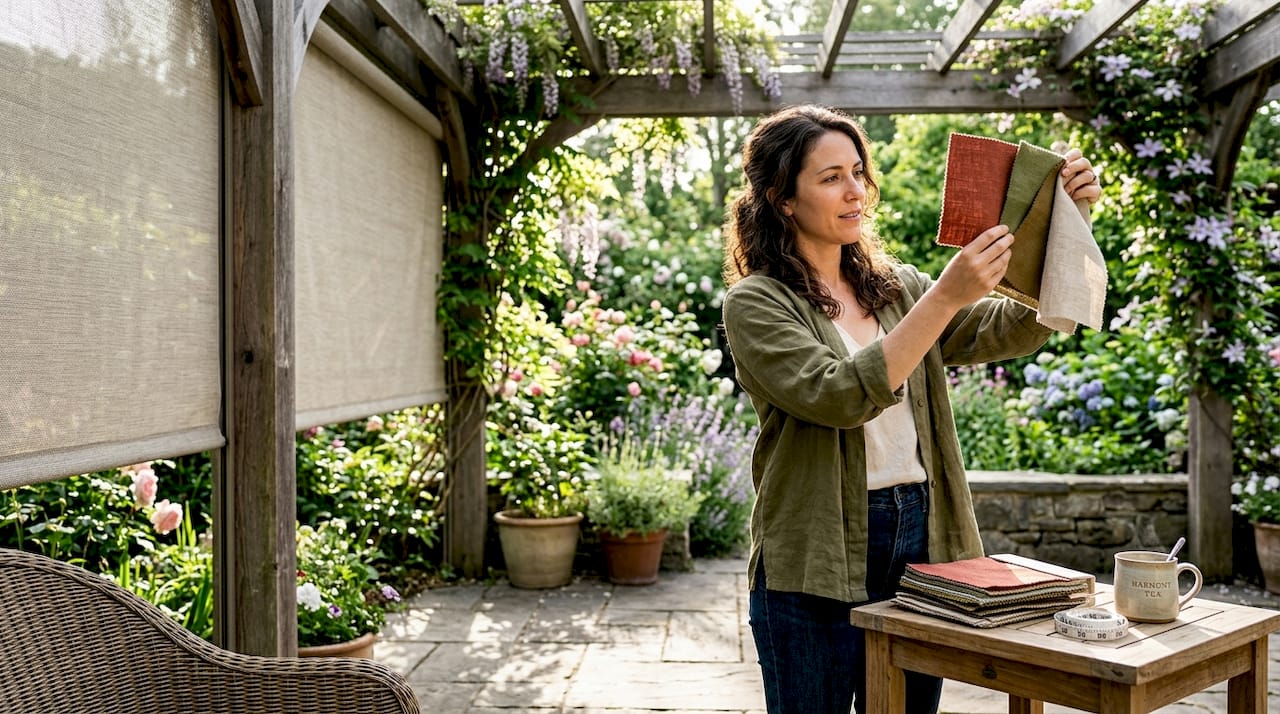
Pro Tip: Request free fabric swatches before committing to any openness level. Holding a swatch up to natural light gives you a realistic preview of visibility, brightness, and how much you can see through it from both sides.
1. 1% openness: Maximum protection, minimum visibility
A 1% openness fabric is the closest you get to a solid barrier without using a solid material. 1% fabrics block 99% of direct light, offering the highest heat reflection and the most daytime privacy of any breathable shade cloth option.
Best for: West-facing patios that catch harsh afternoon sun, outdoor workspaces where screen glare is an issue, or any space where neighbors are close.
Pros:
- Maximum UV and heat blockage
- Strong daytime privacy from outside observers
- Dramatically reduces glare on screens and furniture
Cons:
- Very limited outward visibility, especially at dusk
- Minimal airflow compared to higher openness levels
- Can feel closed-in on smaller patios
This is not the fabric you choose for a scenic mountain view. It is the one you choose when you want to actually use your patio during a blazing July afternoon without retreating inside.
2. 3% openness: High protection with a bit more breathing room
The 3% level is a sweet spot for homeowners who want serious UV and heat protection but find 1% too visually restrictive. You still get strong performance against direct sun, solid daytime privacy, and enough structure to handle intense exposure well.
Best for: South-facing pergolas, hot climates with extended sun exposure, and patios that double as outdoor dining spaces where privacy matters.
Pros:
- Excellent heat reduction without feeling like a sealed room
- Better view than 1%, though still limited
- Works well across most residential outdoor settings
Cons:
- Still restricts panoramic views significantly
- Less airflow than 5% or 10% options
- May feel dim on overcast days
Think of 3% as the residential workhorse. It handles the tough conditions without the extreme visual limitation of 1%, and it performs well in the range of climates where most homeowners actually live.
Pro Tip: If you are buying for a pergola specifically, check out these creative pergola shade ideas that show how combining 3% on one side with a higher openness on another can change the entire atmosphere of the space.
3. 5% openness: The most versatile choice for most homeowners
This is the level that consistently earns the most recommendations, and for good reason. A 5% openness blocks approximately 95% of UV rays while maintaining enough visibility to see your yard, garden, or view clearly. You can see out, but people outside have a harder time seeing in during daylight hours.
Best for: Most residential patios, screened porches, and pergolas with moderate to strong sun exposure.
Pros:
- Strong UV and thermal protection
- Good daytime privacy with reasonable outward visibility
- Comfortable airflow for most outdoor settings
- Widely available in the most color and material options
Cons:
- Not ideal if you are dealing with truly intense west-facing exposure all afternoon
- Does not maximize airflow the way 10% does
If you are unsure which openness to choose and your patio gets a normal mix of sun and shade throughout the day, 5% is almost certainly the right answer. It is the fabric most outdoor shade specialists recommend as their default suggestion for residential use.
4. 10% openness: Priority goes to the view and the breeze
The 10% openness option is designed for situations where you want glare reduction and airflow without sacrificing the panoramic view. Think of a beachside deck, a hillside patio with a view you paid for, or a shaded backyard where full sun is rarely an issue.
Best for: Coastal properties, mild climates, shaded patios with good natural coverage, and spaces where the view is a priority.
Pros:
- Maximum airflow and breathability
- Best outward visibility of any shade cloth option
- Reduces glare without blocking the scene outside
Cons:
- Less UV and heat protection than tighter weaves
- Not suitable for intense or uninterrupted afternoon sun exposure
- Offers minimal daytime privacy
Using a 10% fabric in a high-sun setting without supplemental shade from a roof or trees is a common mistake. You end up with a fabric that is doing very little for your comfort on the days you need it most.
5. Openness levels side by side: A quick comparison
Here is how the four main shade fabric openness levels compare across the criteria that matter most for residential outdoor spaces.
| Openness | UV blockage | Visibility | Privacy | Airflow | Heat reduction | Best use case |
|---|---|---|---|---|---|---|
| 1% | Excellent (99%) | Very limited | Maximum | Minimal | Maximum | West-facing, intense sun |
| 3% | Very good (97%) | Limited | High | Low-moderate | Very good | Hot climates, dining patios |
| 5% | Good (95%) | Moderate-clear | Good | Moderate | Good | Most residential patios |
| 10% | Moderate | Excellent | Minimal | High | Moderate | Mild sun, scenic views |
One detail the table above cannot fully capture: how openness interacts with your structure’s existing ventilation. Choosing a looser weave in a low-airflow setting can actually cause heat to build up inside the covered area rather than escape. A fully enclosed pergola with 10% fabric can trap warm air more effectively than you’d expect. Use higher openness where there is already good natural airflow, not where you are hoping the fabric will create it.
Pro Tip: Fabric color interacts with openness in ways most guides skip. Darker fabrics absorb more heat but can provide better cooling effect in already-shaded areas. Lighter colors reflect heat better in direct sun. For intense exposures, a light-colored 3% or 5% fabric often outperforms a dark 5% in raw comfort.
6. How to choose the right openness for your specific space
Knowing the specs is one thing. Matching them to your actual outdoor situation is where the decision gets made. Here is a practical framework:
- Assess your sun exposure honestly. Does your patio get direct sun for two hours a day or eight? A west-facing space with full afternoon exposure is a completely different problem than a tree-shaded backyard that gets dappled light.
- Decide what you want from the space. If it is a dining area where you need to see faces across the table and feel a breeze, 5% or 10% makes more sense than 1%. If it is a workspace or lounge area where heat and glare are the enemy, go tighter.
- Match openness to your structure type. Pergolas with open tops benefit from tighter side fabrics since the top is already a source of heat and light. Covered patios with solid roofs can often afford to use a higher openness level on the sides since overhead sun is already blocked. Learn more about selecting outdoor shades for style and efficiency before finalizing your choice.
- Use different openness levels within one space. Zoning by exposure is one of the most underused strategies in outdoor shading. Put a 3% or 5% fabric on the sun-exposed west side and a 10% on the north side where airflow and view matter more.
- Consider your climate. In humid, hot climates, airflow is comfort-critical. In dry, high-altitude areas, UV protection often matters more than ventilation because the air is already pleasant. HDPE breathable shade cloth balances both when selected in the right openness for the climate.
- Think about maintenance and aesthetics. Tighter weaves collect dust and debris more visibly. Lighter colors show dirt faster. These are not deal-breakers but they are worth factoring in, especially on a frequently used patio.
My honest take after years of outdoor shade decisions
I’ve helped a lot of homeowners work through this decision, and the pattern I keep seeing is people defaulting to the tightest fabric available because they are afraid of sun damage. They install a 1% across an entire patio, and six months later they feel like they are sitting inside a cave. The shade is doing its job perfectly and they still hate it.
The real mistake is treating shade fabric openness as a single variable when your outdoor space is a system. Wind, neighboring structures, tree cover, the angle of your roof overhang, and even what you plan to do in the space all interact with that openness number. I have seen a 5% fabric on a well-designed pergola outperform a 1% fabric on a poorly oriented structure every single time.
My default recommendation is 5% for most homeowners, but I push back on that if the space has genuinely brutal west-facing afternoon exposure. In that case, 3% on that exposure with 5% or 10% everywhere else gives you a space that is actually livable. And if you have a view worth protecting, do not sacrifice it entirely. Use 10% where the view is and let the structure itself do more of the heavy lifting.
One more thing: UPF ratings alone do not tell the full story. A fabric can carry a UPF 50+ label and still leave you uncomfortable if the openness level is wrong for your setup. Pay attention to the actual openness percentage, not just the certification badge on the packaging.
— Sunny
Find your perfect shade setup at Valueblindsdirect
If you have narrowed down the openness level that fits your space, the next step is finding a product that actually delivers on it. Valueblindsdirect carries a full range of outdoor patio shades in multiple openness levels, materials, and colors, so you are not forced into a one-size-fits-all solution.
For those who want to go further, the motorized outdoor sunshades with 2 to 30% openness let you dial in exactly the level of protection you need, with the added convenience of automated control for wind and weather. Not sure where to start? The Window Treatment Design Studio walks you through your specific space and recommends products matched to your sun exposure, structure type, and style preferences. Free swatches are available so you can test before you commit.
FAQ
What is the best openness factor for a patio shade?
For most residential patios, a 5% openness factor is the best starting point. It blocks approximately 95% of UV rays while preserving a clear outward view and allowing moderate airflow.
Does a lower openness percentage mean better UV protection?
Yes. A lower openness percentage means a denser weave, which blocks more direct light and UV radiation. However, UPF ratings and fabric structure also affect protection, so openness is not the only spec to check.
Can I use different openness levels in the same outdoor space?
Absolutely. Zoning different openness levels by sun exposure is a practical strategy that improves comfort without sacrificing views or airflow where they matter most.
What openness is best for a pergola with a scenic view?
A 10% openness fabric works well for pergolas in mild sun or shaded settings where preserving the view is the priority. For pergolas with direct sun exposure, a 5% gives better UV protection while still allowing a reasonable view.
Is breathable shade cloth the same as a high openness fabric?
Not exactly. Breathability refers to how well air moves through the material, which is influenced by openness percentage but also by fiber type and weave construction. HDPE fabrics, for example, can block up to 90% of UV rays while remaining breathable even at lower openness levels.
Recommended
- How to select outdoor shades for style and efficiency
- Outdoor Shades丨Patio Shades丨Porches Blinds丨Outdoor Patio Shades & Blinds
- Value Blinds™ Motorized Outdoor Windproof Sunshades with Side Rails
- Value Blinds™ Motorized Outdoor Windproof Sunshades with Light Filtering 2-30% Openness - Up to 9.8x9.8 ft