
Article: Retractable Awning Cost: What You'll Really Pay in 2026
Retractable Awning Cost: What You'll Really Pay in 2026
Most retractable awnings in the US cost somewhere between $800 and $4,000 installed, with a national average of about $2,700, according to Fixr’s installation cost data. The range is wide because “an awning” can mean a $350 manual window awning or a fully motorized patio system that tops $25,000. The number that matters for you is the all-in price for your width, your projection and your wall, so we’ll show you how each piece adds up, and why a motorized awning with measuring and installation handled together is the easiest way to get a quote you can trust. ☀️
TL;DR
- Installed retractable awnings run roughly $800 to $4,000, averaging about $2,700, with most projects priced at $15 to $30 per square foot.
- A 10’ x 10’ awning averages $1,500 to $3,000 installed. A 12’ x 12’ averages $2,160 to $4,320.
- Size, motorization, fabric, full cassette design, sensors and wiring drive the price. Installation conditions (masonry, stucco, second story) move it too.
- Compare quotes on the same basics: width, projection, motor, fabric, installation and electrical work.
- Our motorized Classic and Full Cassette awnings come with optional professional measuring and installation, so the scope is clear from the start.
Table of Contents
- What a retractable awning costs in 2026
- Retractable awning price by size
- What pushes the price up or down
- Quote versus price tag: what’s included
- Why the cheapest awning is not always the lowest cost
- Installation: DIY or professional?
- Quick ways to keep the total sensible
- Our point of view
- Ready to price your own patio?
- FAQ
- Sources
What a retractable awning costs in 2026
Start with the headline numbers. Fixr reports an installed range of $800 to $4,000 for the US, with a national average of $2,700. That average describes a motorized 8-foot awning over a deck. At the bottom, a manual window awning installed runs about $350. At the top, a fully installed 12’ x 24’ motorized patio enclosure with side panels and screens reaches $25,000. Those are the edges of the market, not what most homeowners pay.

The other useful yardstick is price per square foot. Fixr puts most retractable awnings at $15 to $30 per square foot fully installed. Do the math on your own patio: width times projection (how far the awning reaches out from the wall) times your per-foot range gives you a first estimate in about a minute.
Prices move with fabric, metal and labor costs and differ by region, so treat any published range as a starting point and confirm the figure on your own written quote. Cost guides are updated periodically, which is why we cite the year and publisher for every number here.
Retractable awning price by size
People ask about two sizes more than any other. Here is what the same cost data says.
| Size | Typical installed price | Source basis |
|---|---|---|
| 10’ x 10’ | $1,500 to $3,000 | Fixr |
| 12’ x 12’ | $2,160 to $4,320 | Fixr |
A 10x10 covers roughly a small bistro table and two chairs, or a standard back door landing. A 12x12 covers a proper dining set or a lounge corner. The 12x12 is 44% more area than the 10x10, and the price range grows by about the same proportion, which is what you’d expect when most pricing is per square foot.
Width and projection do not cost the same, though. Width mostly adds fabric and a longer front bar. Projection asks more of the arms, which are the moving parts that hold the fabric out against wind. Going deeper often means stepping up to a heavier arm design, so a 10 x 12 can cost more than a 12 x 10 even though the area is identical. Ask any quote to show width and projection separately.
A quick worked example: a 12’ x 10’ awning is 120 square feet. At $15 to $30 per square foot, you’re looking at roughly $1,800 to $3,600 installed. If your quote lands well above or below that, it should come with a clear reason: motorization, a cassette housing, a tricky wall or a premium fabric.

What pushes the price up or down
Manual or motorized
A hand crank is the entry point. A motor adds parts cost, a remote and often electrical work, and it is the feature most people end up loving: you press a button instead of cranking, and the awning closes before a gust can catch it. If you’re weighing the two, our manual vs. motorized awning comparison walks through the cost and daily-use differences.
Open roll or full cassette
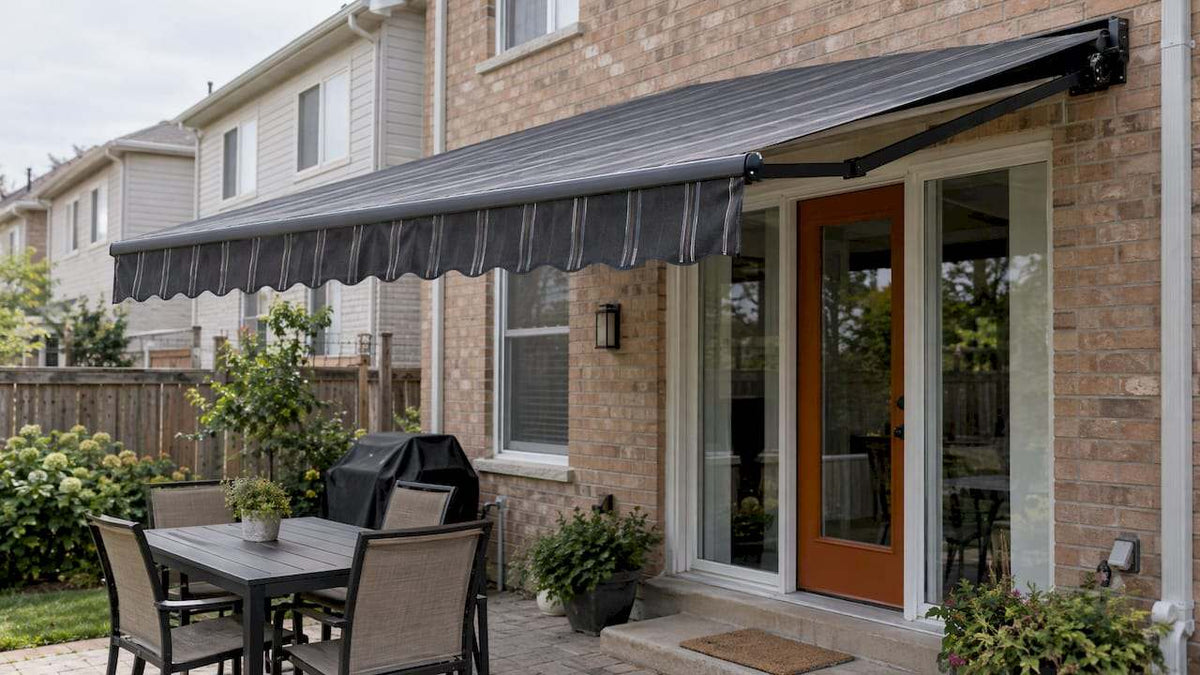
An open-roll awning leaves the rolled fabric and arms exposed when retracted. A full cassette tucks everything into a hood, which protects the fabric from sun, rain and dirt between uses. That hood is more metal and more engineering, so it sits higher on the price ladder. Many owners choose it when they want a clean look and longer-lasting fabric.
Fabric
Outdoor fabric is not just color. Solution-dyed acrylic is dyed all the way through, which helps it hold its color in strong sun, and it typically costs more than basic coated polyester. If your awning faces south or west and gets hours of direct sun, fabric is not the place to trim the budget.
Sensors, smart controls and wiring
Wind and sun sensors retract the awning automatically. A smart hub lets you run it from your phone or a voice assistant. Each is an add-on to the quote. Motorized awnings also need power, either a nearby outlet or a hardwired circuit, and an electrician’s time is usually listed on its own line. Ask whether the quote includes the power connection or leaves it to you.
Your wall and your height
Mounting into accessible wood framing at ground-floor height is the simple case. Brick, stucco, masonry, soffits and second-story walls take more time, more hardware and sometimes a lift, which raises labor. This is the most common reason two similar awnings get very different installed prices.
Quote versus price tag: what’s included
A price on a product page and a price on a quote are two different things. Before you compare, check that each number covers the same scope.
- Unit only or installed? A low sticker price may be the awning alone, with shipping, mounting and wiring still to come.
- Delivery and removal. Freight, and hauling away an old awning if you have one, can be separate lines.
- Permits. Some towns require one, others exempt simple retractable awnings. Local rules vary, so call your building department. For example, one Ohio city’s retractable awning rules set minimum wind-load requirements and require a wind sensor. If you live in a homeowners’ association, check its architectural guidelines before you order.
- Electrical work. Is the outlet or circuit included?
- Warranty. Look at what the warranty covers on frame, fabric and motor, and for how long.
A clean way to compare is to write down five things for every quote: width, projection, operation (manual or motor), fabric, and who does the installation and wiring. If those match, the totals are comparable. If not, you’re comparing apples with garden hoses.
Why the cheapest awning is not always the lowest cost
Two awnings of the same nominal size can have very different frames. Arm strength, the thickness of the aluminum, the quality of the hardware and the fabric grade all decide how the awning holds its pitch season after season, and how it handles wind. A frame that sags or a fabric that fades in two summers means paying twice.
That is why we suggest thinking in cost per year of shade, not just cost at checkout. The same logic applies to energy. Awnings shade windows before the sun reaches the glass, and Pacific Northwest National Laboratory’s guide to window attachments notes that horizontal exterior shading such as awnings can be very effective at shading windows while still letting you see out. An awning over a sunny south- or west-facing patio door can make the room behind it more comfortable in summer, which is part of what you are paying for.
Installation: DIY or professional?
Retractable awnings are heavy, and they load the wall they hang from. The arms store spring tension, and the brackets have to find solid framing or the right masonry anchors. Mistakes show up as sagging, a crooked pitch, or worse, a fixing that pulls out in wind. This is also why measurement matters: an awning ordered a few inches off, or measured without accounting for the door swing or gutter line, is costly to fix.
That is where measuring and installing together pays off. We offer Pro Measure & Install as an optional paid service, so the person who measures your space and the person who mounts the awning are working toward the same result. Our professional installation is available nationwide, and for a motorized awning it keeps the question of who does what from becoming a surprise on installation day. Installed pricing for your project comes from your own measurements, so request it for your specific size.
If your awning is motorized, plan the power early. Decide where the motor cable will enter the house, where the switch or receiver goes, and whether a sensor needs a clear spot on the wall. Settling this at the quote stage keeps the electrical line honest.
Quick ways to keep the total sensible
- Size to your furniture, not your wall. Cover the seating area plus about two feet. Extra width you won’t use is extra cost.
- Choose the right projection. Deeper is not always better. Pick a depth that shades the table at the hours you use it.
- Pay for the fabric that matches your sun. Sunny exposure justifies a high-quality outdoor fabric.
- Bundle the work. Measuring, delivery, mounting and wiring in one quote means fewer gaps and fewer surprise lines.
- Decide on motorization once. Adding a motor later to an awning not built for one can be more complicated than choosing it upfront.
- Think about the awning versus a pergola. If you want a permanent structure and not just a shade, see our pergola vs. retractable awning guide and our motorized pergola price ladder.
Our point of view
We think of an awning as a daily-use product, not a one-time purchase. The awning you actually use is the one that opens with a button and closes just as easily when the weather turns. That is why our retractable line is motorized, in a Classic style and a Full Cassette style, so you can choose between a clean, simple look and a fully enclosed hood.
The price question is really a scope question. Width, projection, fabric, sensors, wiring and mounting all belong in one number, and the clearest way to get it is to have the space measured properly and the awning installed by the same team. We offer exactly that with Pro Measure & Install, and we back our products with warranties and a satisfaction guarantee.
If you’re deciding between an awning and something more permanent, we also make pergolas, so you can compare both options for the same patio and choose what suits your home best.
Sunny
Ready to price your own patio?
See our motorized retractable awnings, including the Classic model and the Full Cassette model. Both are built for effortless shade, and you can add professional measuring and installation so your quote covers the whole job. Our custom retractable awnings roundup is a good next read if you’re still picking a style.
While you’re upgrading outdoors, the same team can help with interior shades and blinds. Browse the full range at Value Blinds.
FAQ
How much does a retractable awning cost?
Most installed retractable awnings cost between $800 and $4,000, with a national average of about $2,700, according to Fixr. A common rule of thumb is $15 to $30 per square foot installed. Your exact price depends on size, motor, fabric and how hard your wall is to mount on.
How much does a 12x12 retractable awning cost?
Fixr lists an installed 12’ x 12’ retractable awning at $2,160 to $4,320. Choosing a motor, a full cassette, sensors or a premium fabric moves you toward the upper part of that range. Ask for a quote based on your measurements to get the exact total.
How much does a 10x10 retractable awning cost?
A 10’ x 10’ retractable awning averages $1,500 to $3,000 installed, per Fixr. That is a good fit for a small patio, a back door or a deck corner.
Are retractable awnings worth the money?
For most homeowners who use their patio often, yes. You get shade on demand, a cooler space behind sunny windows, and the option to retract the awning when you want sun or when the weather turns. Choosing a motorized model makes it effortless to use, and the more you use it, the better the value.
Do I need a permit for a retractable awning?
It depends on your town and sometimes your homeowners’ association. Some places exempt simple retractable awnings, while others set wind-load and sensor requirements. Call your local building department before you order, and check your HOA’s guidelines if you have one.
Sources
- Cost to Install a Retractable Awning, Fixr
- Window Attachments for Solar Control and Energy Efficiency, Pacific Northwest National Laboratory
- Rules and Guidelines for Retractable Awnings, City of Greenwood Village, Ohio