
Sidelight Window Coverings: Shades That Fit and Keep Privacy
The best sidelight window coverings are custom-sized shades that fit the narrow glass exactly, clear the door swing and let you choose between light and privacy in one move. Cordless cellular shades with a top-down/bottom-up lift, soft Roman shades and zebra shades all do this well, and made-to-measure sizing is what makes them look built in rather than bought off a shelf. 🚪 At Value Blinds we make custom shades in all of these styles, so you can pick the one that suits your entry and have it cut to your glass.
TL;DR
- Sidelights are the narrow windows beside your front door. They usually need a covering because they sit at eye level, which is why most homeowners add one.
- Top-down/bottom-up cellular shades, zebra shades and Roman shades are the most practical styles for narrow glass.
- Measure the glass recess depth and the gap beside the door before you order. Hinge-side gaps can be tiny.
- Choose true blackout with side channels for hard afternoon sun, and light filtering when you want a bright, soft foyer.
- Custom sizing, free swatches and optional professional measuring and installation take the guesswork out of an odd-shaped opening.
Table of Contents
- What sidelights are and why they need a covering
- Which shade styles work on narrow sidelights
- How to get privacy and light at the same time
- Blackout, room darkening or light filtering?
- Measuring sidelights without jamming the door
- Operation: cordless, motorized or smart
- Where the glass faces the weather
- Tips for choosing the right sidelight look
- Our perspective
- Ready to cover your sidelights?
- FAQ
- Sources
What sidelights are and why they need a covering
A sidelight is a narrow, usually fixed, vertical window that flanks a door or a larger window, and it is most often used to emphasize the main entrance and bring in light, according to Wikipedia’s entry on sidelights. The same entry points out that sidelights, unlike transom windows above the door, usually need to be covered because of where they sit. A transom is high enough that nobody looks through it. A sidelight is at face height.
That tension is the whole design problem. A door manufacturer’s guide to sidelites lists the reasons people want them: more natural light, a bigger-feeling entry and a view out to see who is at the door. Those are exactly the things a poorly chosen covering takes away. So the goal is not to hide the glass. It is a covering you can adjust through the day: open when you want light and a view, closed when you want privacy.
Which shade styles work on narrow sidelights
Curtains are the first thing many people try, and they can work on wider sidelights. On narrow glass, though, fabric panels need room to stack and tend to swing or catch when the door opens. A shade that sits flat against or inside the opening is usually neater. Here is how the main styles compare for a front door.
| Style | Light control | Privacy | Best for |
|---|---|---|---|
| Cellular (honeycomb) shades | Light filtering or blackout | High, with top-down/bottom-up lift | Narrow glass where you want privacy and light together |
| Zebra shades | Alternating sheer and solid bands you can line up or offset | Adjustable | A clean, modern entry with fine control |
| Roman shades | Fabric softens and diffuses light | Good when lowered | Traditional or farmhouse entries |
| Roller shades | Simple, flat profile | Depends on fabric | Minimal looks and tight clearances |
| Natural bamboo blinds | Textured, warm filtering | Moderate to high | Organic, relaxed entries |
Cellular shades: the privacy-and-light workhorse
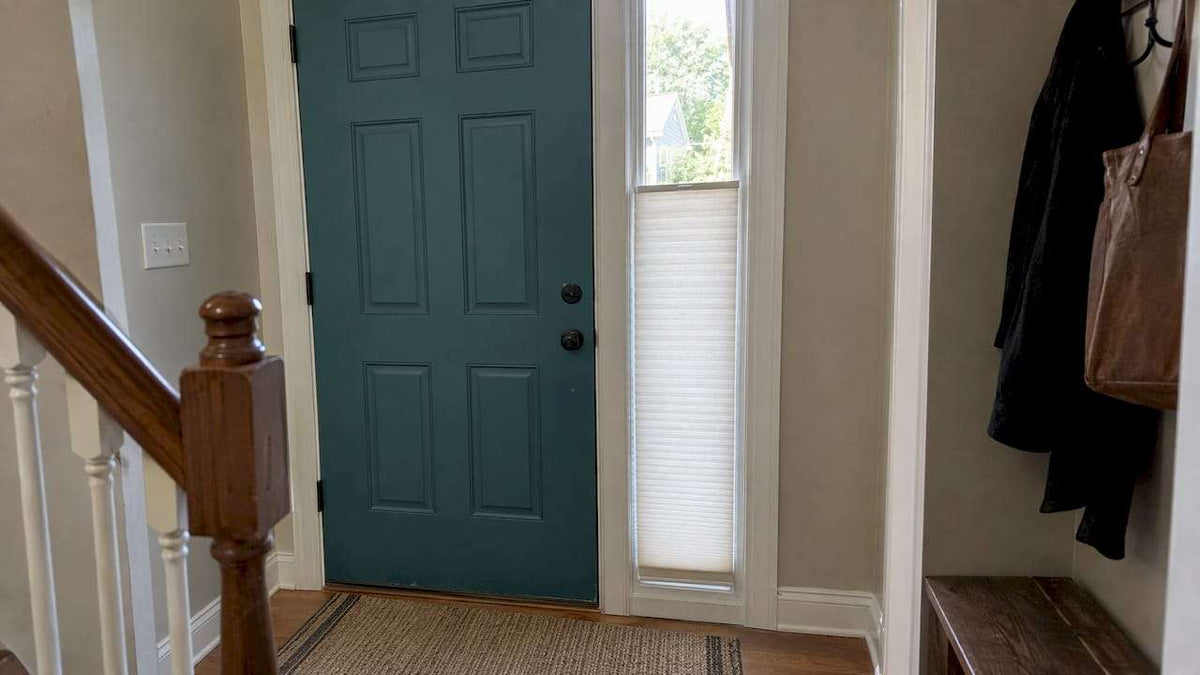
If you only read one section, read this one. Our cellular shades come in light-filtering and blackout versions, and the Duo-Tone top-down/bottom-up honeycomb shades are made for exactly this job. Pull the top rail down and light comes in from above while the lower part of the glass stays covered at eye level. Neighbors and delivery drivers see fabric; you still see sky and daylight.
Cordless operation matters at the front door, too. There are no dangling strings next to a door that gets opened by kids, guests and packages all day. See the cordless blackout cellular shades, or the Deluxe Light Filtering Cellular Shades if you prefer a softly glowing foyer.
Zebra shades: privacy you can dial in
Zebra shades alternate sheer and solid stripes on a continuous loop. Line the bands up and you have a view and daylight. Offset them and the glass is covered. On a tall, narrow sidelight the vertical lift gives you many in-between settings, and the motorized and smart-control version means you never reach across a door frame to adjust it.
Roman shades: the soft, finished look
If your entry leans traditional, a folded fabric shade makes the sidelight look dressed rather than covered. Roman shades are the choice when you want pattern, color or texture to tie into a hall runner or a painted door. Our free swatches let you hold the fabric against your door color in your own light before you commit. 🎨
How to get privacy and light at the same time
People usually search for a shade they can see out of while nobody sees in. Three ideas do most of the work.
- Lower from the top. A top-down/bottom-up lift keeps the lower half of the glass covered and opens the upper half. The sky comes in; the street view does not.
- Pick the right openness. Solar-style fabrics are woven with a stated openness percentage (the share of the fabric that is open weave). A lower percentage blocks more view and glare, a higher one gives a clearer look outside. In daytime the person outside generally sees a darker, reflective surface while you see out. At night with the lights on inside, that flips, so pair it with a lined shade or lower it after dark.
- Use a layer you can open fully. Zebra shades let you shift between sheer and solid without raising anything. Our Premium Solar Shades with Smart Motorization are an example of that kind of control from your phone or a schedule.
We have a short read on window shades you can see through if you want to compare fabrics before choosing.
If your sidelight glass is plain clear glass and you also want a built-in privacy finish, such as frosted or textured glazing, that is a change to the glass unit itself, which local window and door tradespeople handle. Door makers list privacy through frosted or textured glass as one of the standard sidelite options in that Marvin guide. A shade on top of any glass finish gives you the adjustable layer.
Blackout, room darkening or light filtering?
This choice changes how your entry feels, so it is worth a minute.
- Light filtering: daylight glows through the fabric. Great for a foyer with no other windows. Privacy by day is good; at night you will want it lowered or layered.
- Room darkening: cuts light noticeably but does not stop it. One home-design guide says room-darkening fabrics reduce light by roughly 50 to 90 percent and will not fully tame a bright western exposure heating the entry.
- True blackout: the same guide explains that a blade of light can slip along the vertical edges unless the shade has side channels, so for hard afternoon sun it recommends blackout lining plus side channels.
For a west-facing door, a blackout cellular shade is a strong pick. For a north-facing entry that needs every bit of daylight, go light filtering. Not sure? Order swatches and look at them at the time of day your door is brightest. ☀️
Measuring sidelights without jamming the door
This is where most sidelight projects go sideways, and where custom sizing earns its keep. Standard-width off-the-shelf shades rarely match a sidelight. Here is the routine.
Step 1: Check the glass shape
Many sidelights have arched tops, beveled edges, decorative grilles or caming (the thin dividers between glass pieces). One installation guide recommends making a tracing-paper or cardboard template of the exact glass shape, grilles included, before ordering anything custom. If your glass is a plain rectangle, you can skip the template. If it is not, a pro measure is worth considering.

Step 2: Find the recess depth
Measure the smallest depth of the glass recess. The same guide advises an inside mount when there is at least one inch of depth, and an outside mount otherwise, with side channels to control light and keep the fabric from swinging. A slim recess does not rule out a great result. It just changes the mount.
Step 3: Check the door side
The gap between the door and the sidelight is often less than half an inch, and a bracket on the hinge side can make the door jam. Mark your brackets and test with the door closed.
Step 4: Measure three times, then order
Measure width at the top, middle and bottom and height on both sides, then use the smallest width for an inside mount. Our measurement guides walk through each opening type, and our guide to measuring outdoor and exterior shades covers the same principles for exterior installs.
Step 5: Install and test
Pre-drill pilot holes one size smaller than the screw, which helps avoid splitting a hollow-core door. Test the lift, then open the door to 90 degrees, where the handle comes closest to the shade, and test again. That final check catches the clearance problem that a closed-door test misses.
At each step the risk is the same: a quarter inch off on a narrow window is very visible. That is why we offer optional professional measuring and installation. 📏 Our Pro Measure & Install service covers the measuring and the mounting, and we install nationwide.

Operation: cordless, motorized or smart
Sidelights are frequently narrow and tall, which can make a cord or wand awkward to reach. Three options solve it:
- Cordless lift: push or pull the bottom rail. No cords near a busy entry.
- Motorized: a remote, phone app or schedule raises and lowers the shade. Handy if the sidelight sits behind a console table or a bench.
- Smart control: set a routine so the shade closes at sunset and opens in the morning, the way you would for any other room.
We offer motorization across our shade styles, including the motorized light-filtering cellular shades and motorized zebra shades.
Where the glass faces the weather
Some front doors sit under an open porch, with sidelights taking direct sun and rain-blown dust. For covered porches where you want to cut heat before it reaches the glass, motorized exterior shades with side rails stop sunlight outside the window and keep the privacy of the entry. Inside, they pair nicely with any of the shades above.
Tips for choosing the right sidelight look
- Match both sidelights. Order two identical shades and set them to the same height so the entry looks symmetrical.
- Stay with the door color story. White or soft neutral fabrics blend with trim, while a deeper color makes the entry a feature.
- Think about the knob side. The Wikipedia entry notes that, for security, a sidelight should only be installed on the side of the door without the knob or handle. If you are planning a new entry, keep that in mind.
- Plan for cleaning. Fabric shades with a smooth finish wipe down easily, which suits a high-traffic entry.
Our perspective
We think a sidelight is the hardest little window in the house to dress well. It is narrow, it is at eye level, it sits next to a swinging door, and it is the first thing guests see.
That is why we lean on made-to-measure. When a shade is cut to your exact glass, with the lift you picked and the fabric you saw as a free swatch, the whole entry looks intentional. Our cordless and motorized options keep the door area tidy, and our top-down/bottom-up cellular shades let you keep privacy and daylight in the same moment.
If measuring around a door frame makes you nervous, our professional measuring and installation is there for it, and our satisfaction guarantee backs the order. 😊
Sunny
Ready to cover your sidelights?
Tell us what your entry needs and we will help you pick: light-filtering cellular for a glowing foyer, blackout for a sunny west-facing door, zebra for fine control, or Roman for a softer finish. Browse the full range of blinds and shades, order free swatches to test against your door, and add professional measuring and installation if you would like it done for you.
You can see everything on Value Blinds.
FAQ
How do I cover the glass beside my front door and still get light?
Use a top-down/bottom-up shade. Lower the top rail to let daylight in, and keep the bottom portion raised to cover the glass at eye level. Light-filtering cellular shades give you the soft glow as well.
Can I find a shade I can see out of but people can’t see into?
Solar-style fabrics with a low openness percentage work this way in daylight, since the brighter side is the one that is harder to see through. At night, with lights on inside, lower the shade or choose a lined style. Zebra shades also let you offset the bands to close off the view quickly.
What is a sidelight window?
It is a narrow, usually fixed window on one or both sides of a door. Sidelights add daylight and emphasize the entry, and because they sit at eye level they typically need a covering.
Should I choose an inside mount or an outside mount for a sidelight?
If the glass recess is at least one inch deep, an inside mount gives the cleanest look. If it is shallower, use an outside mount with side channels. Always check that nothing touches the door when it opens fully.
Sources
- Sidelight, Wikipedia
- What is a Sidelite? Marvin
- Front Door Shade Ideas: Why Most People Get It Wrong, The Decor Advisor