
Skylight Blackout Shades: How to Pick, Measure and Install
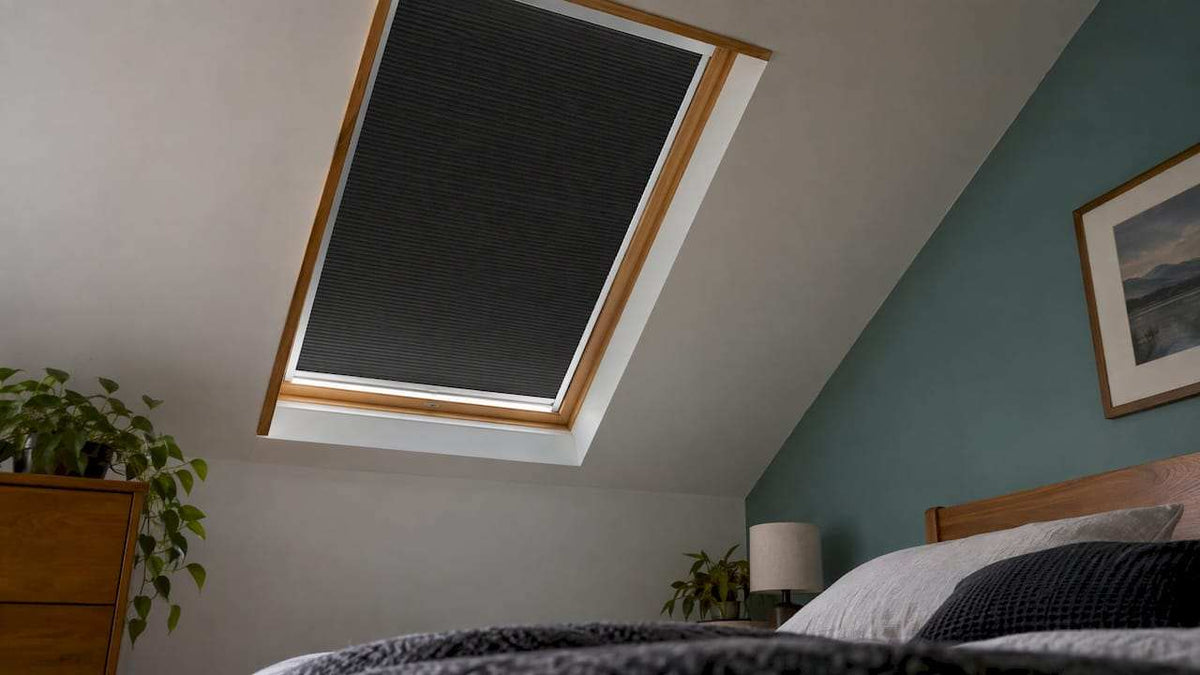
Skylight blackout shades are made to cover an overhead window and shut out daylight almost completely. They’re the fix for the bedroom that turns into a sunroom at 6 a.m., or the media room that’s never quite dark enough. The best setup for most homes is a custom-made blackout cellular (honeycomb) shade, sized to your exact skylight and paired with the control that fits how high up it sits. 🌤️ We build custom shades for a living, so here’s how to choose, measure and install one without the usual headaches.
TL;DR
- Blackout vs. room darkening: blackout fabric is made to block essentially all light. Room-darkening and light-filtering fabrics let some glow through, which is a better match for rooms where you want daylight.
- Cellular is the go-to style: the honeycomb pockets add a layer of insulation while the fabric darkens the room.
- Control depends on reach: a pole works for a skylight you can reach with one. Motorized is the easy answer for high ceilings or several skylights.
- Measure twice: skylights are often odd sizes, and made-to-order shades only fit if the numbers are right.
- Want it done for you? Our Pro Measure & Install service takes the ladder work off your plate.
Table of Contents
- Why skylights are such a tricky window to cover
- Blackout, room darkening or light filtering?
- Why cellular shades are a natural fit
- Manual or motorized: the reach test
- Measuring a skylight so the shade fits
- Choosing color and fabric
- Installing your shade
- Getting the most out of your shade
- Ready to darken your room?
- FAQ
- Sources
Why skylights are such a tricky window to cover
A regular window gets light from the side. A skylight gets it from above, so the sun hits it harder and for more of the day. That’s wonderful for a dark hallway, and not so wonderful for a nursery nap, a night-shift sleeper or a home theater.
Covering one also comes with a few challenges a wall window doesn’t have:
- It’s overhead. Shades have to stay put against a ceiling or slanted surface, and you have to be able to operate them.
- It’s often out of reach. Vaulted and cathedral ceilings can put the glass well above arm height.
- It’s frequently an unusual size. Skylights come in plenty of dimensions, so off-the-shelf sizes rarely fit well.
- Light leaks are obvious. Any gap around the edges shows up as a bright line, especially in a bedroom.
Those four points shape every choice below.
Blackout, room darkening or light filtering?
These three terms get mixed up constantly, so here’s the plain version.
| Fabric type | What it does | Best for |
|---|---|---|
| Blackout | Made to block essentially all light | Bedrooms, nurseries, home theaters, shift workers |
| Room darkening | Cuts a lot of light but a soft glow can remain | Offices, living areas where you want it dimmer, not dark |
| Light filtering | Softens and diffuses daylight | Kitchens, hallways, rooms where you want a bright feel |
Family Handyman’s guide to choosing skylight shades suggests blackout shades for daytime naps or a home movie theater, and light-filtering shades when energy efficiency and a bright room matter more. That lines up with how most people use their space: dark where you sleep and watch, soft where you cook and work.
A quick gut check: if you’d happily pay for darkness at 2 p.m., go blackout. If you’d miss the daylight, go lighter.
Why cellular shades are a natural fit
Cellular shades (also called honeycomb shades) are built from fabric folded into rows of small air pockets. For a skylight, that structure does two jobs at once. The fabric darkens the room, and the pockets add a layer between the glass and your living space.
You can see the style in our cellular shades collection, and if you’re curious how the air-pocket design works, we’ve explained it in our guide to cellular shades insulation.
Other styles can work for darkening too. Roller shades and zebra shades come in blackout options for regular windows, but for the flat, tight space of a skylight, cellular is the shape most people end up with. Every one of our shades is made to order, so the size follows your window rather than a catalog.
Manual or motorized: the reach test
This is where most skylight decisions are really made. Ask yourself one question: can I comfortably reach it?

The Roofing Brief’s skylight blinds guide recommends manual blinds when a rod can reach a single skylight, and notes that one popular telescopic rod extends to 10 feet. It points to motorization for skylights beyond rod reach and for rooms with three or more skylights. Solar-powered motors avoid wiring through drywall, which is a real plus in a finished ceiling.
When a manual shade makes sense
- One skylight, ceiling at a normal height
- You don’t mind a pole or a cord
- You want the simplest setup
When motorized is worth it
- Vaulted or cathedral ceilings
- Several skylights in one room that you want to close together
- Kids’ rooms or anywhere you’d rather not have cords
- You like the idea of a remote, schedule or phone app
Family Handyman notes that manual shades use cords or poles, while motorized shades use a remote or smartphone app. Picture waking up, tapping a button and watching the room go dark, with no stepladder in sight. 😴 That’s the game-changer people describe.
What it costs, roughly
Our own pricing depends on size and options, so we don’t publish a flat number. For general ballpark figures, The Roofing Brief (June 2026) reports HomeGuide ranges of $100 to $250 for manual blinds (materials), plus $100 to $350 for a hardwired electric connection. At the midpoints that works out to about $175 for manual versus $400 for motorized, materials only, so roughly $225 more per skylight. Those are market averages, not our prices. Our motorized blinds cost guide walks through what drives the price of motorization.

That extra cost looks different when you count the pole, the ladder and the daily fuss. For a hard-to-reach skylight, motorized is the one you’ll actually use every day.
Measuring a skylight so the shade fits
Made-to-order shades are only as good as the measurements behind them. Here’s the routine we recommend.
- Decide where it mounts. Some skylights have a deep well (the angled shaft between the ceiling and the glass), and some are flush. You can mount inside the opening or on the surface around it. Inside gives a clean built-in look. Outside, around the frame, can help with side light gaps.
- Use a steel tape measure. Cloth tapes stretch and give you sloppy numbers.
- Measure width in three places. Check the top, middle and bottom of the opening, since skylight frames are rarely perfectly square. Use the smallest figure for an inside mount.
- Measure length the same way. Run the tape along the slope from top to bottom, again at three spots.
- Check the depth. Brackets need a flat surface and enough room to sit properly. Note any trim, handles, or obstructions.
- Write down which way is which. Label width and length, and mark the high and low end of the skylight if it’s angled.
- Measure again. A second pass takes five minutes and is much cheaper than reordering a custom shade.
Our site has measurement guides to help you through this, and if you’d rather not climb up there at all, our Pro Measure & Install service is available. A professional measuring visit means someone else deals with the ladder and the odd angles.
Mistakes that cost people a reorder
- Measuring only once, in one spot
- Rounding up instead of using the smallest width
- Forgetting that a tilted skylight needs measuring along the slope
- Ignoring a handle, vent crank or trim that sticks out
Choosing color and fabric
Free swatches are the best way to avoid surprises, because fabric looks different overhead than it does on your screen. Hold a swatch up to the actual skylight at different times of day. Skylights light a fabric from above, so tones can shift.
A few pointers:
- Light colors feel airy on the room side and look tidy against white ceilings.
- Darker colors feel cozy in a media room or a bedroom.
- Neutral tones blend with most paint colors and are easy to live with.
If you also have regular windows nearby, matching the fabric across them gives the room a pulled-together look. Our Zebra shades come with a blackout option and smart control for wall windows, so a bedroom can be darkened from floor to ceiling in one look.
Installing your shade
Installation depends on your control type, your ceiling and your comfort with a drill. The general flow looks like this:
- Gather tools and prepare the area. You’ll want a drill, a level, a pencil, a tape measure and a sturdy ladder. Clear furniture from under the work zone.
- Mark the mounting points. Hold the shade or its brackets in position and mark where they go. Double-check that the marks are level.
- Install the brackets. Drill pilot holes and fix the brackets so they hold firmly to the frame or surface.
- Attach the shade. Snap or slide the headrail into the brackets and test the movement.
- Set up the control. For motorized shades, pair the remote or app and set your limits. For manual shades, attach the pole or cord.
Our motorized blinds installation guide covers the same flow in more detail, including measuring and marking your mounting points and installing the brackets.
Safety while you work overhead
- Use a stable ladder and have someone steady it.
- Don’t lean out to reach a far bracket. Move the ladder instead.
- Switch off power at the breaker before touching any wiring for a hardwired motor.
- If wiring through the ceiling is involved, a licensed electrician is the right person to handle that part.
If any of this sounds like more than a weekend project, our professional measuring and installation service is there for exactly that.
Getting the most out of your shade
A few habits make a blackout shade work harder:
- Close it before the sun gets strong. A shade is easiest on a room when it’s down before the room heats up.
- Schedule it. With a motorized shade, you can set it to close at dawn or open at a set time, depending on your system.
- Dust gently. A soft brush or a low-suction vacuum keeps cellular fabric looking fresh.
- Treat it as part of a set. Pair it with blackout shades on nearby windows so light doesn’t sneak in from the side.
Our take on skylight darkening
When people come to us about skylights, the story is almost always the same: a beautiful room that’s just too bright at the wrong time. We think the answer is a custom shade that fits the opening properly, because a blackout fabric only does its job if the edges are right. That’s why everything we make is made to order, and why we offer measurement guides and a Pro Measure & Install service for the awkward, high-up ones.
We also love motorization here. A skylight is the window you’re least likely to touch if it takes a stepladder, so a remote or app control turns a shade you ignore into one you use every day. Pair that with cellular construction, and you get a room that’s darker, calmer and a little more comfortable. 🙌
Not sure where to start? Request free swatches, hold them up to your skylight, and picture the room you want. That’s usually when the decision gets easy.
Sunny
Ready to darken your room?
We make custom blinds and shades in styles including cellular, zebra, roller and Roman, with motorized, cordless and blackout options. Start with free swatches, use our measurement guides, and add professional measuring and installation if you want a hands-off finish. Browse the full range on Value Blinds, or head straight to our cellular shades.
FAQ
Do they make shades for skylights?
Yes. Skylight shades are made for overhead and angled windows, in manual and motorized versions, and in blackout, room-darkening and light-filtering fabrics. Cellular is a popular style because it darkens the room and adds a layer at the glass. Custom sizing matters, since skylights come in many dimensions.
How do I black out a skylight?
Cover it with a blackout shade that fits the opening closely, so there are no bright gaps around the edges. Measure the width and length in three places and mount it either inside the well or on the surface around it. For a high or hard-to-reach skylight, motorized control makes it easy to close.
Is a manual or motorized skylight shade better?
It comes down to reach. A pole is fine for one skylight you can reach comfortably. Motorized is better for high ceilings, several skylights in one room, or anyone who’d rather skip cords and ladders. Remote and app control are the usual options.
Will a blackout shade make my room totally dark?
Blackout fabric is designed to block essentially all light through the material. The last bit of brightness usually comes from small gaps at the edges, which is why accurate measuring and the right mounting matter so much.
Can I install a skylight shade myself?
Many homeowners do, with a drill, a level and a sturdy ladder. If your skylight is high, awkward or needs wiring, our Pro Measure & Install service can handle it for you. Any ceiling wiring should be done by a licensed electrician.
Sources
- How to Choose the Right Skylight Shades for Your Home (Family Handyman)
- Skylight Blinds in 2026: VELUX, Sun-Tek, DIY (The Roofing Brief)