
Article: How Much Do Motorized Blinds Cost? A 2026 Price Guide
How Much Do Motorized Blinds Cost? A 2026 Price Guide
Motorized blinds and shades cost more than manual ones, and the gap depends on three things: the style you pick, the size of the window, and how the motor is powered. One widely cited market forecast puts a fully automatic setup in a typical home at roughly $800 to $3,500 per window, but only when hardware, a hub and professional installation are all counted. A motor added to a shade you already like is a much smaller step. Below, we break down where the money goes, so you can build a real budget instead of guessing. 😊
TL;DR
- Price per window is shaped mostly by shade style, size, fabric, motor type and how you want to control it (remote, app or voice).
- The all-in figure for a fully automated, professionally installed window is far higher than the motor alone. Separate the product price from hub, controls and labor when you compare quotes.
- Battery motors suit retrofits. Hardwired motors make most sense during a build or renovation, when walls are already open.
- Energy savings can help offset the cost, but treat them as a bonus. Convenience, safety and comfort are the main payoff.
- Order free swatches and measure carefully first, so your made-to-measure order is right the first time.
Table of Contents
- The short answer on price per window
- What drives the price of motorized blinds
- Installation costs: DIY or professional
- A simple way to budget your whole home
- Is motorization worth it? Energy, comfort and lifespan
- Ways to get more for your money
- Our perspective
- Ready to price your windows?
- Frequently asked questions
- Sources
The short answer on price per window
There isn’t one number, and anyone who gives you one without asking about your windows is guessing. What you can do is understand the layers. Every motorized window treatment price is built from the same pieces:
- The shade or blind itself: style, fabric or slat material, and size.
- The motor: battery, plug-in or hardwired, plus any smart features.
- Controls: a handheld remote, wall switch, app, voice assistant, or a hub that ties them together.
- Installation: DIY, or a professional measuring and install visit.
That forecast mentioned above bundles all four layers for a fully automatic home system and lands in the $800 to $3,500 range per window. If you skip the hub, install a battery-powered motor yourself, and pick a straightforward roller shade, your spend per window will sit well below that. If you want a whole house on one smart system with an electrician wiring it in, it can climb toward the upper end.
The lesson: always ask what a quote includes. A low price for the shade alone and a high price for a complete installed system can both be “right” and still describe very different projects.
What drives the price of motorized blinds
Style and material
The covering itself is usually the biggest line in your budget, and motorization sits on top of it. Different styles ask for different amounts of fabric, slats and hardware:
- Roller shades are a simple, clean design and a popular starting point for motorization.
- Zebra shades layer sheer and solid bands so you can dial in light and privacy with one motion.
- Cellular shades (honeycomb) trap air in their cells, a nice pick for bedrooms and living rooms where comfort matters.
- Roman shades bring soft folds and a tailored look, and they involve more fabric.
- Solid wood blinds and faux wood blinds carry more weight in the slats, which matters when sizing a motor.
Heavier, more complex coverings generally cost more to make and ask more of the motor. A plain light-filtering roller and a lined Roman shade in the same window are not the same price, with or without a motor.
Size of the window
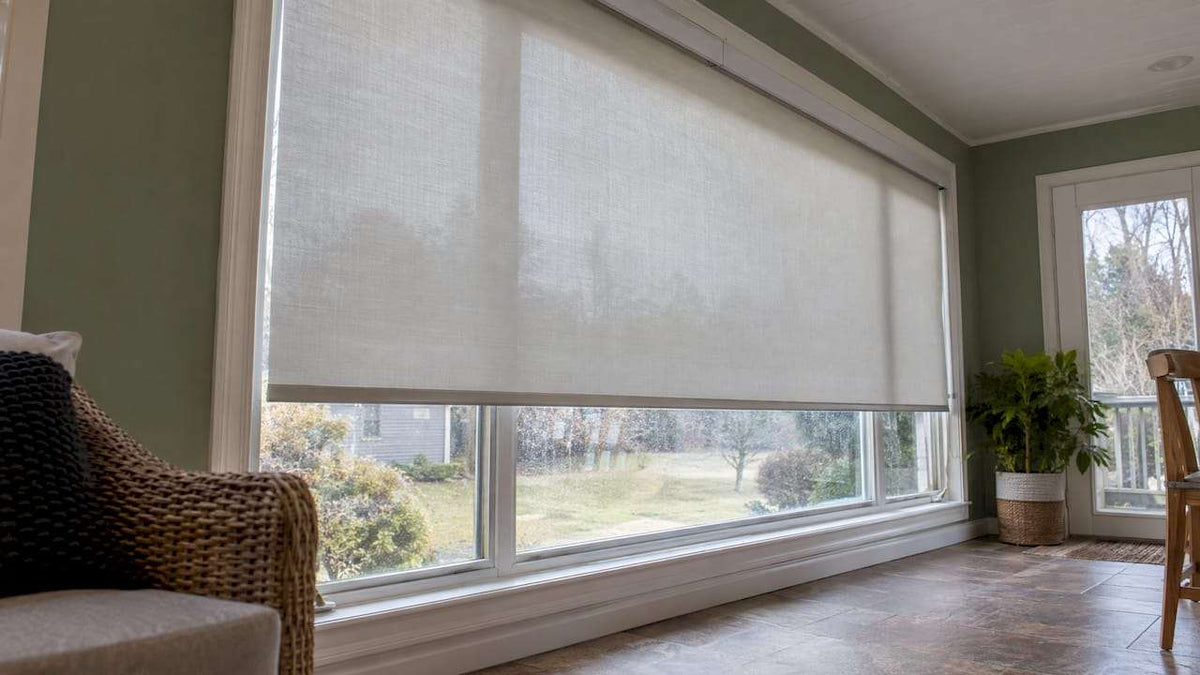
Because custom shades are made to measure, wider and taller windows use more material. Very large panels, like patio doors and picture windows, are where motorization becomes most useful (nobody enjoys wrestling a heavy shade up a nine-foot window), but they are also where the price per window rises. Measuring accurately matters here, because a small error on a large custom piece is an expensive one.
Motor type and power source
The motor’s power source changes both the product price and the labor:
| Power source | Best for | What to expect |
|---|---|---|
| Rechargeable battery | Retrofits in finished homes, renters, quick DIY | No wiring. You recharge periodically (a USB-style charge or an optional solar panel). |
| Plug-in (low-voltage adapter) | Windows near an outlet | No battery charging, but you manage a cord or hide it. |
| Hardwired | New builds and renovations | Cleanest look and no charging, but needs an electrician and open walls. |
If your walls are already finished, battery power is usually the practical answer because it avoids the cost of opening drywall and an electrician’s visit. If you’re in the middle of a renovation and the walls are open anyway, hardwiring a few key windows can be worth planning for. Want a deeper look at powering options? Our guide on solar powered motorized blinds covers the charging side.
Controls and smart features
A simple remote is the baseline. Add-ons that raise the total include:
- A hub or bridge so shades respond to your phone, schedules and voice assistants
- Wall-mounted switches for guests and kids who don’t want an app
- Sensors and automation, such as lowering shades when the afternoon sun hits
- Group control, so one tap handles every shade in a room
Not every window needs the full package. Many households automate the hard-to-reach windows and the sunniest ones, then leave the rest on a remote.
Features you want in the fabric
Blackout, light filtering, waterproof or stain-resistant fabrics, and cordless operation all shape the choice. Motorization is already cordless by nature, which is a real plus for homes with small children and pets, since loose cords are a known hazard. If you have kids, motorized shades are a tidy way to get a cord-free window.
Installation costs: DIY or professional
Installation is the line that surprises people most, so plan for it early.
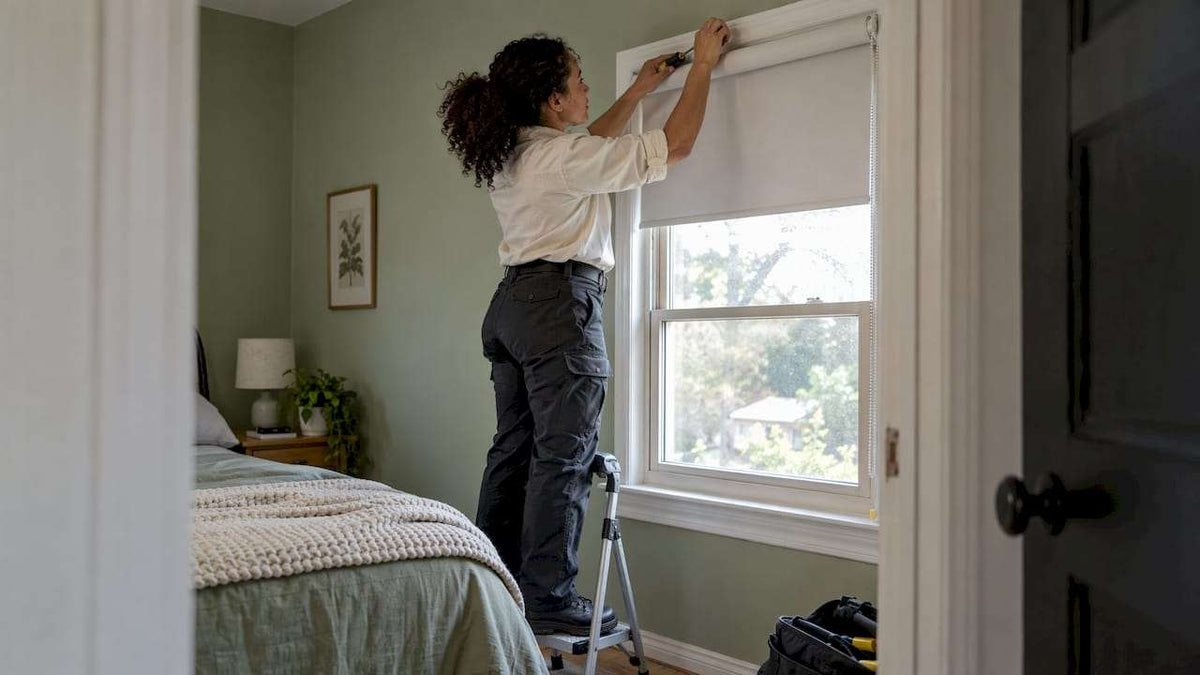
DIY installation. Many battery-powered motorized shades are designed to mount with brackets, much like a manual shade. If you’re comfortable with a drill and a level, you can follow our step-by-step motorized blinds installation guide and keep labor out of your budget. The most important step is accurate measuring and marking, because a made-to-measure shade can’t be trimmed afterward.
Professional measuring and installation. If you’d rather hand it off, we offer professional measuring and installation, plus a Pro Measure & Install service. Pricing for these services isn’t published on our site, so you’ll get the exact figure for your windows when you ask. A pro visit is especially handy for tall or wide windows, ceiling mounts, multiple rooms, or anything needing wiring. You can read more about expert motorized shade installation before you decide.
Electrical work. If you choose hardwired motors, expect an electrician in the mix. That is a separate cost from the shades and is best planned alongside any other wiring in a renovation. If you’re comparing window projects more broadly, a window replacement cost estimator shows how window count, controls, power source and installation all move a quote, which is a useful way to think about shades too.

A simple way to budget your whole home
Here’s the method we suggest. It takes about fifteen minutes, and you don’t need a calculator with fancy settings. 🙂
- List every window and note its approximate width and height.
- Rank them by pain. Which windows are hard to reach, blast with afternoon sun, or sit in a nursery or bedroom? Those get motors first.
- Choose a style per room. Blackout in bedrooms, light filtering in living areas, moisture-friendly materials in kitchens and baths.
- Pick a power source per window. Battery where there’s no outlet, plug-in where there is one, hardwired only if walls are open.
- Decide on control. Remote only, or a hub for app and voice.
- Decide on installation. DIY, or professional measuring and installation.
- Request a quote for the set and compare it against the pieces above, not just the total.
And phase it. You don’t have to do the whole house at once. Start with the three windows that annoy you most, live with them for a month, and add more as it fits your budget. Because shades are made to measure, keep your measurements and product choices on file so later windows match the first ones.
Is motorization worth it? Energy, comfort and lifespan
Let’s be honest about what you’re paying for. Motorized shades are mainly about convenience, safety, and a nicer-feeling home: shades that open with the sunrise, close at sunset, and never leave a cord dangling near a crib. Our comparison of motorized blinds advantages walks through the day-to-day benefits in more detail.
Energy savings are a real plus, though they vary a lot by climate and window. Research on smart blinds from an energy-industry publication reports 10 to 25 percent less cooling energy use in sun-exposed zones and a simple payback of 3 to 8 years in hot, high-tariff markets (their cost figures are quoted per square meter, so they are not a per-window US price). Market research, by contrast, notes that if you count energy savings alone, payback can take 8 to 15 years in moderate climates. So the smart way to look at it: energy savings help soften the cost, while comfort, safety and convenience justify it.

Cellular shades and solar-minded fabrics are made to help manage heat and light at the window, and automation lets them do it on a schedule so you aren’t relying on remembering to close them. Not sure which fits your sun exposure? Our complete guide to motorized blinds and shades is a good next read.
Ways to get more for your money
- Motorize selectively. High, wide and sunny windows give the biggest daily payoff.
- Mix motorized and manual. A wall of small windows can stay manual while the big picture window gets a motor.
- Choose battery motors for retrofits to avoid wiring and electrician costs.
- Order swatches first. Free fabric swatches let you check color and light control in your own room, which prevents an expensive wrong guess.
- Measure twice. Use our measuring guidance and, for tricky windows, consider professional measuring.
- Group your order. Matching shades across a room look better and make control simpler.
- Plan for the long run. Motors from quality manufacturers are built for years of daily use, so think in terms of cost per year rather than only the day-one price.
Our perspective
Here’s how we look at motorization: it shouldn’t be a luxury reserved for giant projects. Most of our customers start with one or two windows, such as the big living room window that’s always a hassle or the bedroom that needs blackout at the touch of a button, and they add more once they’ve lived with it.
Our approach is to keep the choices clear. Pick the style you love, whether that’s zebra, cellular, Roman, roller, wood or bamboo, then add motorization, cordless operation and smart control as you need them. We offer free swatches, measuring guides and professional measuring and installation, so you can choose how hands-on you want to be. Our products are designed around quality materials, energy efficiency and customization, and we back them with a satisfaction guarantee.
If we could give you one tip, it’s to budget by window, not by house. That keeps the project manageable, and it lets you see exactly where every dollar goes.
Sunny
Ready to price your windows?
If you’d like to see motorization on real products, start with our motorized zebra shades with smart control, our motorized light filtering cellular shades or our motorized wood blinds. Each is made to your measurements. Prefer a natural texture? Our natural woven shades with motorization bring warmth to a room.
Browse the full range at Value Blinds, order free swatches, and choose between DIY and professional installation. You’ll see your exact price in the configurator for each product you build.
Frequently asked questions
How much does it cost to motorize blinds you already own?
It depends on the blind, since many existing blinds can’t take a motor and shades are made to measure. In most cases, the better route is ordering a new shade with the motor built in, so the fit, power source and controls are designed to work together. Browse our motorized options to compare.
Are battery-powered or hardwired motorized shades cheaper?
Battery-powered shades are usually the lower-cost route for a home that’s already finished, because you avoid opening walls and paying an electrician. Hardwired setups make more sense during new construction or a renovation, when the wiring is easy to add and you never have to think about charging.
Does installation cost extra?
It can. If you install yourself, you only pay for the shades. If you choose our professional measuring and installation, the price is quoted for your windows, since it isn’t listed on our site. Our DIY installation guide shows how brackets and shade mounting work if you want to try it.
Do motorized shades save energy?
They can help, especially in sunny rooms, because shades that close at the right time reduce heat gain. How much you save depends on your climate, your windows and how you use them, so think of it as a welcome extra on top of the comfort and convenience.
How long do motorized blinds last?
They’re built for daily use, and the shade’s materials, the motor and how often it runs all play a part. Choosing quality materials and following the care guidance helps your shades last. Warranty details for each product are on its page.
Sources
- Automated Blinds and Shades Market Forecast, Persistence Market Research
- Smart Blinds & Curtains: Passive Cooling That Cuts AC Bills, Energy Solutions Intelligence