
Article: Blinds Sizes Chart: The Numbers You Need to Order Right
Blinds Sizes Chart: The Numbers You Need to Order Right
Ordering an inside mount blind? Take the smallest of your three width measurements and subtract 1/4" to 1/2". For height, most inside-mount blinds use your full measured drop with little to no deduction. Going outside mount instead? Add 1.5" to 2" per side to your window opening, plus 2" to 3" above for headrail clearance.
Here’s why the fussy fractions matter: blinds are cut to exact specs, and a window frame that looks “square” almost never is.
- Inside mount: smallest width − 1/4" to 1/2"; height = full drop (check manufacturer specs)
- Outside mount: opening width + 1.5"–3" per side; add 2"–3" above for headrail
- Always round to the nearest 1/8 inch for best accuracy.
Key Takeaways
Accurate blind sizing comes down to three-point measurements, correct deductions for your mount type, and rounding to the nearest 1/8 inch every time.
| Point | Details |
|---|---|
| Measure three times | Check width at top, middle, bottom and height at left, center, right before deciding on a final number. |
| Match deduction to mount type | Inside mount subtracts 1/4"–1/2" from width; outside mount adds 1.5"–3" per side plus 2"–3" for headrail. |
| Check depth before choosing inside mount | Shallow window reveals may not fit brackets, forcing an outside-mount installation instead. |
| Treat blind type as a variable | Vertical blinds need stacking room, and cellular shades often need a template for specialty shapes. |
| Use standard sizes as a reference only | Custom sizing is common and often more reliable than fitting your window to an off-the-shelf range. |
Table of Contents
- How Do You Measure a Window for a Blinds Sizes Chart?
- Inside Mount or Outside Mount: How Does the Math Change?
- What Are Typical Blind Sizes by Room?
- Do Different Blind Types Need Different Measurements?
- How Value Blinds Helps You Measure With Confidence
- What Actually Matters When You Measure for Blinds
- Sources
How Do You Measure a Window for a Blinds Sizes Chart?
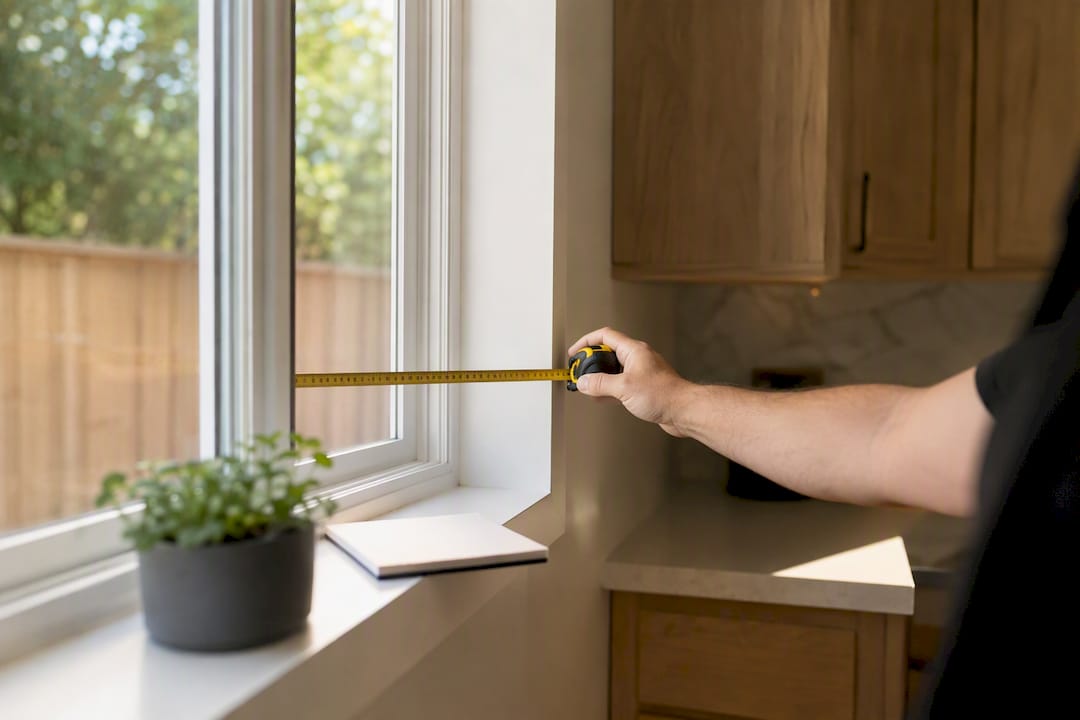
Grab a steel tape measure (cloth tapes stretch and lie to you), a pencil, paper, a step stool, and optionally your phone camera to snap reference photos. Skip the drywall tape hanging in your junk drawer. It bends, and bent measurements mean a blind that doesn’t fit.
Here’s the process, step by step:
- Measure width three times: top, middle, and bottom of the window opening. Windows settle and frames warp over the years, so these three numbers are rarely identical.
- For inside mount, use the smallest width. This keeps the blind from binding against the frame at its tightest point.
- Measure height three times: left, center, and right. If you want the blind to fully cover the opening down to the sill, use the largest height. If a little gap at the bottom doesn’t bother you, subtract 1/4" from that largest number instead.
- Measure the depth of your window frame (front to back). This tells you whether you even have room for an inside mount, since shallow window reveals may not accommodate the brackets and headrail some products need.
- Round every number to the nearest 1/8 inch and write it down as W × H immediately. Don’t trust your memory. You will mix up a window in the den with one in the bedroom.
Pro Tip: Photograph each window with the tape measure still extended before you write anything down. If a number looks off later, you’ve got a backup instead of a return-shipping headache.
This three-point method (and using an online calculator to double-check your math) is the same standard our own step-by-step measuring guide walks you through in more detail.
Inside Mount or Outside Mount: How Does the Math Change?
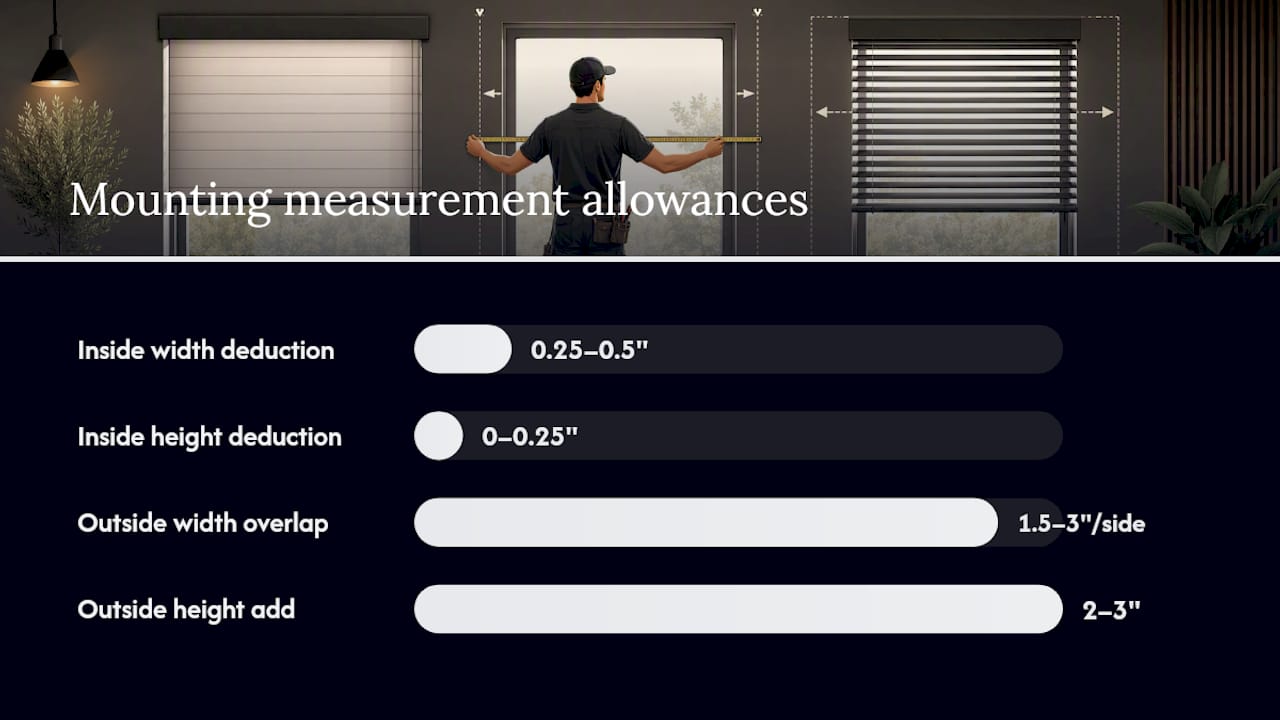
Inside mount means the blind sits inside the window frame, flush against the opening, like a picture in a frame. Outside mount means it hangs on the wall or trim surrounding the window, covering the opening entirely.
The deduction and overlap rules are where most first-time measurers get tripped up:
- Inside width: deduct 1/4" to 1/2" from your smallest measured width, so the blind can operate without rubbing.
- Inside height: deduct 0" to 1/4" depending on the manufacturer. Some brands need zero clearance at all.
- Outside width: add 1.5" to 3" per side beyond the window opening (retailers commonly recommend at least 1.5" per side for better light blocking and privacy).
- Outside height: add 2" to 3" above the opening for headrail clearance.
Say your window opening measures about 36" wide by 60" tall. For an inside mount, you’d order a width slightly smaller than 36" by 60" tall. For an outside mount on that same window, you’d order a width several inches wider than 36" by a height a couple of inches taller, depending on your preferred overlap.
These are common ranges, not universal laws. Manufacturer specs vary, so always check the product’s own instructions before finalizing an order, especially with cellular shades and specialty products that use different tolerances.
What Are Typical Blind Sizes by Room?
“Standard” blind sizes exist mostly because window manufacturers tend to build to a handful of common dimensions. But your window isn’t obligated to match them, and most retailers will cut or custom-build to your exact opening anyway. Standard sizes are a starting reference, not a ceiling.
Roughly speaking:
- Bathrooms and kitchens: generally have narrower windows suitable for smaller blinds
- Bedrooms: often feature medium-sized windows within typical residential ranges
- Living rooms: tend to have larger windows, sometimes quite wide for picture windows
- Sliding glass doors: usually wider and taller, often fitted with vertical blinds or wide roller shades
Here’s how some common window openings might translate into finished blind sizes after deductions or overlaps, generally several fractions of an inch smaller inside mount and a few inches larger for outside mount.
If your window falls between these bands, that’s completely normal. Common window sizes vary widely by home age and builder, so custom ordering is often the more reliable route than shopping off-the-shelf.
Do Different Blind Types Need Different Measurements?
Yes, and this is where a lot of DIY orders go sideways. Each blind style has its own quirks.

Horizontal and venetian blinds need enough mounting depth for the headrail and slat stack. Check your frame depth first. If it’s shallow, an inside mount may not have room for brackets, and you’ll need to go outside mount instead.
Vertical blinds stack to one or both sides when opened, so you need clearance beyond the window itself for that stack. They’re the go-to choice for sliding glass doors and wide openings, and outside mount is usually the better call for doors since it covers trim and hardware cleanly.
Roller and cellular shades depend heavily on headrail height and fabric drop. If you want true blackout coverage, you’ll need extra width and length allowance so light doesn’t sneak around the edges. This is where outside mount often outperforms inside mount for bedrooms.
Skylights and specialty shapes (arches, angles, trapezoids) are not DIY-measurement territory. Use a manufacturer template or request a professional measuring guide built for that exact shape.
Pro Tip: If your window depth is tight or your frame has trim that eats into your reveal, check hardware clearance the same way you’d check uPVC window part measurements for a replacement part. The same “measure twice, order once” logic applies.
When your window doesn’t fit a standard size, or when you want blackout, motorized, or cordless features, custom sizing is the more dependable path. It’s built around your exact numbers instead of a generic range.
How Value Blinds Helps You Measure With Confidence
Getting your numbers right the first time saves you a return shipment and a second round of measuring. That’s exactly why we built tools around this process instead of leaving you with a tape measure and a prayer.
- Our inside mount measuring guide and full measurement walkthrough cover depth checks, bracket space, and photo documentation tips
- Free fabric swatches let you check light control and color before you commit to a blackout or light-filtering order, cutting down returns tied to unexpected opacity
- Our online Design Studio walks you through mount type, dimensions, and style selection in one place, with support available if a measurement feels uncertain
- Every custom order comes backed by a warranty, so an honest measuring mistake doesn’t become a permanent problem
If you’d rather have a second set of eyes on your numbers before you order, our design studio is built for exactly that.
What Actually Matters When You Measure for Blinds
Most measuring guides bury the useful part under too much preamble. The real skill here isn’t understanding blind construction. It’s discipline: measuring three points instead of one, writing numbers down immediately, and resisting the urge to round to the nearest inch because a quarter inch “shouldn’t matter.”
It does matter. A blind cut a half inch too wide for an inside mount will bind against the frame and never close smoothly. One cut too narrow for an outside mount leaves gaps of light at the edges that undercut the privacy you were trying to buy in the first place.
Where conventional advice falls short is treating every blind type the same. A roller shade and a set of vertical blinds for a sliding door don’t share the same tolerances, and skylights don’t belong in a DIY conversation at all. If there’s one thing to prioritize first, it’s depth. Measure your frame depth before anything else, because that single number decides whether inside mount is even on the table. Get that right, and the rest of the math is just arithmetic.
— Sunny
Sources
- Window Blind Size Calculator | Inside & Outside Mount - CalculatorLib
- How to Measure and Install Blinds - Lowe’s
- How To Measure for Blinds and Shades - The Home Depot
- Blind Size Calculator - Omni Calculator
- Bali measuring guide (cellular/pleated) - resource PDF