
Article: Skip the Kit: Custom Fit Vertical Blinds for Patio Doors
Skip the Kit: Custom Fit Vertical Blinds for Patio Doors
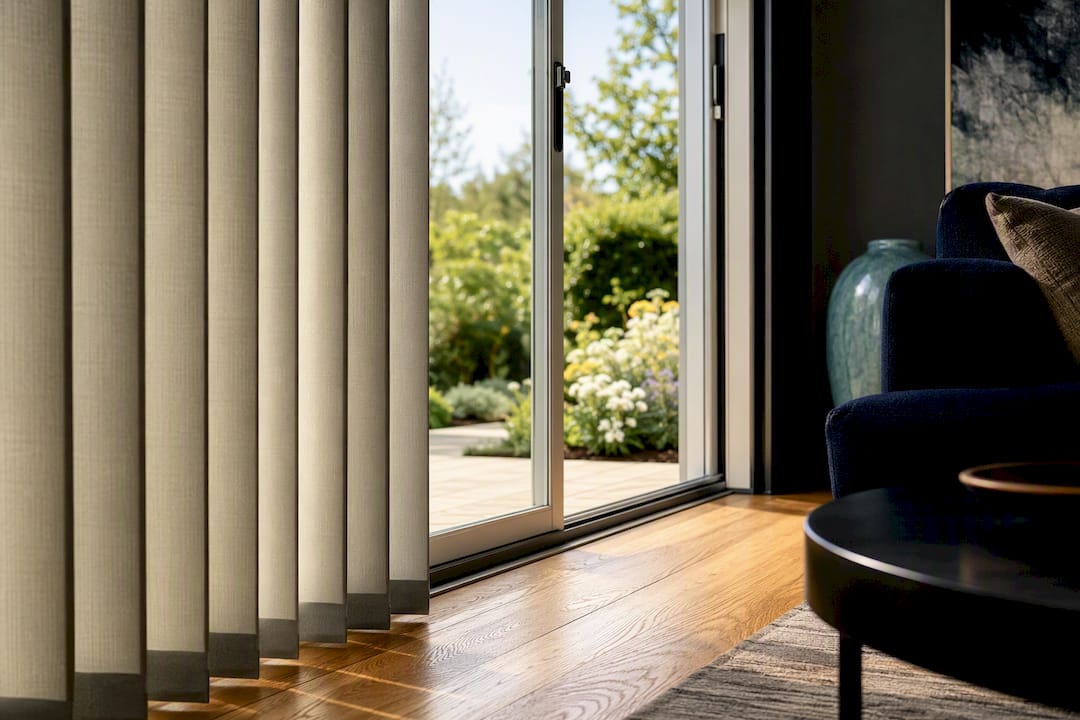
For most standard sliding glass doors, custom vertical vanes in a 3.5 inch width give you the best mix of light control, privacy, and smooth operation. If your opening runs wider than about 8 feet or has a modern frame, a panel-track system is the smarter call. Either way, the next move is the same: measure your opening (or grab free swatches first) before you order anything. 🌤️
TL;DR:
- Panel-track systems are better suited for doors wider than 8 feet or with modern frames, offering a cleaner look and fewer seams.
- Vinyl and PVC vanes are the most durable options for outdoor conditions, resisting moisture and easy to clean with minimal warping.
- Outside mounts are generally more practical for sliding doors, as inside mounts require sufficient frame depth and may block handles or limit light control.
- Cordless blinds are safer and offer a sleeker appearance, while motorized options provide automation but come with a higher price.
- Custom orders with accurate measurements and durable materials are more reliable than off-the-shelf kits, especially for non-standard door sizes.
Table of Contents
- What Vertical Blind Styles Actually Work for Patio Doors?
- Which Material Holds Up Best on a Patio Door?
- How Do You Measure a Patio Door for Vertical Blinds?
- Wand, Cord, Cordless, or Motorized: Which Control Fits Your Door?
- Which Upgrades Are Worth Paying for on Patio Door Blinds?
- Ready-Made Kit or Custom Order: Which Makes Sense for Your Door?
- How Do You Install and Maintain Vertical Blinds on a Patio Door?
- How Value Blinds Helps You Order the Right Fit
- A Buyer’s Priority Checklist for Patio Door Vertical Blinds
- Ready to Order Vertical Blinds for Your Patio Door?
- Sources
What Vertical Blind Styles Actually Work for Patio Doors?
Not every vertical blind style handles a sliding door the same way, and picking the wrong one means fighting your blinds every time you step outside. Here’s the breakdown.
Traditional vertical vanes are the classic choice, and for good reason. They come in widths from about 2 inches up to 3.5 inches (some brands go wider), and each vane rotates on its own carrier along a headrail track. Wider vanes (3.5 inch and up) mean fewer seams across your door, which looks cleaner and gives you fewer gaps for light to sneak through. Narrower 2 inch vanes have a softer, more delicate look but need more of them to cover the same span, so cleaning takes a little longer.
Panel-track systems (sometimes called sliding panels) ditch the individual vane setup entirely. Instead, wide fabric or vinyl panels glide along a track, stacking to one or both sides. This style shines on very wide sliding or French doors, especially anything over 8 feet across, and it gives patio doors a cleaner, more contemporary look than a wall of narrow vanes. Fewer seams also means less visual clutter, which is a big reason panel-track has become the go-to for modern great-room doors.
Sheer vertical panels split the difference between privacy and light. They use a sheer or semi-sheer fabric that filters sunlight without blacking out the room, which works well if your patio door faces a busy backyard or a neighbor’s window and you want softness without feeling boxed in.
Here’s how the three stack up on the things that matter most for door access:
- Traditional vanes: Stack tightly to one side, leaving the door path clear; best for standard 6 to 8 foot openings
- Panel track: Glides smoothly on a track system with minimal effort, ideal for wide or heavy-traffic doors
- Sheer verticals: Offer a softer stack and gentler light, but bulkier fabric can add a bit of width to the stacked pile
If you’re not sure which fits your frame, the vertical blinds collection breaks each style out by size range so you can compare before you commit.
Which Material Holds Up Best on a Patio Door?
Your patio door blinds deal with more sun, more moisture, and more hands-on traffic than almost any other window treatment in your house. Material choice isn’t just about looks here. It’s about what survives daily use.
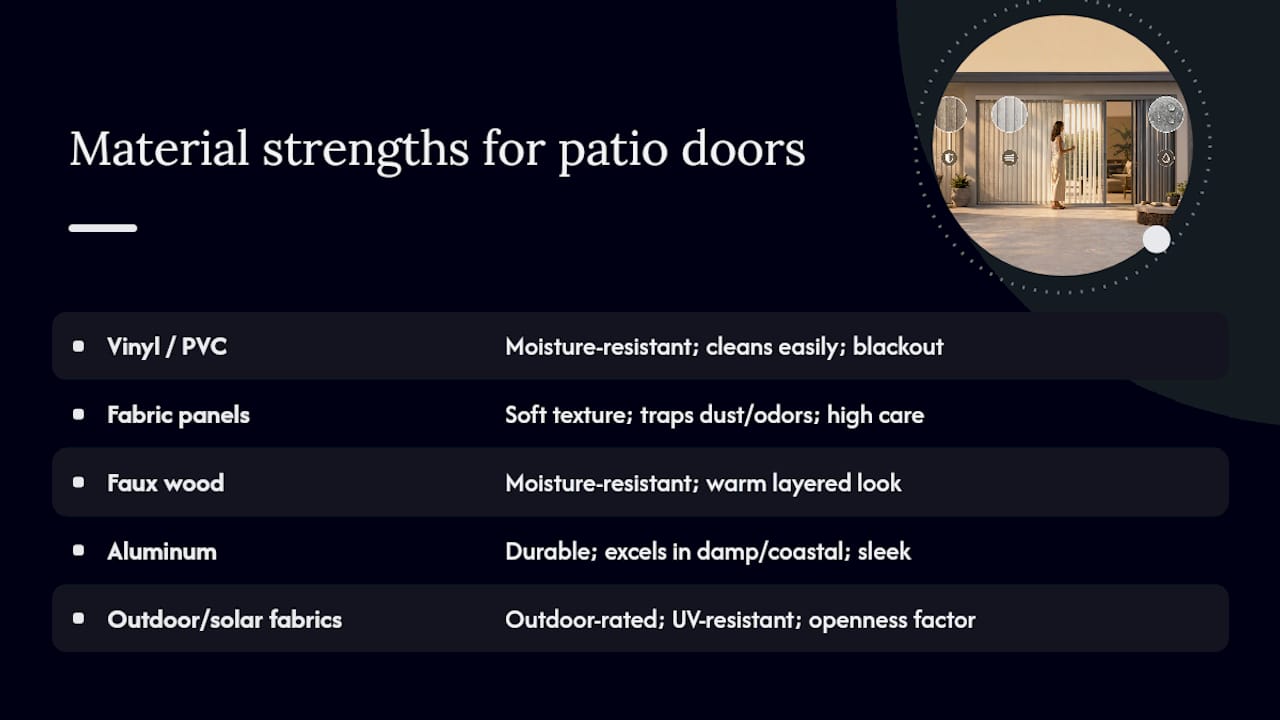
Vinyl and PVC vanes are the workhorse option. They resist moisture, wipe clean in seconds, and hold up in humid climates without warping. Blackout versions are widely available, which matters if your patio door faces east and floods your living room with morning glare. The tradeoff: vinyl can look a little utilitarian next to fabric, and cheaper vinyl can yellow over time with heavy sun exposure.
Fabric panels bring texture and a softer look, and they’re a strong pick if your patio door is more decorative than functional (think a formal dining room slider). The catch is maintenance. Fabric absorbs odors and dust more than vinyl, and it’s not the first choice for a door that gets opened constantly with kids or pets running through.
Faux wood and aluminum vanes split the difference. Faux wood resists moisture better than real wood while giving you that warm, layered look, and aluminum brings a sleek, modern edge with excellent durability in damp or coastal conditions. Neither one blocks light as completely as blackout vinyl, but both handle humidity swings without trouble.
Outdoor-rated and solar fabrics matter most if your patio door opens onto a covered porch or three-season room, where the blinds face temperature swings and higher UV exposure. These fabrics come with an openness factor rating, essentially how much light and visibility passes through at a given weave density, which lets you dial in glare control without going full blackout.
One thing worth remembering: retail listings for ready-made cordless kits built for sliding doors typically use 3.5 inch vinyl slats specifically because that width and material combo balances light-blocking with easy cleaning.
How Do You Measure a Patio Door for Vertical Blinds?
Get this step wrong and you’ll either have a headrail that blocks your door handle or vanes that leave a gap wide enough to see daylight through. Measuring for a patio door isn’t quite the same as measuring a standard window, mostly because you have to account for a moving door panel, not a fixed frame.
Start by deciding between inside mount (blinds fit inside the door frame) and outside mount (blinds mount on the wall or trim surrounding the frame). Inside mount gives you a cleaner, built-in look, but it only works if your frame has enough depth to clear the headrail and the door’s handle. Outside mount is more forgiving and almost always the safer bet on sliding glass doors, since it lets you cover the entire opening plus a little extra for full light control.
Here’s the process:
- Measure width at three points — top, middle, and bottom of the opening — and use the smallest number for inside mount.
- Measure height at three points — left, center, right — and use the longest measurement so the vanes reach the floor or sill without a gap.
- Check clearance for the door handle. Vertical vanes need to clear the handle when the door slides open, so measure from the frame to the handle’s outer edge.
- Add overlap for outside mount. Extend the headrail 3 to 4 inches beyond the frame on each side, and go slightly higher on top, so closed vanes actually block light instead of leaking around the edges.
- Decide your stack direction. Vanes need somewhere to go when they’re open, so figure out whether they should stack left, right, or split down the middle before you order.
Pro Tip: If your patio door slides open from the left, order vanes that stack to the right (and vice versa) so the stacked pile never blocks the doorway you’re actually trying to use.
If your door has an unusual width or you’re covering a slider next to a fixed sidelight, a split-stack configuration, where vanes open from the center toward both sides, or a reversible track can solve problems a single-stack system can’t. Our full measuring guide for vertical blinds walks through exact tools and troubleshooting for tricky frames, and if you’re leaning inside mount, the inside-mount measuring guide covers depth requirements in more detail.
Wand, Cord, Cordless, or Motorized: Which Control Fits Your Door?
The control mechanism you pick changes how your blinds feel to use every single day, not just how they look.
Wand and traverse controls are the old reliable. A single wand rotates the vanes open and closed, and a separate cord (or the wand itself, on some systems) pulls the whole stack to one side. It’s simple, it’s cheap to repair if something breaks, and there’s very little to go wrong mechanically.
Cordless operation has become the default recommendation for most households, and for good reason. Without dangling cords, there’s nothing for kids or pets to get tangled in, and the look is noticeably cleaner. Ready-made kits sold for sliding doors, like cordless room-darkening options built specifically for standard patio openings, often pair cordless wands with reversible tracks so you can set the stack direction to match your door’s swing without ordering a custom part.
Motorized vertical blinds are the upgrade for doors you open constantly or reach that are awkward to access, like a slider behind a large sectional. Most motorized systems now include a remote, and many tie into smart-home platforms so you can schedule your blinds to open at sunrise or close automatically when the sun hits peak glare in the afternoon. The tradeoff is cost. Motorization adds a real premium to the price tag, and it’s an upgrade worth reading more about in our guide to electric patio door blinds if you’re on the fence.
A few things to weigh before deciding:
- Wand/traverse: Lowest cost, easiest to repair, but requires manual effort every time
- Cordless: Best safety profile for homes with kids or pets, minimal learning curve
- Motorized: Highest convenience and smart-home compatibility, but the priciest option and needs occasional battery or wiring maintenance
Which Upgrades Are Worth Paying for on Patio Door Blinds?
Not every add-on changes how your blinds actually perform. Some are pure style, and some genuinely change how much light, heat, or privacy you get. Knowing the difference saves you from overspending on the wrong feature.
Valances and cornice options hide the headrail and hardware, giving the whole setup a finished look. This is purely cosmetic, but it’s the detail that makes custom blinds look built-in rather than bolted on.
Blackout lining versus light-filtering lining is where the real functional decision happens. Blackout lining is worth it for a patio door facing direct morning or evening sun, or for any slider leading into a media room. Light-filtering lining softens glare while still letting the room feel open and bright, which suits most everyday living spaces better than full blackout.
Wider vanes (3.5 inch and up) cut down the number of seams across a wide door, which means less visual noise and slightly better insulation since there are fewer gaps between vanes when closed.
Split-stack and reversible configurations aren’t just about control, they’re about keeping your walking path clear. If your patio door sits in a corner or next to furniture, choosing the correct stack direction upfront avoids a headrail that blocks half your doorway.
Quick summary of what to prioritize:
- Valance/cornice: Style only, no functional change
- Blackout lining: Real functional upgrade for sun-facing or media-room doors
- Wider vanes: Fewer seams, marginally better insulation
- Reversible/split-stack: Functional fix for tight or awkward door placement
Ready-Made Kit or Custom Order: Which Makes Sense for Your Door?
Ready-made kits work fine for standard door sizes, but a lot of patio doors fall outside “standard” without homeowners realizing it until the box shows up too small.
Off-the-shelf kits commonly cover widths from about 35 to 97 inches and heights from 36 to 96 inches, based on typical retail listings for cordless vertical blinds sized for sliding and patio doors. If your opening falls inside that range and you’re not picky about vane width or exact color match, a kit can save both time and money.
What actually drives the price up:
- Material: Vinyl runs cheapest; fabric and faux wood cost more
- Control type: Motorized adds the biggest premium; cordless sits in the middle; wand/traverse is the budget baseline
- Valance and lining upgrades: Blackout lining and decorative valances both add to the total
- Professional measuring or installation: Worth the fee on oversized or nonstandard openings where a measuring mistake means reordering
Ready-made kits typically ship faster since they’re pre-stocked, while custom orders take longer but eliminate the guesswork on odd-sized frames, alcoves, or doors with obstructions like a nearby wall vent. Reputable retailers also encourage requesting free fabric swatches before you buy, which matters more than it sounds. Colors read very differently on a small screen versus against your actual wall and door trim.
If your door is anywhere close to a kit’s size limits, custom is almost always the better value. A half-inch miscalculation on a DIY kit order means light gaps or vanes that snag the door handle, and reordering costs more than paying for accurate measurements the first time.
How Do You Install and Maintain Vertical Blinds on a Patio Door?
Installing vertical blinds yourself is manageable for most standard openings, but wide or motorized systems are where professional installation starts to earn its cost.
- Gather your tools. A drill, level, tape measure, pencil, and the mounting hardware that ships with your order.
- Mark and level the headrail bracket locations using the level, not eyeballing it, since even a slight tilt throws off how the vanes hang.
- Secure the headrail to the wall, trim, or inside the frame, depending on your mount type, and confirm it’s flush before adding the vanes.
- Snap or clip vanes onto the carriers, working from one end to the other so spacing stays even.
- Test the stack and rotation before you consider the install finished. Open, close, and stack the vanes fully to catch any binding early.
- Attach the valance last, once you’ve confirmed the headrail and vanes operate smoothly underneath it.
For doors wider than about 10 feet, or for any motorized system tied into your home’s wiring or smart-home hub, hiring a professional installer removes the risk of an uneven track or a motor that’s wired incorrectly.
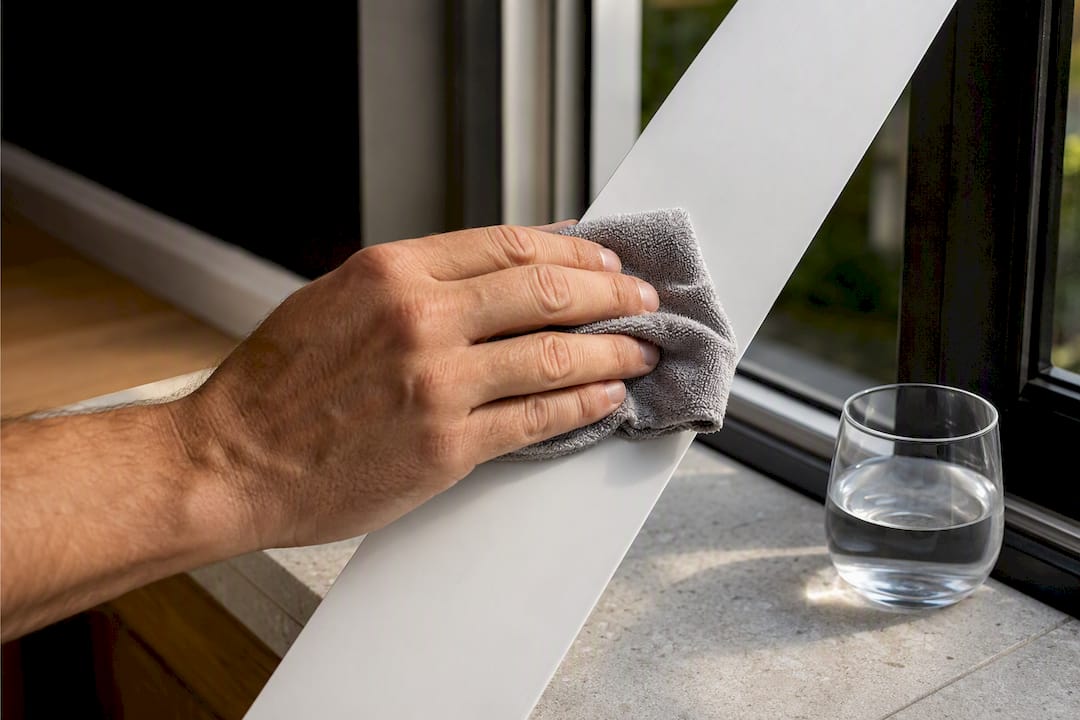
Maintenance depends on material. Vinyl and PVC vanes wipe clean with a damp cloth and mild soap in seconds. Fabric panels need a vacuum brush attachment or occasional spot cleaning, and faux wood does best with a dry microfiber cloth to avoid trapping moisture in the grain texture. If you notice uneven stacking or a track that binds partway through, check first for dust buildup in the headrail track, which is the most common (and easiest to fix) culprit.
How Value Blinds Helps You Order the Right Fit
Ordering custom vertical blinds sight unseen feels risky, and that’s exactly why we built the supports we did. Our measuring guides walk you through inside and outside mount step by step, so you’re not guessing at whether your patio door needs a 3 inch or 4 inch overlap. Free swatches let you hold the actual vinyl, fabric, or faux wood against your door trim before you commit to a color, and our design studio lets you preview vane widths and valance styles on your own space digitally.
We back every custom order with a warranty, and our support team is there if something about your measurements or install doesn’t line up once the blinds arrive. That kind of buyer protection is worth checking for with any vendor. BBB profiles for window-coverings businesses are a solid way to confirm a company’s return policy and customer track record before you order anywhere.
For patio doors specifically, we also carry motorized and outdoor-rated options built to handle sun exposure and frequent use, whether you’re covering a standard slider or a wide panel-track opening.
A Buyer’s Priority Checklist for Patio Door Vertical Blinds
If you take nothing else from this, take this: prioritize fit, durability, and smooth stacking before you even think about price. A gorgeous fabric that snags every time you open the door isn’t a bargain no matter what it cost.
My order of operations, every time: first, request swatches so you’re judging real material against your actual door trim, not a screen. Second, measure carefully (three points, both width and height) because a quarter-inch error compounds fast on a wide opening. Third, confirm your control type and stack direction match how you actually use the door, not how it looks in a showroom.
Doors next to high-traffic areas, like the one connecting to a deck or patio in this article’s comparison of door types and access patterns, need blinds that stack cleanly out of the way every single time. Use the free tools available to you. There’s no reason to guess when swatches and measuring guides exist specifically to remove that risk.
— Sunny
Ready to Order Vertical Blinds for Your Patio Door?
Skip the ready-made kit gamble if your patio door falls outside standard sizing. Valueblindsdirect builds every vertical blind to your exact opening, whether that’s a 6 foot slider or a 12 foot panel-track wall, so you get vanes that stack cleanly and controls that actually match how you use the door.
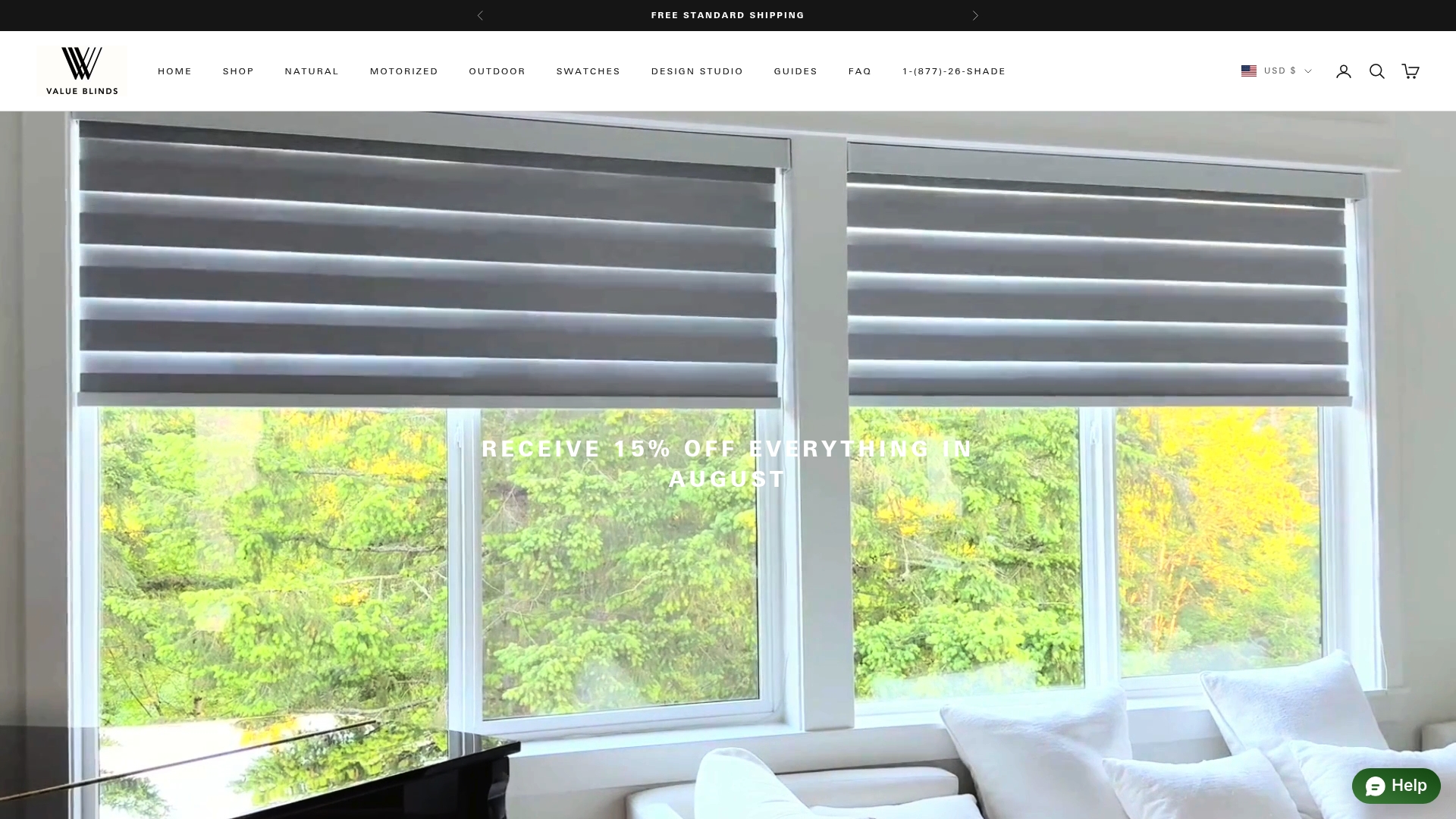
Start by browsing the vertical blinds collection to compare vane widths, materials, and control types side by side. If you’re still deciding on color or fabric, order free swatches first so you can hold real material against your door trim before committing. And if measuring your opening feels intimidating, our Window Treatment Design Studio walks you through sizing and lets you preview your choices before you check out, backed by our warranty on every custom order.
Sources
- Home Decorators Collection White Cordless Room Darkening Vertical Blinds for Sliding Doors Kit with 3.5 in. Slats - 78 in. W x 84 in. L 10793478800933 - The Home Depot
- Walmart
- American Blinds BBB profile — window coverings