
Homeowners, Choose Fit Not Cells: Double Cell vs Single Cell Blinds
If your priority is lowest cost and a slim, disappearing look, single-cell shades are often a preferred choice. If you want maximum insulation and noise dampening, double-cell shades often have a higher price tag. Small or design-forward rooms often use single-cell; large windows, extreme climates, and bedrooms often benefit from double-cell shades. Here’s the reasoning behind that split, and how to apply it to your own windows. 🏠
TL;DR:
- Double-cell shades offer significantly better insulation and noise reduction than single-cell options, especially on older or oversized windows.
- Fabric type and blackout liners determine light control, making a well-chosen single-cell shade as darkening as a double-cell with a blackout backing.
- Proper fitting and measurement are crucial; a well-measured single-cell shade can outperform a poorly installed double-cell shade in energy efficiency.
- Cost differences favor single-cell shades for budget-conscious homeowners, but double-cell shades are preferred for bedrooms, offices, or noisy environments.
- The choice depends more on fabric quality and fit than on cell count alone, with layering treatments providing additional performance and style options.
Table of Contents
- Double Cell vs Single Cell Blinds: How Cellular Shades Actually Work
- Single-Cell vs Double-Cell Shades: A Side-by-Side Look
- Which Rooms Need Double-Cell (and Which Don’t)
- Getting the Measurements and Cell Size Right
- How Valueblindsdirect Helps You Decide With Confidence
- A Straight Answer From Someone Who’s Looked at a Lot of Windows
- Ready to Order? Here’s Your Next Step
- A Couple of Places to Keep Learning
- Sources
Double Cell vs Single Cell Blinds: How Cellular Shades Actually Work
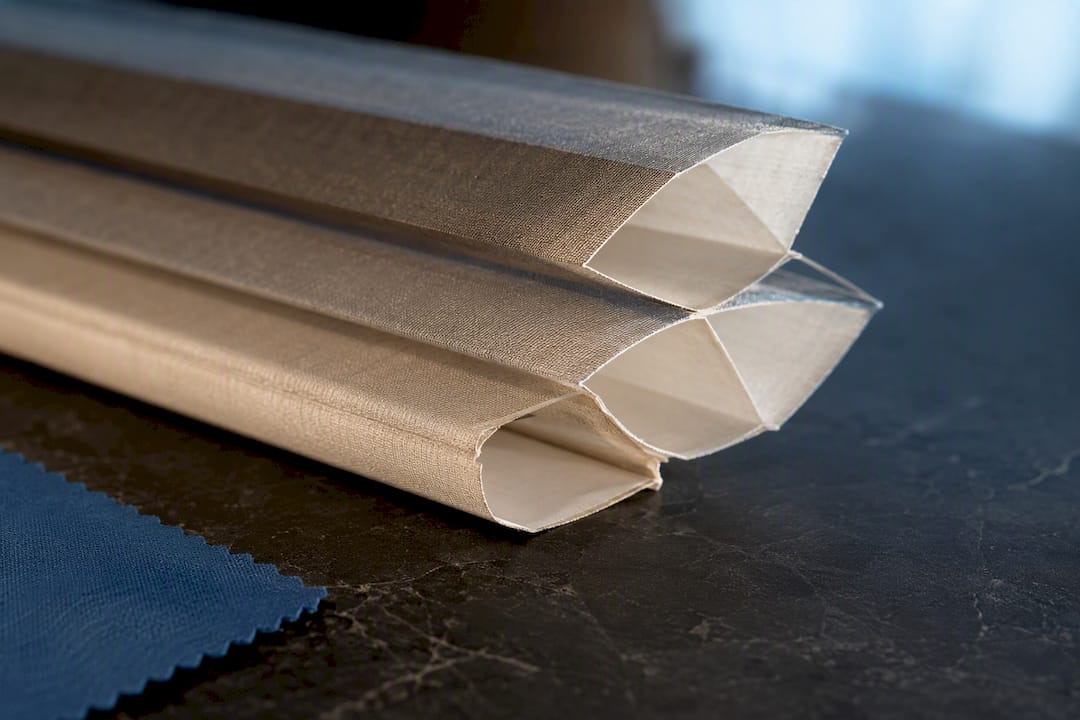
Both styles use the same basic trick: honeycomb-shaped pockets of fabric that trap air against your window. That trapped air acts as a buffer between the glass and your room, which is why cellular shades show up so often on energy-efficiency lists. Single-cell shades have one row of honeycomb pockets front to back. Double-cell shades add a second row (cell-within-a-cell), essentially stacking two insulating layers instead of one.
More trapped air generally means better thermal resistance, or R-value, which is just a measure of how well a material resists heat flow. That’s the whole logic behind Energy to use insulating window coverings like cellular shades to cut heat loss.
Here’s the part people get wrong, though: cell count doesn’t control blackout performance. That comes down to the fabric itself, whether it’s light-filtering, room-darkening, or a true blackout weave with a solid backing. A double-cell shade in a sheer fabric will let in plenty of light. A single-cell shade with a blackout liner can black out a room just as well as its double-cell cousin.
Single-Cell vs Double-Cell Shades: A Side-by-Side Look
Let’s get into the numbers that actually move the needle on your decision.
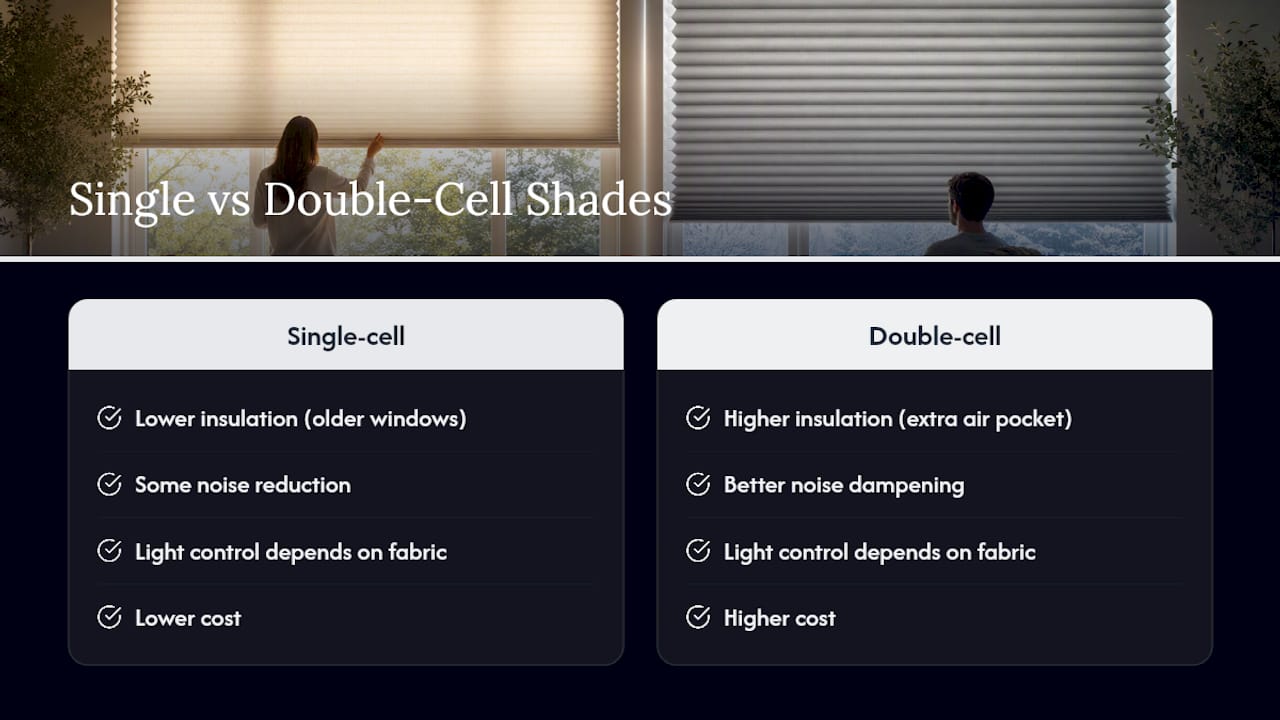
Insulation and energy performance. Double-cell shades typically outperform single-cell in raw thermal resistance because of that second air pocket. On a poorly insulated older window, that difference can meaningfully soften temperature swings near the glass. On a newer, well-sealed double-pane window, the gap narrows considerably, since the window itself is already doing a lot of the work.
Noise reduction. Extra fabric layers absorb and diffuse more sound, so double-cell shades tend to noticeably dampen street noise, barking dogs, or a noisy HVAC unit outside a bedroom window. Single-cell still helps versus a bare window, but if you live near a busy road, the double-cell upgrade is where you’ll actually feel the difference.
Light control. As covered above, this is a fabric and backing question, not a cell-count question. Design writers have made this point directly: a well-chosen blackout single-cell shade can out-darken a light-filtering double-cell one, since opacity and backing determine room-darkening, not the number of cell layers.
Cost. Double-cell shades typically cost more due to added fabric, more complex pleating, and heavier shipping on large sizes. Single-cell is generally more budget-friendly, especially when covering multiple windows.
Profile and look. Single-cell shades sit flatter and slimmer against the glass, which is why design experts favor them when the goal is a shade that visually disappears. Double-cell has a bit more depth and texture, which some homeowners actually like, but it’s a more noticeable presence on the wall.
Durability and maintenance. Both styles collect dust in the honeycomb folds and clean up with a vacuum brush attachment or compressed air. Double-cell’s extra layer means slightly more surface area to dust, but neither style needs more than an occasional wipe down.
📊 One figure worth remembering: Energy.gov calls window coverings one of the most cost-effective retrofits for cutting heating and cooling loss, and cellular shades are specifically named as a top performer in that category.
Pro Tip: Before you assume you need double-cell for a dark bedroom, check the fabric spec sheet first. A single-cell blackout shade often solves the light problem for less money than jumping to double-cell.
Which Rooms Need Double-Cell (and Which Don’t)
Matching the construction to the room saves you from overspending in some spots and underperforming in others.
- Bedrooms and home offices. Go double-cell. You want the sound dampening for sleep and the extra insulation for temperature-sensitive spaces where you spend hours at a stretch.
- Living rooms and tight, contemporary spaces. Single-cell often wins here, since the slim profile keeps the window looking clean and modern rather than bulky.
- Large or poorly insulated windows. Double-cell delivers a real thermal gain on oversized glass, especially in older homes where the window itself is the weak link.
- Rental properties or tight budgets. Single-cell with a blackout fabric is a smart compromise. You get most of the light control benefit without the double-cell price premium.
Design sources also point out that when you need both serious insulation and a specific aesthetic, layering treatments works well: a cellular shade for performance, drapery on top for style. And in homeowner discussions, the pattern holds up. On large windows, owners lean toward double-cell for comfort, but plenty stick with single-cell on smaller or more design-sensitive windows where the visual footprint matters more.
Getting the Measurements and Cell Size Right
Performance on paper only matters if the shade fits the window correctly. A sloppy install can undo half the benefit you paid for.
- Inside vs. outside mount: inside mount needs enough window depth to sit flush; outside mount covers the frame and hides gaps, which helps if your window depth is shallow.
- Cell size by window: smaller cells (around 3/8 inch) suit narrow or short windows, while larger cells (around 3/4 inch to 1 inch) handle tall windows better and fold more compactly when raised.
- Top-down/bottom-up and side channels: these options reduce the edge gaps where warm or cold air sneaks around the shade, which matters more for total performance than most people expect.
- When to call in a pro: oversized windows, bay windows, or anything with unusual angles are worth professional measuring.
Manufacturer guidance backs this up directly: mount type and sealing affect thermal performance enough that a well-fitted single-cell shade can outperform a poorly installed double-cell one. Fit first, cell count second. If you’re doing it yourself, this measuring guide for inside mount blinds walks through the exact steps.
How Valueblindsdirect Helps You Decide With Confidence
Choosing between constructions gets a lot easier when you can actually see and feel the fabric before you commit. Valueblindsdirect’s free swatches let you check opacity and texture in your own lighting, which solves the light control guesswork we talked about earlier.
A few tools worth using before you order:
- The window treatment design studio for visualizing single-cell versus double-cell options on your actual window dimensions.
- A deep dive on cellular insulation if you want the fuller technical picture.
- Custom sizing, cordless blackout options, and motorized upgrades, all available across the cellular shade lineup.
Pro Tip: Order your swatches and measure your window twice before placing a custom order. Cellular shades are made to your exact specs, so a half-inch error is the difference between a perfect fit and a return.
A Straight Answer From Someone Who’s Looked at a Lot of Windows
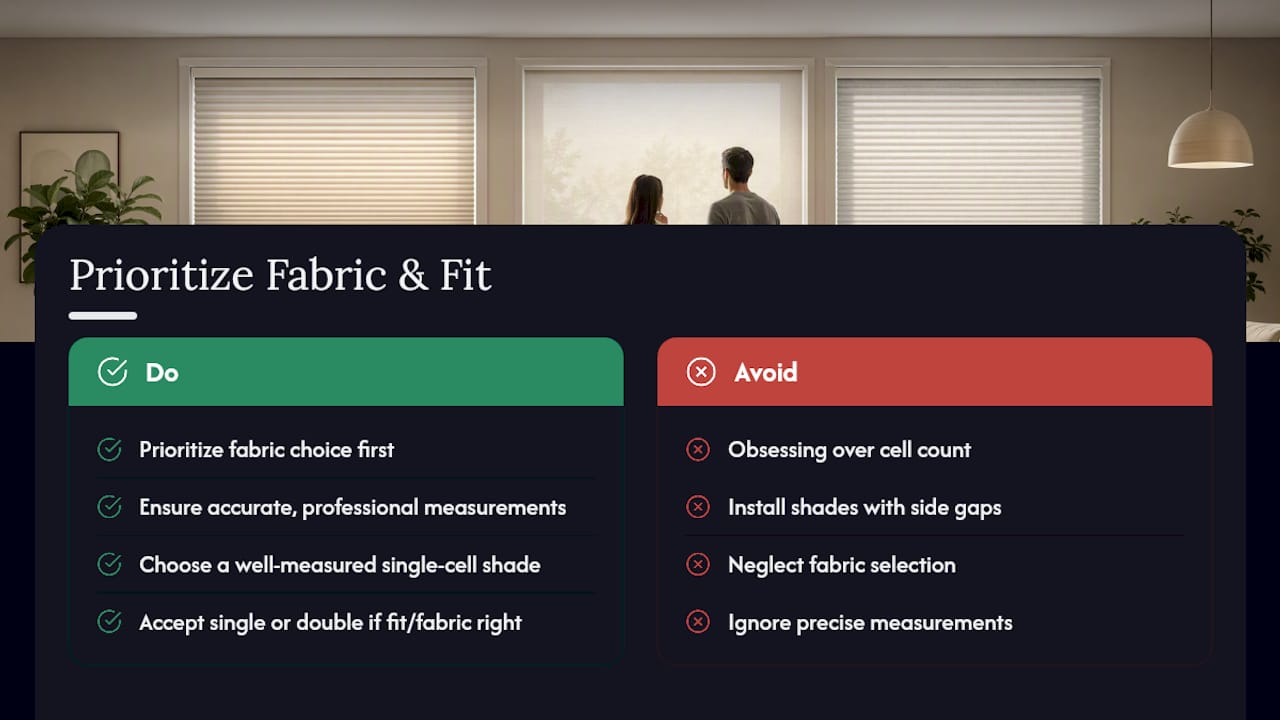
For most homeowners, this decision isn’t really about single-cell versus double-cell at all. It’s about fabric and fit. I’d rather see someone buy a well-measured single-cell blackout shade than a double-cell shade installed with a half-inch gap on either side, because that gap will leak more comfort than the extra cell layer ever recovers.
If you take one thing from this, prioritize your fabric choice and your measurements before you obsess over cell count. Get those two right, and either construction will serve you well.
— Sunny
Ready to Order? Here’s Your Next Step
You’ve got the trade-offs down: single-cell for budget and a slim look, double-cell for insulation and quiet. Valueblindsdirect makes acting on that decision simple, with the same free swatches and design tools referenced throughout this guide, plus custom sizing so you’re not settling for a stock fit.
Whether you land on a slim single-cell shade for the living room or a motorized double-cell option for the bedroom, the process is the same: order swatches to confirm the fabric, use the measurement guide to lock in accurate dimensions, then build your shade in the design studio. If you’re weighing other window treatment styles for the same room, the full blinds collection is worth a browse too. Ready to see your options? Start with a free swatch order and go from there.
A Couple of Places to Keep Learning
For the energy math behind this whole comparison, Energy.gov’s guide to window coverings is the primary source. For design trade-offs and room-by-room advice, Style by Emily Henderson breaks down aesthetics in plain terms.
Sources
- Your whole home cheat sheet to picking the right window coverings | Style by Emily Henderson
- The best window treatments for every type of window | Pella
Recommended

Value Blinds®
Trusted window treatments provider
Value Blinds® is a trusted provider of Greenguard, OEKO-TEX, and FSC-certified window treatments based in Portland, Oregon. Specializing in sustainable, motorized, smart-controlled, and outdoor-ready blinds and shades, the company is built on a foundation of simplified shopping, premium eco-friendly materials, and transparent pricing without the inflated cost.