
Article: Hardwired Motorized Shades: How They Work and When to Choose Them
Hardwired Motorized Shades: How They Work and When to Choose Them
Yes, motorized shades can be hardwired, and for many homes it’s the set-it-and-forget-it way to power them. A hardwired shade gets its power through a cable connected to your home’s electrical supply, so there are no batteries to recharge and no cord dangling down your wall. The catch is that the wiring has to be planned before the walls close, and the right setup depends on your windows, your walls and your local electrical code. 🔌
This guide explains how hardwired shades work, how they compare with battery and plug-in power, what installation involves and how to decide. If you’re ordering custom shades, you can browse our motorized shades and plan the power at the same time as the fit.
TL;DR
- Hardwired means permanent power. The shade motor is connected by cable to a power supply, so there’s no battery charging.
- It suits new builds and remodels. Open walls, tall or hard-to-reach windows and shades you use every day are where hardwiring pays off.
- “Hardwired” can mean two things. It can be a low-voltage motor on a power supply or a motor built for household voltage. Confirm which one your quote includes.
- Electrical work follows local code. A licensed electrician should handle any line-voltage circuit feeding the power supply.
- Plan for outages. A hardwired shade needs backup power to move when the electricity is out.
Table of Contents
- What “hardwired” actually means
- The four layers of a hardwired system
- Hardwired, battery or plug-in: which power option fits?
- What installing hardwired shades involves
- Controls: how you’ll actually operate them
- Can hardwired motorized shades be operated manually?
- Which shade styles work with motorization?
- A quick decision guide for your home
- Our perspective on hardwired shades
- Ready to plan your motorized shades?
- FAQ
- Sources
What “hardwired” actually means
A motorized shade has a small motor inside the roller or headrail. That motor needs electricity from somewhere. There are three common sources:
- Hardwired: a cable runs from the motor to a power supply that’s connected to your building’s electrical system.
- Battery: a rechargeable or replaceable battery pack lives in or beside the headrail.
- Plug-in: a power adapter plugs into an existing outlet near the window.
Hardwired is the one that disappears. Once it’s done, the power is simply there, and you control the shade with a wall switch, a remote or your phone.
Here’s a detail worth knowing. An electrician writing about shade power points out that “hardwired” can describe two different arrangements: a low-voltage motor connected to a power supply, or a motor designed to run on household voltage. Some wired shades can even use a manufacturer-approved adapter plugged into an existing outlet. Those are very different jobs, with different costs and different electrical work, so confirm which one is meant before anyone cuts into a wall.
The four layers of a hardwired system
It helps to picture the system as four layers. This is how a hardwired shade installation is typically laid out:
- The shade and motor at the window.
- Low-voltage cable (commonly 18/2, meaning two conductors of 18-gauge wire) run from each shade back to a central point.
- A power supply or multi-channel transformer panel in an accessible spot, which converts building power to the voltage the motor uses.
- A control system that sends commands, whether that’s a wall switch, a remote, or a bridge or hub that connects to your smart home app.
The low-voltage cable is the part most people picture when they hear “hardwired.” It’s thin, it’s routed inside walls or ceilings, and it ends at a small connection at the shade. The power supply is where the “real” electricity enters the picture, and that’s where an electrician comes in.
Low voltage versus household voltage
Many wired shade lines run on 12-volt DC power from an appropriate adapter or power panel. One widely used wired line must not connect directly to a 120-volt household outlet circuit. The motor needs the converted low voltage, which is exactly why the power supply layer exists.

The practical takeaway: never wire a shade motor straight into a household circuit unless the product is specifically made for it. Follow the manufacturer’s instructions for the motor you buy.
Hardwired, battery or plug-in: which power option fits?
This is the question behind most searches for motorized shade power options. Here’s a plain side-by-side.
| Hardwired | Battery | Plug-in adapter | |
|---|---|---|---|
| Recharging | Never | Periodically | Never |
| Visible cord | None once installed | None | Usually a short cord to the outlet |
| Best for | New builds, remodels, frequent use, tall or hard-to-reach windows | Existing finished rooms, renters, quick upgrades | Windows with an outlet nearby |
| Install effort | Highest: cable runs and a power supply | Lowest | Low |
| During an outage | Needs backup power | Works while charged | Needs power |
The general pattern holds up well. Hardwired shades need no routine battery charging and suit remodeling with open walls, frequent use and hard-to-reach windows. Battery shades are the easy choice when the walls are already finished and you don’t want to open them up.
When hardwired is the smart pick
- You’re building or gutting a room. Pulling a low-voltage cable while the studs are exposed is far easier than fishing it later.
- You have lots of windows. A dozen battery packs means a dozen things to remember. One central power supply means none.
- Your windows are high or awkward. A two-story foyer window is not where you want to be swapping batteries on a ladder.
- You run the shades on a schedule. Daily movement drains batteries faster, and hardwired power doesn’t care.
- You want the cleanest look. No charging cable, no solar tail, no visible wire.
When another option is easier
If your walls are finished and painted and you simply want to upgrade a window or two, battery power is quick and tidy. For an outdoor shade with no outlet nearby, a solar-powered option avoids running electrical to the patio at all. We carry a custom solar-powered outdoor shade that’s motorized without wiring, which is handy when trenching a cable across a yard would be a project in itself.
What installing hardwired shades involves
A hardwired job is more of a small construction sequence than a hang-and-go job. A typical order of work looks like this:
- Confirm the complete system. Shades, motors, power supply and controls all need to be compatible with one another.
- Verify window dimensions and clearance. The shade has to fit the opening, and the motor needs room.
- Map each shade to a channel on the panel. This includes load and voltage-drop calculations, which check that long cable runs still deliver enough power to the motor.
- Pull labeled, protected low-voltage cable. Labeling each run saves a lot of confusion later.
- Mount the accessible power panel. “Accessible” matters: you or a technician will need to reach it someday.
- Close the walls.
- Mount and connect the shades.
- Commission the system. That means setting the upper and lower limits, pairing with a hub and creating scenes (for example, “Good morning” opens the bedroom shades halfway).
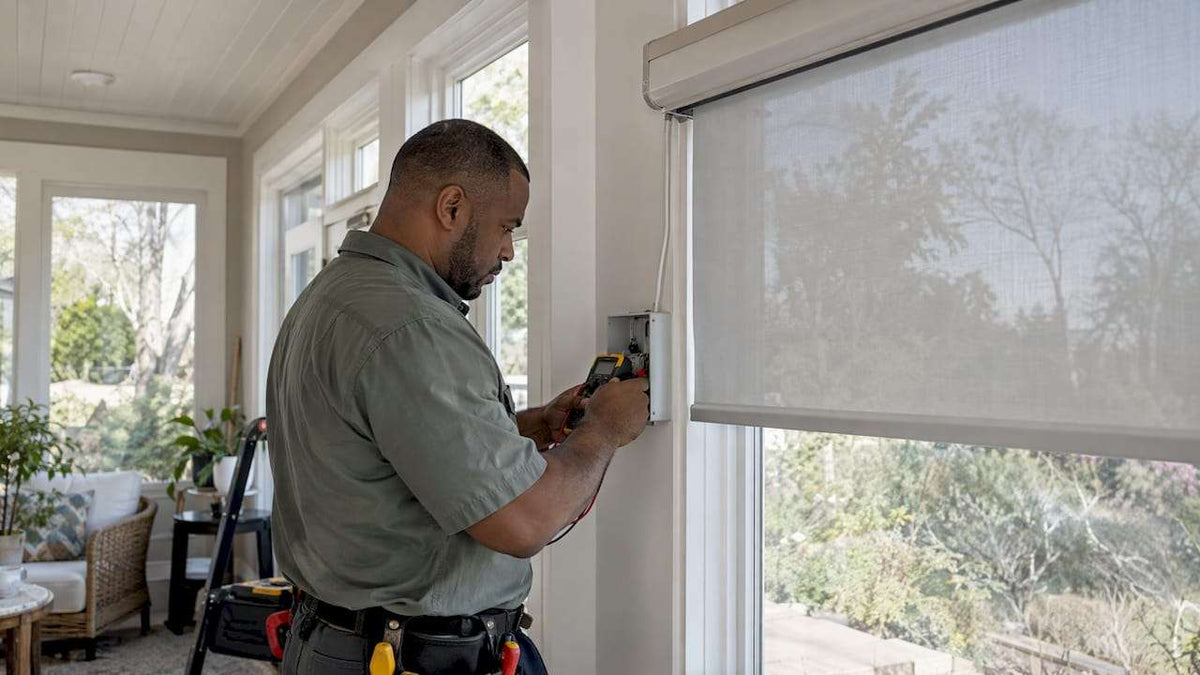
The line-voltage circuit that feeds the panel is a different matter. A licensed electrician should handle that circuit. That’s a safety rule, not a suggestion.
Where hardwired projects go wrong
- Measuring late. If the cable is run to the wrong spot, or the shade size changes after the walls are closed, you’ll be patching drywall. Measure first.
- Mismatched parts. A motor, power supply and control that weren’t designed to work together can leave you troubleshooting.
- Long cable runs. Distance drops voltage, which is why the load and voltage-drop check exists.
- Burying the power supply. If you can’t reach it, a simple fix becomes a wall repair.
- Skipping the code. Connections to a building’s electrical system should follow your local electrical code. A commercial motor specification spells out that connections follow local code, that wiring details such as gauge and limitations are documented, and that electrical components are listed and labeled as defined in NFPA 70 (the National Electrical Code in the US). Your home project follows the same logic: use listed components, and follow the code that applies where you live.
Doing the measuring and install the easy way
Measurements are the step that quietly makes or breaks a motorized order, because a custom shade is made to your size. We offer professional measuring and installation so those numbers are taken for you, and we also publish measuring guidance if you’d like to see how it’s done. If your project includes new cable runs, line up your electrician before the shades arrive so the wiring is ready when the shades are.

Controls: how you’ll actually operate them
Hardwiring is about power. Control is a separate choice, and you’ve got plenty of options:
- Wall switch: simple, always there, great for guests who don’t want an app.
- Remote: handy for a whole room or a single window. Our guide to remote controlled window shades walks through the basics.
- Hub or bridge with an app: lets you group shades, set schedules and build scenes.
- Voice assistants and smart home platforms: work through the hub, so you can say “close the living room shades” and be done.
One thing to know: with a hub-based setup, app access and automations may depend on powered hubs or internet service. A wall switch is a nice backup for everyday use.
Can hardwired motorized shades be operated manually?
Usually not by simply tugging them. A motorized shade has no cord or chain to pull, and the motor holds the shade in place. Don’t assume that a stopped motorized shade can be pulled open by hand; forcing it can damage the motor or the shade fabric.
The better plan is to prepare for an outage:
- Hardwired shades need backup power to operate during an outage.
- Think about which rooms matter most. A bedroom or a nursery might be worth putting on a backed-up supply.
- Before you rely on the shades for privacy, decide how you’d cover a window if the power stays off for a while.
- Read the manual for your specific motor. Some have a manual override or emergency procedure, and the steps vary by model.
If you want a shade that’s easy to use at any time with no wiring at all, battery and solar power are worth a look. Battery-powered shades can operate during a household outage while they still have charge.
Which shade styles work with motorization?
The style question and the power question are separate, so you can pick the look you love first. A few popular choices:
- Roller shades: clean, minimal and a natural fit for motors. See our motorized roller shades guide.
- Zebra shades: alternating sheer and solid bands let you dial in light. Our motorized zebra shades with smart control are water-proof, oil-proof and stain resistant.
- Cellular shades: the honeycomb design is a favorite for comfort. Try our motorized light filtering cellular shades.
- Roman shades: soft, tailored folds. Our motorized Roman shades guide covers the details.
- Wood blinds: warm and classic. See our premium motorized wood blinds.
We also offer free swatches, so you can see fabric and color in your own light before you order.
A quick decision guide for your home
Walk through these questions in order:
- Are the walls open, or will they be? If yes, hardwiring is easiest right now. Ask your builder or electrician to run low-voltage cable to each window.
- Are the walls finished? Battery power is the low-effort path, and an outdoor shade can go solar.
- How many windows? Five or more makes a central power supply more attractive than separate batteries.
- How hard are the windows to reach? If you need a ladder, skip the battery swapping.
- Do you rent or manage rentals? Property managers and tenants will usually prefer solutions that don’t need wall work.
- What will your quote include? Ask whether it covers cable, power supply, controls and commissioning, or only the shades.
For realtors, builders and contractors, the same logic applies at scale: decide the power approach during framing, label every cable run and leave the power panel accessible.
Our perspective on hardwired shades
We love hardwired shades for one simple reason: they take the chore out of window coverings. Once the wiring is planned well, you never think about charging again.
The best results come from planning in the right order. Pick your shade style and fabric, get accurate measurements, then decide how each window will be powered. When those steps happen together, the install goes smoothly and the shades look like they were always part of the room.
That’s why we pair custom, made-to-order shades with professional measuring and installation. Custom sizes need accurate numbers, and a motorized order is only as good as the measurements behind it. Add free swatches and a satisfaction guarantee, and you can make the decision with confidence.
Whether you choose wired, battery or solar, we’d rather you end up with the power setup that fits your home. Tell us about your windows and we’ll help you build the plan. 😊
Sunny
Ready to plan your motorized shades?
If you’re upgrading a single room or outfitting a whole house, start with the style you want and let us handle the measuring and installation. Explore our full range of custom blinds and shades and request free swatches to try colors at home.
Want to see how motorized options work across the range? Our overview of motorized window shades covers style, convenience and smart upgrades in one place.
FAQ
Can motorized blinds be hardwired?
Yes. Many motorized shades and blinds can be powered through a cable connected to a power supply, which is what “hardwired” means. Confirm whether the setup uses a low-voltage motor on a power supply or a motor built for household voltage, because the electrical work differs.
Do I need an electrician for hardwired shades?
If your project includes a line-voltage circuit feeding the shade power supply, yes: a licensed electrician should handle that. The low-voltage cable from the panel to each shade is a separate layer, but it should still follow your local electrical code.
Can hardwired motorized shades be operated manually?
Not reliably. A stopped motorized shade shouldn’t be assumed to be pullable open by hand, and hardwired models need backup power to move during an outage. Check your motor’s manual for any override feature, and keep a wall switch or remote as your everyday backup.
What are the downsides of hardwired motorized shades?
The main planning points are the wiring itself and outage readiness. Cable runs are easiest when walls are open, and you’ll want a plan for power loss. With the wiring mapped before installation, hardwired shades give you charge-free convenience for years.
Can I use a smart home app with hardwired shades?
Yes, through a bridge or hub that connects the shades to your app or voice assistant. A wall switch or remote can still run the shades directly, which is handy if the internet is down.
Sources
- Motorized Window Shade Wiring and Hardwired Power Supplies
- Motorized Shades: Hardwired vs. Battery vs. Solar
- Section 12 25 09 Window Treatment Motors, Controls, and Accessories