


Your Complete Home Safety Checklist for Every Room
A thorough home safety sweep covers five non-negotiables: working smoke and CO detectors, cleared trip hazards, cordless window treatments, secured storage for hazardous substances, and a customized emergency kit. Do these five things and you’ve addressed the risks that cause the most injuries and deaths in American homes.
Here’s what you can act on in the next 30 minutes:
- Test every smoke and CO detector on each floor and near sleeping areas (CDC STEADI identifies falls as the leading cause of injury death for adults 65+, and detector failures rank just as high for fire fatalities)
- Walk your main pathways and remove any loose rugs, cords, or clutter between bedrooms and bathrooms
- Check window cords in kids’ rooms and replace with cordless options where needed (Johns Hopkins Medicine flags corded blinds as an avoidable strangulation hazard)
- Confirm your emergency kit is stocked with household-specific medications (Ready.gov recommends customizing beyond generic kits)
- Make sure your house numbers are visible from the street for emergency responders
Table of Contents
- What does a room-by-room home safety checklist cover?
- How should you set up fire and carbon monoxide detectors?
- How do you reduce falls for older adults and everyone else?
- What kitchen and electrical checks matter most?
- How do you childproof and pet-proof your home?
- Which window treatments are safest for your home?
- How do you build a household emergency preparedness plan?
- What’s a realistic inspection schedule and cost estimate?
- Where can you verify these safety recommendations?
- What pet-specific hazards should you watch for indoors?
- How should you store cleaning products and medications safely?
- How do you plan and practice emergency evacuation routes?
- How do you improve indoor air quality as part of home safety?
- What interior fire hazards are easy to miss?
- What else should you know about window treatment safety?
- Key Takeaways
- The safety upgrade most homeowners skip
- Safe, stylish window treatments from Valueblindsdirect
What does a room-by-room home safety checklist cover?
Printable room-by-room checklists from major health providers make inspections repeatable and shareable with everyone in your household. Here’s a quick-reference version:
| Room | Action 1 | Action 2 | Action 3 |
|---|---|---|---|
| Entry | Visible house numbers | Deadbolt + reinforcement plate | Motion-activated exterior light |
| Living room | Anchor large furniture to wall | Secure rugs with non-slip grippers | Test outlets, check for frayed cords |
| Kitchen | Clean lint trap and dryer vent | Check fire extinguisher gauge | Clear space around stove |
| Bedrooms | Remove loose rugs | Install night lights on path to bath | Check window treatment cords |
| Bathrooms | Non-slip mat in tub/shower | Grab bar near toilet | Check GFCI outlet function |
| Stairs | Handrails on both sides | Anti-slip treads on uncarpeted steps | Good lighting top and bottom |
| Outdoors | Clear walkways of debris | Move flammable materials 5+ feet from structure | Trim vegetation away from home |
Pro Tip: Do a 60-second nightly sweep of the main path from your bedroom to the bathroom. Most nighttime falls happen on that exact route, and it takes less time than brushing your teeth.
How should you set up fire and carbon monoxide detectors?
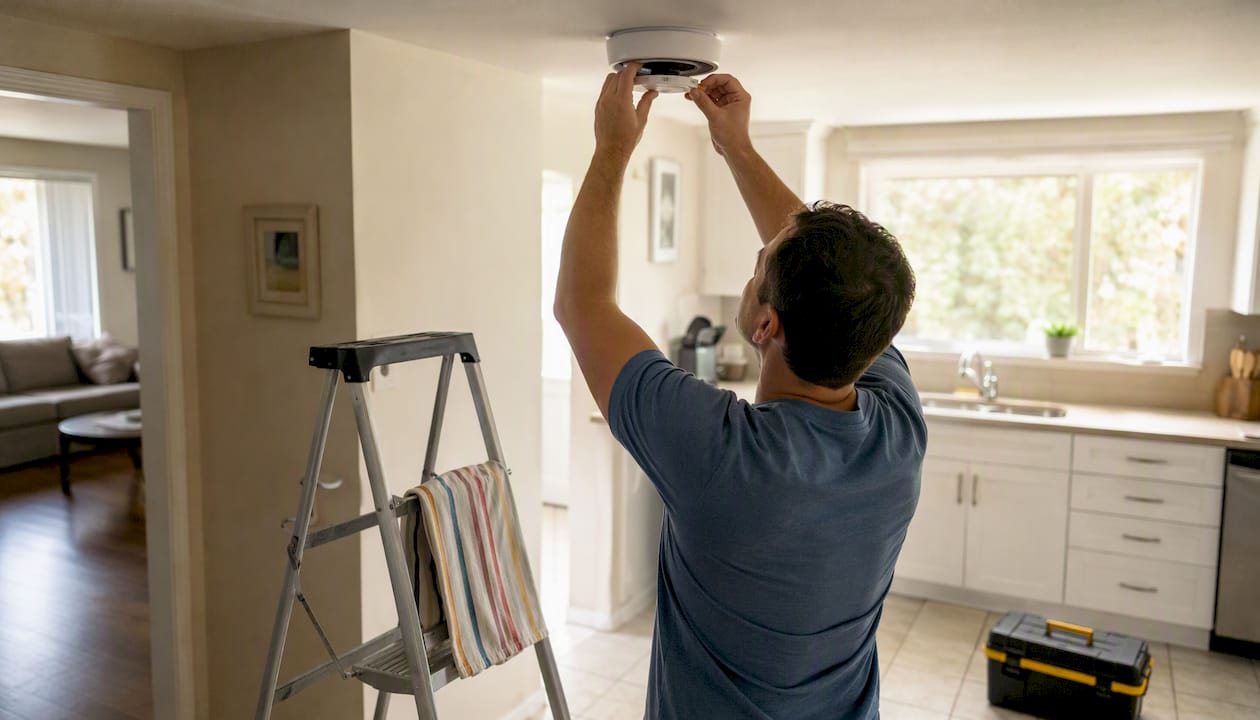
Install smoke detectors and CO detectors on every level of your home, near sleeping areas, and near major gas-burning appliances. MedlinePlus recommends adding detectors near furnaces and water heaters for earlier CO warning. That placement can be the difference between a timely evacuation and a tragedy.
- Mount smoke detectors on the ceiling or high on the wall in every bedroom hallway and on each floor
- Place CO detectors near sleeping areas AND near the furnace or water heater in the basement
- Test every detector monthly by pressing the test button
- Replace smoke detectors at regular intervals as recommended; replace CO detectors per the manufacturer’s schedule (Stanford Medicine Children’s Health)
- Keep a fire extinguisher in the kitchen, mounted visibly; check it periodically since extinguishers have a nominal shelf life of about 10 years
Pro Tip: Set a recurring phone reminder on the first day of each month to test your detectors. It takes 10 seconds and it’s the single highest-ROI safety habit in your home.
How do you reduce falls for older adults and everyone else?
Removing tripping hazards and improving lighting cut fall risk substantially. Falls are the leading cause of injury death for people 65 and older, and the fixes are almost entirely free or low-cost.
- Same day: Remove clutter from all walkways, secure loose rugs with non-slip grippers, and add a night light on the bedroom-to-bathroom path
- This week: Install handrails on both sides of staircases, add anti-slip treads to uncarpeted steps, and check for uneven flooring or lifted carpet edges
- Within a month: Schedule professional repairs for any damaged flooring; consider grab bars near the toilet and in the tub/shower
The National Institute on Aging also recommends keeping frequently used items within easy reach to avoid climbing or overreaching, which is a common fall trigger. Reducing home clutter is one of the fastest ways to lower that risk.
Pro Tip: Prioritize the bedroom-to-bathroom route and the top and bottom of stairs first. Those two zones account for the majority of household falls.
What kitchen and electrical checks matter most?
The kitchen is where most home fires start, and the fixes are straightforward. Routine vent cleaning and filter replacement reduce both fire and air-quality risks significantly.
Monthly checks:
- Clean the lint trap after every dryer load; clean the dryer vent duct at least once a year
- Inspect appliance cords for fraying or damage
- Check the range hood filter and clean or replace it
Yearly checks:
- Replace furnace filters per manufacturer guidance
- Test GFCI outlets in the kitchen, bathrooms, and garage (press the test button, then reset)
- Inspect the area around the water heater and furnace for stored flammable materials
For a deeper look at kitchen safety tips, avoid running cords under rugs, never leave cooking unattended, and keep a Class K or ABC fire extinguisher mounted within reach of the stove. Surge protectors on major appliances are a smart, inexpensive addition.
How do you childproof and pet-proof your home?
Cordless or motorized window treatments are the single most impactful upgrade you can make in rooms where children and pets spend time. Corded blinds pose a strangulation risk for young children, and the fix is simple.
- Lock up all medications and cleaning products in latched or high cabinets
- Anchor tall furniture (bookshelves, dressers, TV stands) to the wall with anti-tip straps
- Cover unused electrical outlets with tamper-resistant covers
- Keep window cords out of reach or switch to cordless options entirely
- Use door knob covers and cabinet locks in rooms with hazardous items
Valueblindsdirect’s parent’s guide to cordless window treatments walks through exactly which treatment types work best for nurseries and playrooms.
Pro Tip: Place furniture away from windows in kids’ rooms. Children climb, and a dresser next to a window becomes a ladder to a dangerous height.
Which window treatments are safest for your home?
Cordless and motorized treatments are the safest choice, full stop. Here’s how the main categories compare:
| Treatment type | Safety | Energy efficiency | Ease of cleaning | Cost shape |
|---|---|---|---|---|
| Cordless cellular shades | Excellent | High (insulating honeycomb cell) | Easy (wipe or vacuum) | Mid-range |
| Motorized shades | Excellent | High | Easy | Higher upfront |
| Cordless roller shades | Very good | Moderate | Very easy | Budget-friendly |
| Motorized woven shades | Excellent | Moderate | Moderate | Higher upfront |
For installation, always anchor brackets into wall studs or use appropriate drywall anchors. Loose brackets can cause treatments to fall, which is a hazard for kids and pets alike. Valueblindsdirect offers free swatches, warranties, and a design studio to help you choose the right fit before you order.
How do you build a household emergency preparedness plan?
Customize your first-aid kit to your household’s actual medical needs rather than relying on a generic drugstore kit. A diabetic household needs glucose tablets; a household with severe allergies needs a spare EpiPen.
- Stock prescription medications (at least a 3-day supply), spare inhalers, and any condition-specific supplies
- Store digital copies of insurance cards, prescriptions, and emergency contacts in a password-protected cloud folder
- Keep a paper emergency card near the phone or on the fridge with local emergency numbers, utility shutoff locations, and a neighbor’s contact
- Make house numbers visible from the street, day and night, so responders can find you fast
Pro Tip: Review and restock your kit every six months. Medications expire, and a kit you haven’t opened in two years may be missing exactly what you need.
What’s a realistic inspection schedule and cost estimate?
| Frequency | Task | Rough cost / time |
|---|---|---|
| Daily | Clear main walkways, check stove area | Free / 2 minutes |
| Monthly | Test detectors, inspect cords and outlets | Free / 15 minutes |
| Quarterly | Check extinguisher, clean range hood, review emergency kit | Low cost / 30 minutes |
| Yearly | Replace furnace filter, clean dryer vent, inspect handrails | Moderate cost / 1–2 hours |
| As needed | Replace smoke detectors (every ~10 years), upgrade to cordless blinds | $15 per detector; $30 per window |
A home maintenance checklist that bundles safety checks with seasonal upkeep keeps costs predictable and prevents the expensive surprises that come from deferred maintenance.
Where can you verify these safety recommendations?
These are the primary sources behind this guide:
- CDC STEADI: Fall-prevention research and home assessment guidance for older adults
- Ready.gov: Emergency kit customization and household preparedness planning
- National Institute on Aging (NIA): Room-by-room worksheet for older adult home safety
- Johns Hopkins Medicine: Household safety checklist including window-cord hazard guidance
- MedlinePlus / NLM: Detector placement, house numbers, and routine maintenance guidance
- Stanford Medicine Children’s Health: Detector testing and replacement schedules
To verify detector or extinguisher lifespans, check the manufacturer label on the unit itself. Most smoke detectors print the manufacture date on the back. For window treatments, Valueblindsdirect’s warranty documentation covers product-specific guidance.
What pet-specific hazards should you watch for indoors?
Pets face hazards that don’t always show up on a standard household safety checklist. Cats and dogs can chew electrical cords, which creates both an electrocution risk and a fire hazard. Keep cords bundled and tucked behind furniture or use cord covers. Certain houseplants (lilies, pothos, philodendron) are toxic to cats and dogs, so check the ASPCA’s toxic plant list and relocate any problem plants out of reach.
Window screens are another overlooked risk. A cat leaning against a screen can push it out, especially on upper floors. Use reinforced or pet-resistant screens, and keep windows that open wide enough for a pet to fall through either locked or fitted with window stops. Blind cords are a hazard for curious pets too, not just children.
How should you store cleaning products and medications safely?
Store all cleaning products, pesticides, and medications in locked or latched cabinets, ideally above counter height. Never store cleaning products and medications in the same cabinet. Mixing up containers in an emergency is a real risk, and children are more likely to reach items stored at lower levels.
Medications deserve their own locked box or cabinet, separate from vitamins and supplements. Dispose of expired medications through a DEA-authorized take-back program rather than flushing them. For cleaning products, keep them in their original containers with labels intact so that poison control can identify the substance quickly if needed. The Poison Control hotline (1-800-222-1222) is worth adding to your emergency card.
How do you plan and practice emergency evacuation routes?
Every household member needs to know two ways out of every room. Walk the routes together, not just in your head.
- Map two exits from each room, including windows on upper floors (consider a collapsible escape ladder for second-floor bedrooms)
- Choose a meeting spot outside the home, at least 100 feet from the structure
- Assign roles for household members with mobility limitations or young children who need assistance
- Practice a drill at least twice a year, including one at night when disorientation is higher
- Check outdoor gate latches so exits aren’t blocked; gate maintenance is easy to overlook until you need a fast exit
For households with older adults or people with disabilities, pre-notify your local fire department. Many departments offer a free registry for residents who may need evacuation assistance.
How do you improve indoor air quality as part of home safety?
Poor air quality is a slow hazard, but it’s a real one. Replace furnace and HVAC filters every 1–3 months depending on usage and whether you have pets. Run bathroom exhaust fans during and for 15 minutes after showers to prevent moisture buildup that leads to mold.
Check under sinks and around window frames seasonally for early signs of mold (dark spots, musty smell). Catching mold early means a $10 bottle of cleaner instead of a $1,000+ remediation. Keep indoor humidity between 30% and 50% using a dehumidifier in damp basements. If you have gas appliances, make sure the kitchen and utility areas are ventilated, and never run a generator or grill indoors.
What interior fire hazards are easy to miss?
Fireplaces and electrical outlets are two of the most overlooked fire risks in a home. Have your fireplace and chimney inspected and cleaned by a certified chimney sweep annually. Creosote buildup is the primary cause of chimney fires, and it’s invisible until it ignites.
For electrical outlets, tamper-resistant receptacles (TRRs) are now required by the National Electrical Code in new construction, but older homes often still have standard outlets. Swap them out in rooms used by children. Never use an extension cord as a permanent wiring solution, and avoid daisy-chaining power strips. If your home has an older electrical panel (pre-1990), a licensed electrician’s inspection is worth scheduling.
What else should you know about window treatment safety?
Beyond going cordless, the material and mounting of your window treatments matter. Vinyl and PVC blinds manufactured before 2010 may contain lead in the paint or coating. If you have older blinds and young children, replacing them is a straightforward safety upgrade.
For mounting, always use the correct bracket type for your window frame (inside mount vs. outside mount) and confirm the brackets are anchored securely. A treatment that falls can injure a child or pet and damage the window frame. Woven shades and fabric treatments should be kept away from open flames and heat sources like radiators. Motorized treatments eliminate the need to reach across furniture or lean over a crib to adjust blinds, which reduces both cord risk and the temptation to place furniture near windows for easier access.
Key Takeaways
A complete home safety sweep requires working detectors, cleared pathways, cordless window treatments, secured hazardous storage, and a customized emergency kit tailored to your household’s specific medical needs.
| Point | Details |
|---|---|
| Detectors save lives | Test smoke and CO detectors monthly; replace smoke detectors roughly every 10 years. |
| Falls are the top injury risk | Remove loose rugs, add night lights, and install handrails to cut fall risk on main pathways. |
| Cordless treatments are the safest choice | Corded blinds pose a strangulation risk for children and pets; switch high-traffic rooms first. |
| Customize your emergency kit | Stock household-specific medications and keep a paper emergency card visible near the fridge. |
| Valueblindsdirect for safe window options | Valueblindsdirect offers cordless and motorized collections with free swatches and warranty support. |
The safety upgrade most homeowners skip
Here’s an honest take: most homeowners spend their safety energy on the obvious stuff (smoke detectors, door locks) and completely ignore window treatments. That’s understandable. Blinds don’t feel like a safety issue until they are one. But the research from Johns Hopkins is clear, and the fix is genuinely easy.
What I’d actually recommend: start in the nursery or the room where your youngest child or most curious pet spends the most time. Swap those corded treatments first. Then work outward. You don’t have to replace every window in a weekend. Motorized shades on hard-to-reach windows are a particular win because you stop needing to climb furniture or lean over a crib entirely. That’s not just safer; it’s genuinely more convenient every single day.
The other habit worth building is a weekly 5-minute walkthrough of your main pathways. Not a full inspection, just a quick scan for anything that migrated onto the floor. Most trip hazards are temporary (a bag left in the hallway, a rug that shifted) and take 10 seconds to fix. The homeowners who get hurt are usually the ones who noticed the hazard and figured they’d deal with it later.
Safe, stylish window treatments from Valueblindsdirect
If you’re ready to swap out corded blinds for something safer and honestly better-looking, Valueblindsdirect makes it easy. The cordless and motorized collection covers everything from blackout cellular shades for nurseries to motorized zebra shades for living rooms, all designed with child and pet safety in mind. Free swatches mean you can check the color and texture in your actual light before committing.

Not sure where to start? The Window Treatment Design Studio walks you through measurement, style, and safety options with expert support. Browse the full blinds collection or request your free swatches today.