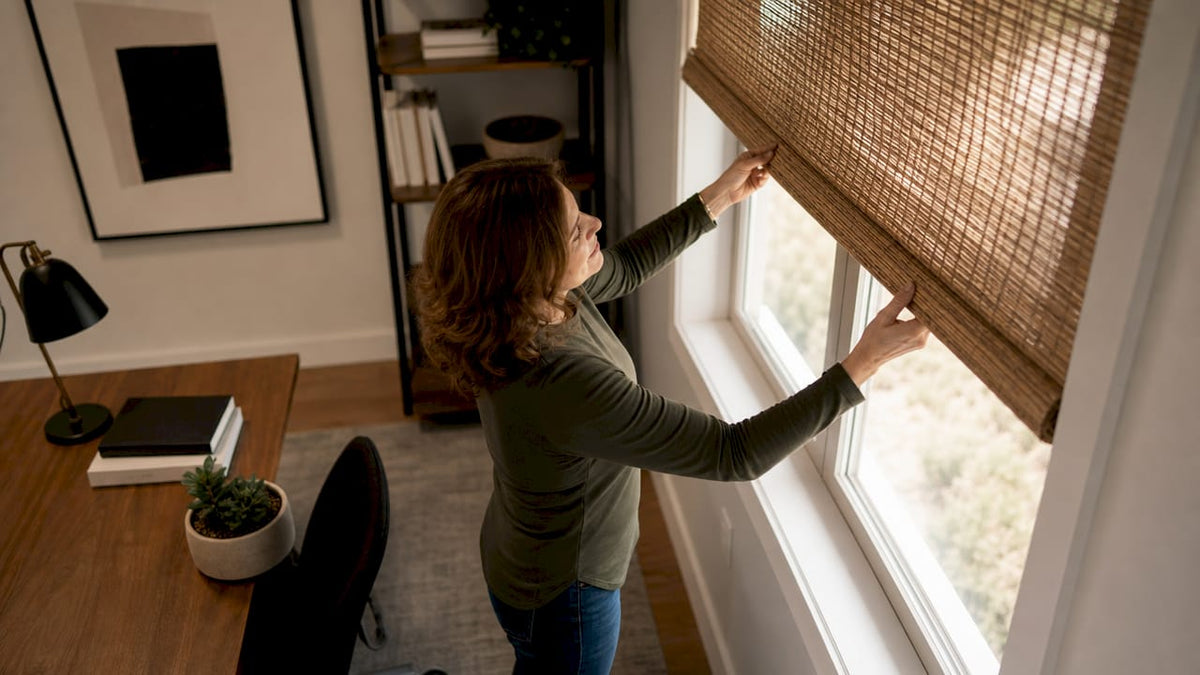


Outside Mount Blinds: What They Are and Why They Work
TL;DR:
- Outside mount blinds are window treatments mounted on the wall or trim around the window, not inside the frame. They provide better light control, conceal damaged trim, and make windows appear larger. They are easier to measure and install, especially on shallow or hardware-obstructed windows.
Outside mount blinds are window treatments installed on the wall or trim surrounding the window frame, rather than inside the frame itself. This mounting style gives you complete control over light, privacy, and the visual size of your windows. Homeowners and renters who ask what is outside mount blinds are usually dealing with one of three situations: shallow window frames, a need for better light blocking, or a desire to make windows look larger. This article covers all three, plus how to measure, install, and style outside mounts for any room.
What is outside mount blinds vs. inside mount?
Outside mount blinds attach to the wall or window trim above and around the window opening. Inside mount blinds, by contrast, sit inside the window frame, fitting within the recess. The difference sounds simple, but it changes everything about how the blind performs and looks.
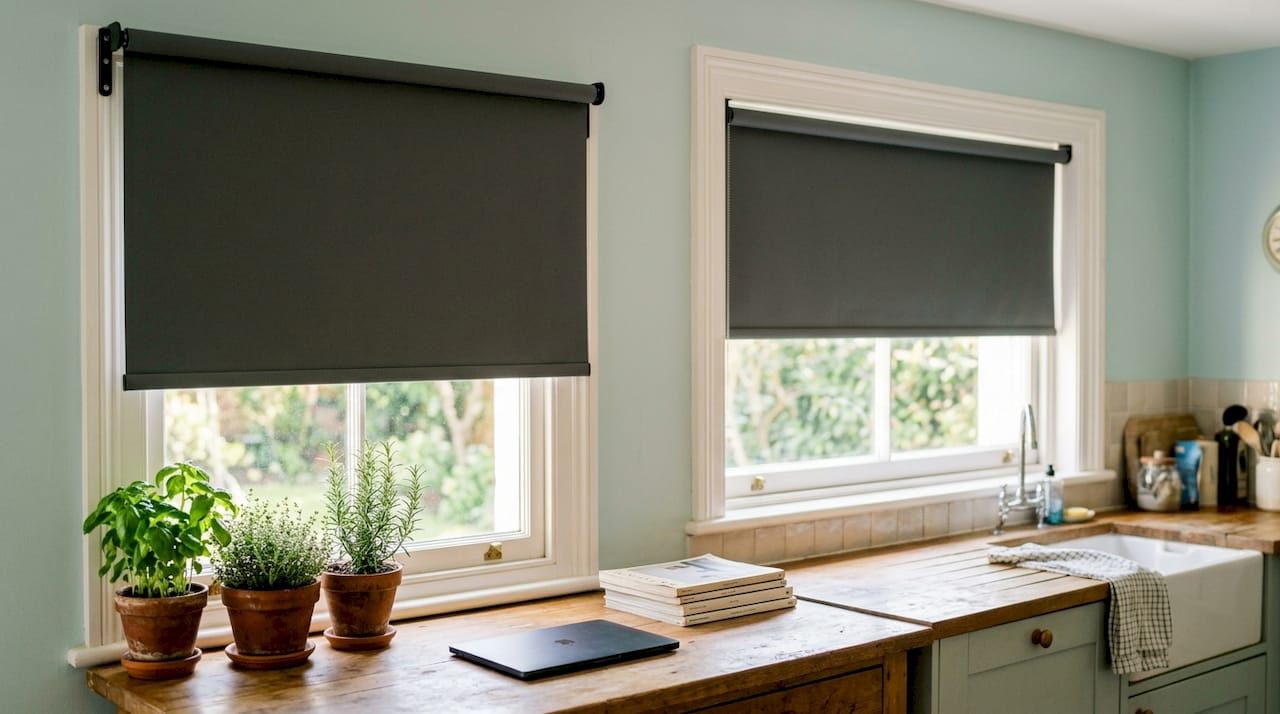
Inside mounts require adequate frame depth. Shallow window frames under 2 inches deep cannot accommodate the headrail of most blinds without obstruction. Outside mounts solve this immediately because the headrail sits on the wall, not inside the frame. That makes outside mounting the only practical choice for many windows in older homes and apartments.
| Feature | Outside mount | Inside mount |
|---|---|---|
| Mounting location | Wall or trim above window | Inside window frame recess |
| Frame depth needed | None required | Minimum 2 inches |
| Light gap control | Superior, overlaps frame | Moderate, gaps at frame edges |
| Window size appearance | Looks larger | Shows true window size |
| Hardware visibility | Brackets visible on wall | Hardware hidden inside frame |
| Best for | Shallow frames, blackout needs | Deep frames, clean look |
Outside mounts cover the window trim entirely. That coverage is both a functional and aesthetic advantage, which the sections below explain in full.
What are the benefits of outside mount blinds?
The most significant benefit is light control. Outside mounts reduce light gaps by overlapping the window frame on each side, typically extending 2 to 4 inches beyond the frame edge. That overlap dramatically cuts the light that bleeds around the edges of inside-mounted blinds. For bedrooms or media rooms, this difference is noticeable.
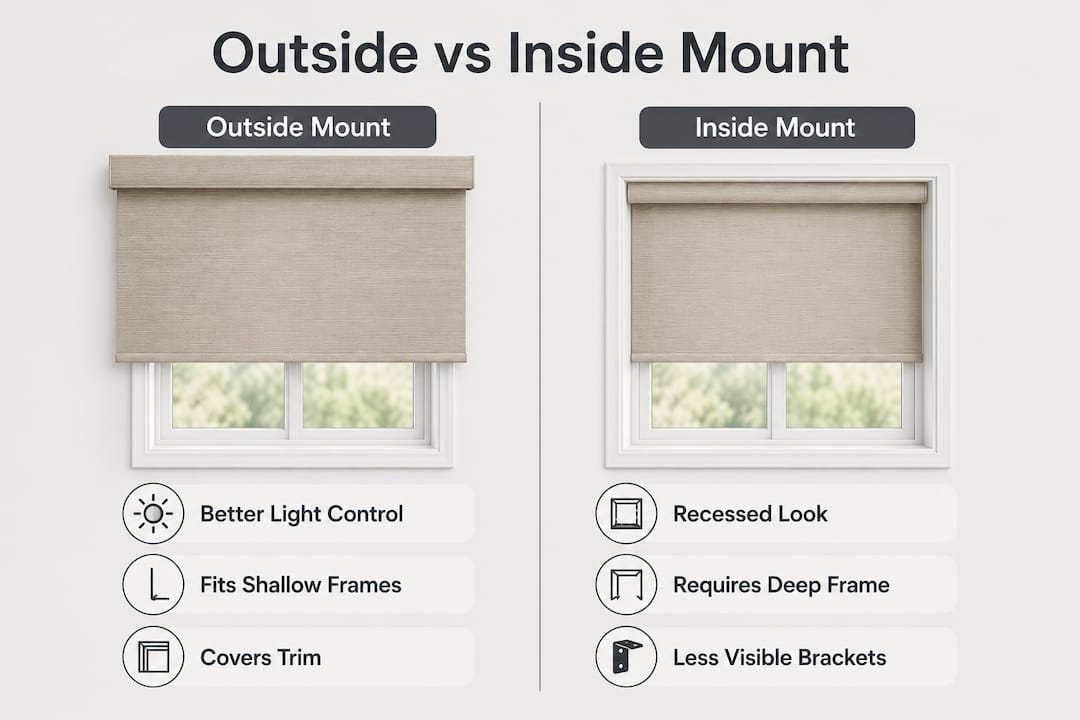
The second major benefit is compatibility with difficult windows. Windows with hardware such as cranks, handles, or locks inside the frame cannot accept inside-mounted blinds without blocking operation. Outside mounts clear all of that hardware entirely.
Outside mounts also work well when your window trim is damaged, stained, or simply outdated. Covering the entire frame hides imperfections and gives the window a clean, finished look without any trim replacement. That is a real cost saver for renters who cannot modify the property.
Here is a quick summary of the key advantages:
- Full light blocking: Overlapping the frame reduces edge gaps that inside mounts cannot eliminate.
- No frame depth required: Works on any window regardless of recess depth.
- Hides damaged trim: Covers unattractive or worn window surrounds completely.
- Clears window hardware: Cranks, handles, and locks stay fully accessible.
- Unobstructed views when raised: Raising the blinds completely exposes the full glass surface, letting in maximum light and view.
The main drawbacks are worth knowing. Mounting brackets are visible on the wall, which some homeowners find less polished than a recessed inside mount. Outside mounts also require clear wall space above and beside the window. In tight spaces where cabinets or trim sit close to the window edge, you may not have enough room for brackets.
Pro Tip: If your goal is a true blackout effect, choose outside mount blinds paired with a blackout fabric. The frame overlap combined with a blackout material blocks far more light than any inside mount can achieve.
How to measure and install outside mount blinds correctly
Measuring for outside mount blinds is more forgiving than measuring for inside mounts. Outside mounting allows for slight measurement variance because the blind sits on the wall surface rather than fitting inside a fixed recess. That said, accurate measuring still matters for a good result.
Follow these steps before you order:
- Decide your overlap. Plan to extend the blind 2 to 4 inches beyond the window frame on each side. This controls light gaps and affects how large the window appears.
- Measure the width. Measure the window frame from outside edge to outside edge. Add your chosen overlap on both sides. That total is your blind width.
- Measure the height. Measure from where you want the top of the blind to sit (usually 2 to 4 inches above the frame) down to the sill or floor, depending on your preference.
- Check for obstructions. Look for light switches, outlets, or trim molding that could interfere with bracket placement.
- Mark your bracket positions. Use a pencil and a level to mark bracket locations. Most blinds use two brackets for widths under 48 inches and three brackets for wider spans.
- Drill and mount brackets. Use wall anchors if you are not hitting a stud. Drywall anchors rated for the blind’s weight work well for most residential applications.
- Snap in the headrail. Clip the headrail into the mounted brackets and test the blind’s operation before finishing.
- Adjust and level. Check that the blind hangs level. Most headrails allow minor adjustment at the bracket before final tightening.
For a detailed walkthrough with diagrams, the outside mount measuring guide at Valueblindsdirect covers every window type. If you want to compare methods side by side, the step-by-step measuring guide walks through both mount types clearly.
Pro Tip: Always measure your window in three places (top, middle, and bottom for width; left, center, and right for height) and use the largest measurement. Walls and frames are rarely perfectly square, and the largest number prevents a blind that is too narrow to cover the frame properly.
How do outside mount blinds affect room decor?
Outside mount window treatments do more than cover glass. They frame the window as a design feature. Extending the blind beyond the frame draws the eye outward and upward, making the window appear wider and taller than it actually is. This optical effect benefits smaller rooms where natural light and perceived space matter.
The design impact goes further when you consider height placement. Mounting the blind close to the ceiling rather than just above the window frame creates the impression of higher ceilings. Interior designers use this technique consistently in apartments and compact rooms.
Outside mounts also give you more styling options:
- Valances and cornices: A decorative valance mounted above the blind conceals the headrail and brackets, giving the window a polished, built-in look.
- Layering with curtains: Outside-mounted blinds pair naturally with curtain panels because both sit on the wall. The curtain rod goes above the blind, and the two layers work together for light control and texture.
- Coordinating with trim color: Choosing a blind color that matches or contrasts intentionally with your wall or trim color turns the window into a focal point rather than an afterthought.
- Architectural compatibility: Outside mounts work on casement windows, sliding doors, bay windows, and picture windows where inside mounts either do not fit or look awkward.
The one styling consideration to plan for is bracket visibility. Decorative brackets in brushed nickel, matte black, or oil-rubbed bronze can complement your hardware rather than clash with it. Treating the bracket as part of the design rather than a problem to hide gives the window a finished, intentional look.
Key Takeaways
Outside mount blinds are the most practical and visually flexible mounting option for windows with shallow frames, hardware obstructions, or blackout requirements.
| Point | Details |
|---|---|
| Definition | Outside mounts attach to the wall or trim, not inside the window frame. |
| Frame depth | No minimum frame depth is required, making them ideal for shallow windows. |
| Light control | Extending 2–4 inches beyond the frame significantly reduces edge light gaps. |
| Aesthetic impact | Outside mounts make windows appear larger and allow layering with curtains. |
| Installation ease | Measurement is more forgiving than inside mounts, but accurate overlap planning is critical. |
Why I always recommend outside mounts for tricky windows
Homeowners often come to the outside mount decision reluctantly. They want the clean, recessed look of an inside mount but their windows simply will not cooperate. Shallow frames, cranks in the way, or trim that has seen better days all push the decision toward outside mounting.
My honest view is that outside mounts are underrated as a design choice, not just a fallback. When you mount a blind 3 to 4 inches above the frame and extend it generously on each side, the window reads as a deliberate design element rather than a functional afterthought. The room feels larger. The light control is better. And if you add a valance or pair the blind with curtain panels, the hardware disappears entirely.
The installation challenge I see most often is homeowners under-measuring the overlap. They extend the blind just past the frame by an inch, which is not enough to block light gaps or create the visual effect that makes outside mounts worth choosing. Go wider. Go higher. The extra few inches make a real difference in both function and appearance.
Renters especially benefit from outside mounts because they require only a few small holes in the wall above the window, which is far less invasive than other modifications. If your window trim is damaged or the frame is too shallow for anything else, outside mounting is not a compromise. It is the right answer.
— Sunny
Custom outside mount blinds at Valueblindsdirect
Valueblindsdirect offers a full range of outside mount window treatments, from aluminum blinds built for durability to natural bamboo blinds that add texture and warmth to any room. Every product is available in custom sizes, so you order exactly the width and height your measurements call for.

The Window Treatment Design Studio at Valueblindsdirect lets you visualize your selection before you buy. You can choose fabric, opacity, color, and mount type in one place. Motorized options, cordless lifts, and blackout fabrics are all available for outside mount configurations. Free swatches and expert support mean you can confirm your choice before committing to a full order.
FAQ
What is outside mount blinds in simple terms?
Outside mount blinds are window coverings that attach to the wall or trim above and around the window frame, rather than fitting inside the frame itself. They cover the entire window opening and surrounding trim.
What does inside mount mean for blinds?
Inside mount blinds fit within the window frame recess, sitting inside the opening. They require a minimum frame depth of at least 2 inches to accommodate the headrail without obstruction.
How far should outside mount blinds extend beyond the frame?
Extending the blind 2 to 4 inches beyond the window frame on each side is the standard recommendation. That overlap reduces light gaps and creates the visual effect of a larger window.
Are outside mount blinds harder to install than inside mounts?
Outside mounts are generally easier to install because measurement precision is more forgiving. The blind mounts on the wall surface rather than fitting inside a fixed recess, which allows for minor adjustments during installation.
Can outside mount blinds work on any window type?
Outside mounts work on virtually any window, including casement windows, sliding doors, bay windows, and picture windows. They are the only practical option for windows with frames shallower than 2 inches or with hardware obstructions inside the frame.
Recommended
- Outdoor Blinds: Transforming Outdoor Living Spaces
- Custom Blinds Benefits: Everything You Need to Know
- Motorized Exterior Shades: Boosting Comfort and Efficiency
- Stylish outside window blinds for comfort and efficiency

Value Blinds®
Trusted window treatments provider
Value Blinds® is a trusted provider of Greenguard, OEKO-TEX, and FSC-certified window treatments based in Portland, Oregon. Specializing in sustainable, motorized, smart-controlled, and outdoor-ready blinds and shades, the company is built on a foundation of simplified shopping, premium eco-friendly materials, and transparent pricing without the inflated cost.