

Article: Cut Sun Damage Keep Your View: Research Backed UV Blinds for Homeowners
Cut Sun Damage Keep Your View: Research Backed UV Blinds for Homeowners
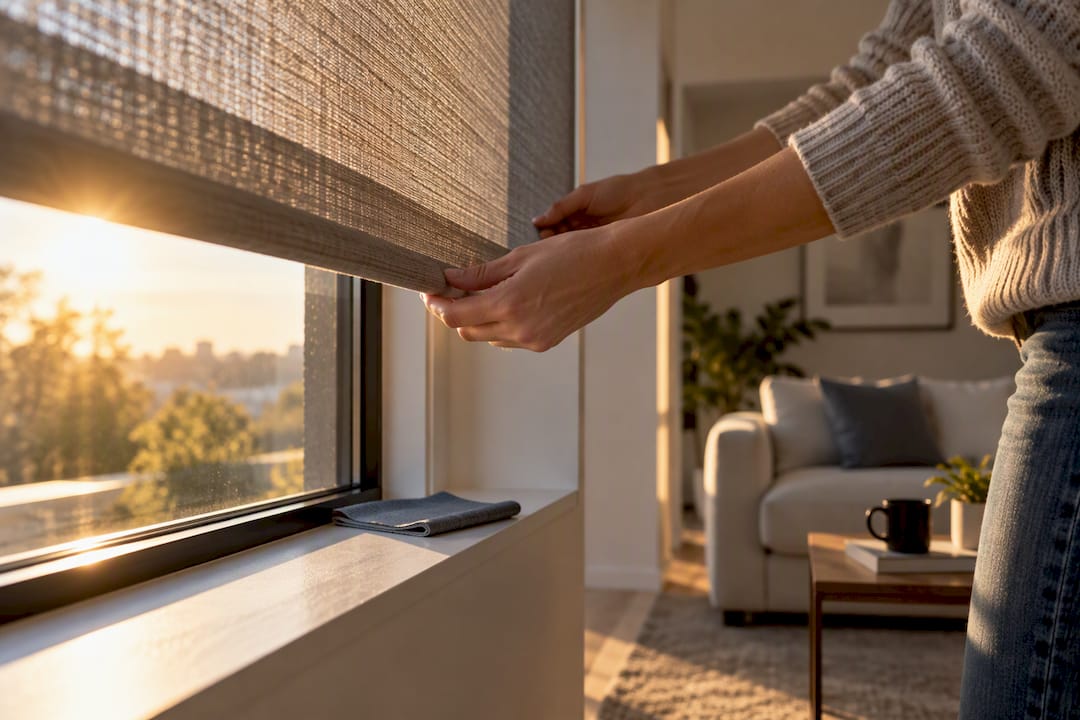
Solar (sunscreen) roller shades and tightly woven cellular shades are your best bet for cutting indoor UV, especially when you get full window coverage and pick a lower openness factor. Here’s why: standard window glass blocks most UVB, but UVA sails right through it, quietly fading floors, art, and furniture over time. 🌞
TL;DR:
- Tightly woven solar and cellular shades with lower openness factors provide the best UV protection, especially when covering the entire window area.
- The openness factor and visible transmittance ratings are crucial in determining how much UV and daylight pass through, with lower OF offering better control.
- Proper measurement, full coverage, and matching the openness factor to the window’s sun exposure are essential to maximize UV blocking and prevent furniture fading.
- Exterior solar screens intercept the sun before it reaches glass, offering stronger protection than interior shades alone for high-exposure windows.
- Fabric degradation from UV exposure over time may reduce shade effectiveness, so regular cleaning and swatch testing help maintain performance.
Table of Contents
- Types of UV-blocking window coverings and when to use each
- How UV blocking actually works: openness factor, Tv, and color
- How to choose the right UV blinds: a quick checklist
- Measuring and installation tips that preserve UV protection
- Maintenance, lifespan, and UV degradation: what to expect
- How Value Blinds Direct solves this for homeowners
- Priorities and final takeaway for homeowners
- Next steps with Value Blinds Direct
- Sources
- FAQ
Types of UV-blocking window coverings and when to use each
Not every shade does the same job, so let’s match the product to the problem you’re solving.
Solar (sunscreen) roller shades are the workhorse here: tightly woven fabric cuts glare and UV while often still letting you see outside, depending on the weave. Cellular (honeycomb) shades trap air in their pockets, which helps with both UV and your energy bill. Blackout roller shades are the heavy hitters for media rooms or bedrooms where zero light is the goal. Woven or natural shades bring texture and warmth but generally offer lighter UV protection unless lined. Exterior solar screens stop the sun before it even touches your glass, which is about as effective as it gets. And motorized versions of nearly any of these let you automate the schedule so you’re not chasing the sun around the house.
- Living rooms with big windows: solar shades that balance view and glare control.
- Media rooms or bedrooms: blackout roller shades for full light control.
- Sun-facing furniture or artwork: exterior screens or low-openness solar shades.
- Kitchens and casual spaces: woven or natural shades for texture without heavy blackout.
Curious about how these stack up side by side? Our UV-blocking window options guide breaks it down room by room.
How UV blocking actually works: openness factor, Tv, and color
Two numbers matter most on any solar shade spec sheet: openness factor (OF), which tells you how much of the fabric is actually open weave, and visible transmittance (Tv), which tells you how much daylight gets through. Lower OF generally means better glare and UV control, but less view. Higher Tv means more daylight, which is great in a north-facing room but can backfire on a west-facing one that already gets slammed with afternoon sun.
Here’s where it gets interesting: these numbers aren’t fixed. Research from Purdue and Lawrence Berkeley National Laboratory found that a shade’s optical properties shift depending on the angle the sun hits it, not just its openness factor and color, meaning a single “normal incidence” number on a spec sheet doesn’t tell the whole story. Lutron’s research, developed alongside Purdue, went further and built a View Clarity Index.pdf) that combines OF and Tv to predict how clear your view actually looks, and found that automated shades paired with the right fabric can match closed shades for glare control while letting in more daylight overall.
One figure worth remembering: the AERC’s measurement standard requires reporting both direct and diffuse transmittance, plus angle-dependent behavior, because a shade’s real-world performance changes throughout the day.
- South and west-facing rooms: lean toward a lower OF (tighter weave) to control heat and glare.
- North-facing rooms: a higher OF often works fine since direct sun exposure is limited.
- High-fade-risk windows (art, hardwood, leather furniture): prioritize low OF and darker colors over view clarity.
How to choose the right UV blinds: a quick checklist
Shopping for UV protection can feel like drowning in acronyms, so here’s the shortlist that actually matters.
- Confirm the shade will provide full window coverage, edge to edge, with no gaps.
- Choose your mount type (inside mount for a clean look, outside mount for better light blocking).
- Pick an openness factor suited to your window’s orientation (tighter for south/west, looser for north).
- Check the Tv rating and fabric color together, since dark, low-OF fabrics behave differently than light ones with the same OF.
- Verify child-safe, cordless controls if you have kids or pets at home.
- Review the warranty and return policy before you commit.
When you’re comparing vendors, ask directly: What’s the measured UV-block percentage, and under what test standard? What are the OF and Tv values, not just a marketing blurb? Is motorization available, and what does the warranty actually cover?
Pro Tip: If a manufacturer only gives you a single “UV block” percentage with no angle or durability data behind it, treat that number as a starting point, not a guarantee.
Red flags worth walking away from: no swatches available, vague or missing warranty terms, or spec sheets that only show best-case, straight-on sun numbers.
Measuring and installation tips that preserve UV protection
Even the best fabric loses its edge if it’s installed wrong, so measurement matters as much as material.
- For outside mount, add at least a couple of inches of overlap on each side to block light leaking around the edges.
- For inside mount, measure your window depth carefully. A shade that’s too shallow won’t seal against the frame.
- Extension brackets and top-down bottom-up options help with deep-set or oddly shaped windows.
- Exterior screens offer the strongest real-world protection since they intercept sun before it reaches your glass at all.
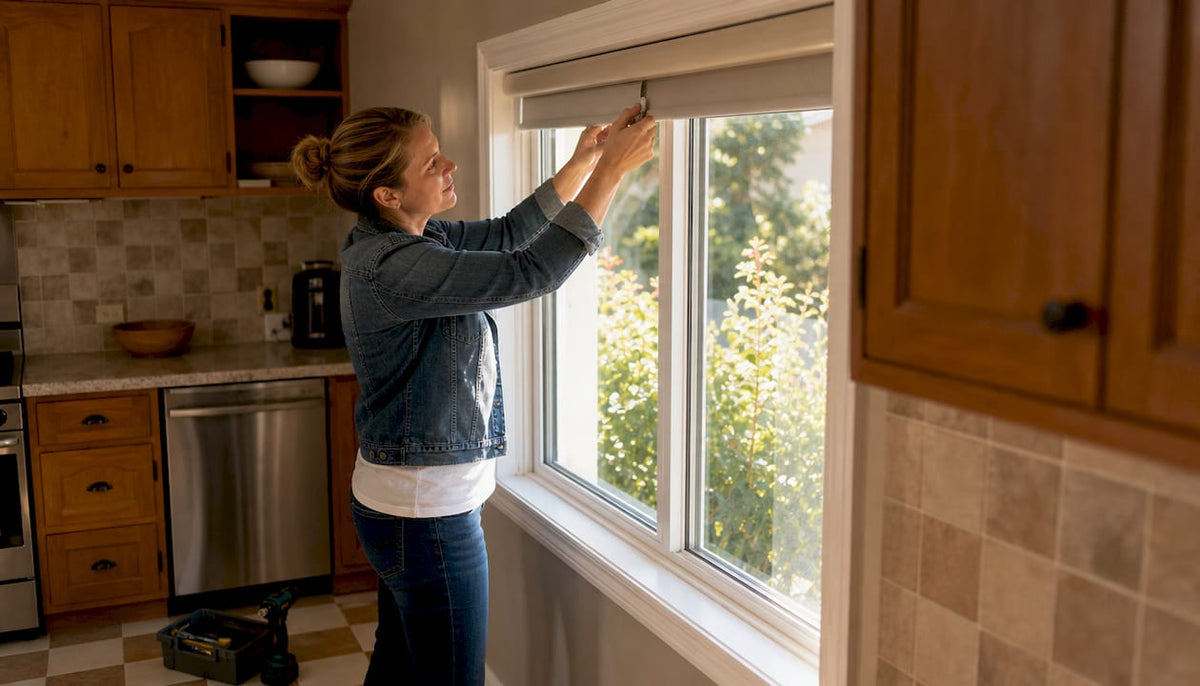
If you’re dealing with oversized glass, bay windows, or exterior mounts, professional measuring saves you from a costly redo. DIY works fine for standard rectangular windows, but complex openings are where a pro measure and install service earns its keep.
Maintenance, lifespan, and UV degradation: what to expect
Fabric doesn’t last forever under direct sun. UV exposure gradually breaks down fibers, a process sometimes called solarization, which can leave shades looking faded, brittle, or less optically consistent over the years.
- Dust or vacuum shades regularly with a soft brush attachment to avoid buildup that dulls the fabric.
- Spot clean rather than soaking fabric shades, which can distort the weave.
- Watch for visible discoloration, stiffening, or a change in how much light passes through: those are signs it’s time to check your warranty.
- Rotate or supplement heavily exposed windows with exterior shades, and order free swatches to double check color retention before a big order.
How Value Blinds Direct solves this for homeowners
This is exactly the gap our tools are built to close. Value Blinds Direct offers custom solar, roller, and cellular shade lines with measurement guides, a Window Treatment Design Studio, an energy calculator, and free fabric swatches so you can check openness factor and color in your own room before ordering. Since spec sheets don’t always tell the whole story, holding a swatch up to your actual window at different times of day is one of the most reliable ways to judge real glare and view performance. For high-exposure or complex windows, professional measure and install service, backed by warranties, can take the guesswork off your plate.

Priorities and final takeaway for homeowners
If you take one thing from all this: full coverage and the right openness factor for your window’s orientation matter more than any single “UV block” percentage on a label. Match OF to sun exposure, check Tv for daylight balance, and lean on swatches or a pro measurement when the stakes (fading floors, pricey furniture) are high.
— Sunny
Next steps with Value Blinds Direct
Ready to stop guessing and start seeing? You can order free swatches, explore openness factors in the Design Studio, and use professional measure and install services to help ensure your shades perform as expected.
Browse our full roller shades, zebra shades, cellular shades, and more to start building a window treatment plan that fits your home and your sun exposure.
Sources
- Solar Optical Properties of Roller Shades: Modeling Approaches, Measured Results and Impact on Energy Use and Visual Comfort
- AERC-1.1 Revision 5: Procedures for Determining the Optical and Thermal Properties of Window Attachment Materials
- Data on ultra-violet solar radiation and the solarization of window materials
FAQ
What blinds are best for UV protection?
Solar (sunscreen) roller shades and tightly woven cellular shades with a lower openness factor offer the strongest, most reliable UV protection while still allowing customizable light control. Exterior solar screens go a step further by blocking sun before it reaches your glass at all.
Does UV go through blinds?
A tighter weave with a lower OF and full window coverage significantly reduces how much gets through compared to an open, loosely woven fabric.
Do sunscreen blinds work?
Yes. Sunscreen (solar) shades are specifically woven to reduce glare and UV exposure while often preserving some outward view, and their performance is measured using openness factor and visible transmittance ratings rather than a single blanket claim. Choosing the right OF for your window’s sun exposure is what makes them effective in practice.
Is there a shade I can see out of but people can’t see in?
Solar shades with a moderate openness factor and a darker fabric color tend to give you daytime privacy while still letting you see outside, though this depends on lighting conditions on both sides of the glass. At night, with interior lights on, that privacy effect typically reverses, so a secondary blackout liner is worth considering for evening privacy.




%20roller%20shades%20and%20tightly%20woven%20cellular%20shades%20are%20your%20best%20bet%20for%20cutting%20indoor%20UV,%20especially%20when%20you%20get%20full%20window%20coverage%20and%20pick%20a%20lower%20openness%20facto...)