
Article: 1%–7% Openness: How Homeowners Pick Translucent Shades With Swatches
1%–7% Openness: How Homeowners Pick Translucent Shades With Swatches
A translucent shade is a light-filtering fabric that lets daylight pass through and spread across a room while blurring out anyone’s view of the details inside, so you get glow without a clear picture. The tradeoff is real: more openness means a better outside view but more glare, and less openness means better glare control but a dimmer, more closed-in feel. Before you buy, check the openness factor, the visible transmittance, the fabric color, and always test a swatch right on your own window. 🪟
TL;DR:
- Fabrics with an openness factor below 3% provide good glare control but may restrict outside views, while those above 6% enhance visibility but increase glare.
- Swatch testing during daytime and at night is essential to accurately assess privacy, light levels, and glare before purchase.
- For west-facing windows, selecting a lower openness factor than expected helps mitigate intense afternoon sunlight.
- Combining translucent shades with additional layers, such as room-darkening fabrics, improves privacy for nighttime use.
- Automated shading systems linked to lighting controls can offer energy savings, but effectiveness depends on window orientation and usage.
Table of Contents
- 1. What makes a shade “translucent,” anyway?
- 2. How translucent shades compare to sheer, blackout, and everything between
- 3. How do you choose the right translucent shade?
- 4. How do you test and install a translucent shade correctly?
- 5. Why we think testing beats guessing on translucent shades
- 6. Ready to try a translucent shade in your own window?
- Sources
- FAQ
1. What makes a shade “translucent,” anyway?
Two numbers do most of the talking on a translucent fabric’s spec sheet: openness factor (OF) and visible transmittance (Tv). Openness factor measures the tiny gaps woven into the fabric, and most common shading fabrics fall somewhere between 1% and 7%. A lower OF blocks more glare but gives you a fuzzier view outside; a higher OF opens things up visually but lets in more direct light and glare.

Color and weave density change how the same OF percentage feels in a room, since a darker fabric absorbs more light than a light one with an identical opening.
Designers sometimes reference standards like EN14501 and EN17037 to classify glare protection, though researchers caution that these thresholds were partly built through simulation and don’t always hold up across every fabric type.
- Openness factor (OF): the percentage of open weave in the fabric, typically 1% to 7% for common shades.
- Visible transmittance (Tv): how much visible light actually passes through, shaped by both OF and color.
- Standards like EN14501: used to classify glare protection, but treated as a guide rather than a guarantee.
A controlled study found that fabrics with an OF below 3% gave good glare protection but a poor outside view, while a charcoal fabric above 6% improved the view but let more glare through. That single data point explains why picking a shade by percentage alone rarely gets you exactly what you pictured.
2. How translucent shades compare to sheer, blackout, and everything between
Not every light-filtering fabric behaves the same way, and mixing them up is the fastest way to end up disappointed on install day. Here’s how the main categories stack up in daily use.
- Sheer shades let you see clear outlines through the fabric during the day and offer almost no privacy after dark once the lights go on inside.
- Translucent (light-filtering) shades diffuse daylight into a soft glow, hide sharp details from outside, and work well in bathrooms, dressing areas, and living rooms where you want brightness without a clear view in.
- Room-darkening shades cut most light and most view, a good middle ground for bedrooms where you want dimness without a full blackout.
- Blackout shades block nearly all light and all view, the pick for media rooms or bedrooms where total darkness matters more than glow.
Translucent fabric earns its spot when you want a room to feel bright and private at the same time, rather than choosing one or the other. If total darkness is the goal, pair it with a room-darkening layer instead of expecting one fabric to do both jobs.
3. How do you choose the right translucent shade?
Start by ranking what matters most to you: keeping the view, cutting glare, or holding daytime privacy. That priority decides where you land on the openness scale, since a fabric built for one goal often trades away another.
- Want the view? Lean toward a higher OF, knowing you’ll trade away some glare control.
- Want glare control? Lean toward a lower OF and accept a softer, more obscured view.
- Want daytime privacy? A tighter weave with a darker backing performs better, especially on street-facing windows.
- Care about nighttime privacy too? No single-layer translucent fabric fully delivers it once your lights are on, so plan for a second layer.
Always request swatches and check the OF and Tv listed on the product page rather than guessing from a photo. A dual-sided fabric, with a lighter face and darker backing, often gives better nighttime privacy without sacrificing daytime brightness. Decide on manual or motorized control too: DOE case studies on automated shading integrated with lighting controls show that operational adjustments, not just fabric choice, drive a lot of the comfort payoff. Finally, treat energy savings claims as conditional. Orientation, glazing, and how often you actually operate the shade all shape the real-world number.
Pro Tip: If your window faces west, pick a lower openness factor than you think you need. Afternoon sun is harsher than it looks on a showroom sample.
4. How do you test and install a translucent shade correctly?
Fabric that looks perfect on a swatch card can behave completely differently once it’s hanging in your actual window, so testing in place matters more than any spec sheet number.
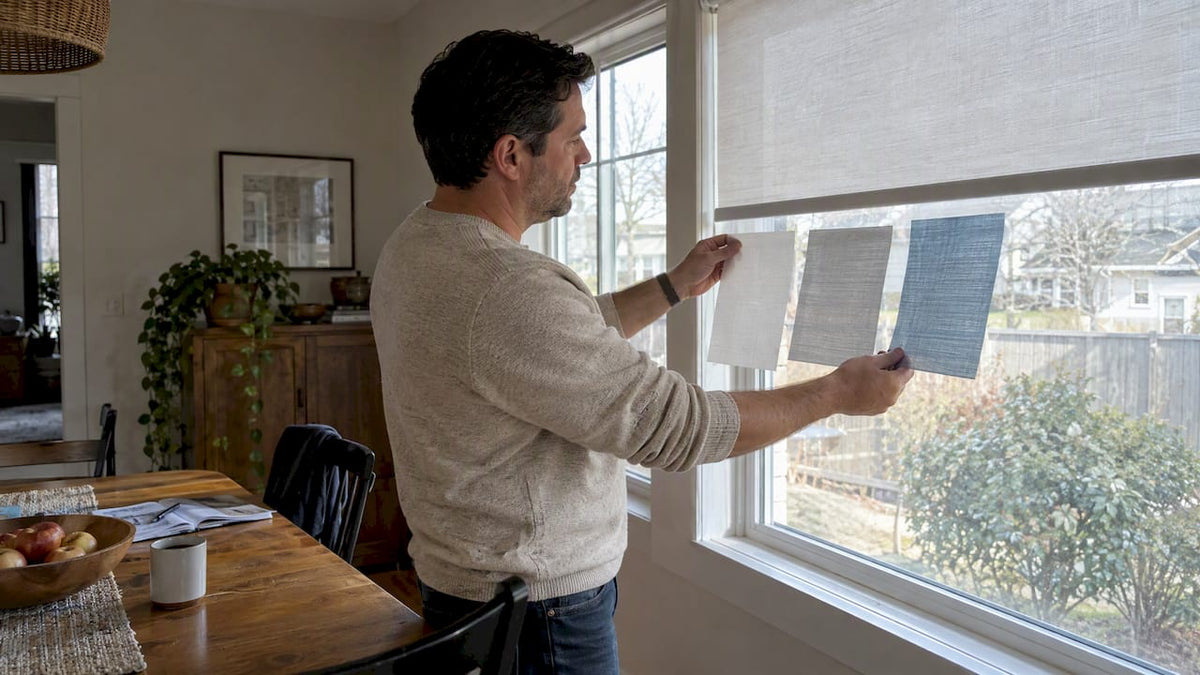
- Order swatches first. Never buy based on a screen photo alone.
- Tape the swatch over your glass and check it during the day, then again at night with your interior lights on, since that’s when privacy claims get tested for real.
- Try a temporary mock-up if you can, hanging a sample shade for a few days to see how light and view change across morning and afternoon.
- Mount tight to the frame or use wraparound returns to close the side gaps that let in stray light and let others see in from an angle.
- Layer a room-darkening or blackout shade behind the translucent one if nighttime privacy is a dealbreaker, rather than replacing the whole fabric.
- Clean gently with a vacuum brush attachment or damp cloth, since buildup on the weave dulls both light quality and the finish over time.
Partial lowering, tilting, or a scheduled automation tied to the sun’s position lets one fabric serve double duty: open for daylight in the morning, adjusted for glare by afternoon.
Pro Tip: Test your swatch on the actual window frame, not a wall inside the house. Light bouncing off nearby surfaces changes how translucent the fabric looks.
5. Why we think testing beats guessing on translucent shades

Most people pick a shade fabric the way they’d pick a paint color: from a small swatch under different lighting than their actual room. At Value Blinds, we lean on tools built for exactly that gap, including free swatches, measurement guides, a design studio, and energy calculators, so you’re testing in your own light before you commit.
Professional measuring, installation, and motorization options can help ensure the fabric choice is complemented by proper mounting and operation for best results.
— Sunny
6. Ready to try a translucent shade in your own window?
The easiest way to know if a translucent shade will work for your space is to hold one up to the glass yourself, and that starts with a free swatch. 
Value Blinds carries Roller Shades and Cellular Shades in light-filtering fabrics built for exactly this daylight-and-privacy balance, backed by warranties and flexible shipping.
- Free swatches: test fabric color and openness in your own light before you buy.
- Measurement support: options exist to help get sizing right whether measuring yourself or using professional services.
- Motorization options: automated shade controls can be scheduled to adjust with the sun for convenience.
Start at the main Value Blinds catalog, order a swatch, and try it taped to your window before you make the final call.
Sources
- User assessment of fabric shading devices with a low openness (KIT study)
- Beyond Widgets: Automated Shading Integrated with Lighting Controls (U.S. DOE)
- Window shades: selecting optical properties for visual comfort (BSA 2017 proceedings)
FAQ
What is the difference between translucent and sheer shades?
Sheer shades show clear outlines through the fabric during the day and offer very little privacy once interior lights are on at night. Translucent shades diffuse light into a soft glow and obscure defined shapes, giving you daytime privacy that sheer fabric doesn’t provide.
What openness factor is best for glare control?
Fabrics with an openness factor below 3% gave good glare protection in a controlled user study, though participants often found the outside view too limited and raised their shades to compensate.
Do translucent shades provide privacy at night?
Not on their own. Once your interior lights are on, a single-layer translucent fabric typically loses its privacy effect, which is why layering with a room-darkening shade or curtain is the common fix for nighttime privacy.
Can automated translucent shades really save energy?
Automated shading integrated with lighting controls has shown meaningful comfort and energy benefits in Department of Energy case studies, but results depend on your window’s orientation, glazing, and how often the system actually runs. Treat any energy figure as a possibility tied to your specific setup rather than a guaranteed outcome.
Where should I use translucent shades in my home?
Translucent shades work well in bathrooms, dressing areas, living rooms, and guest bedrooms where you want brightness and privacy without full blackout. For rooms needing total darkness, like a media room, pair translucent fabric with a room-darkening layer instead of relying on it alone.