
Article: Custom Outdoor Shades for Patios: Buy, Measure, Install
Custom Outdoor Shades for Patios: Buy, Measure, Install
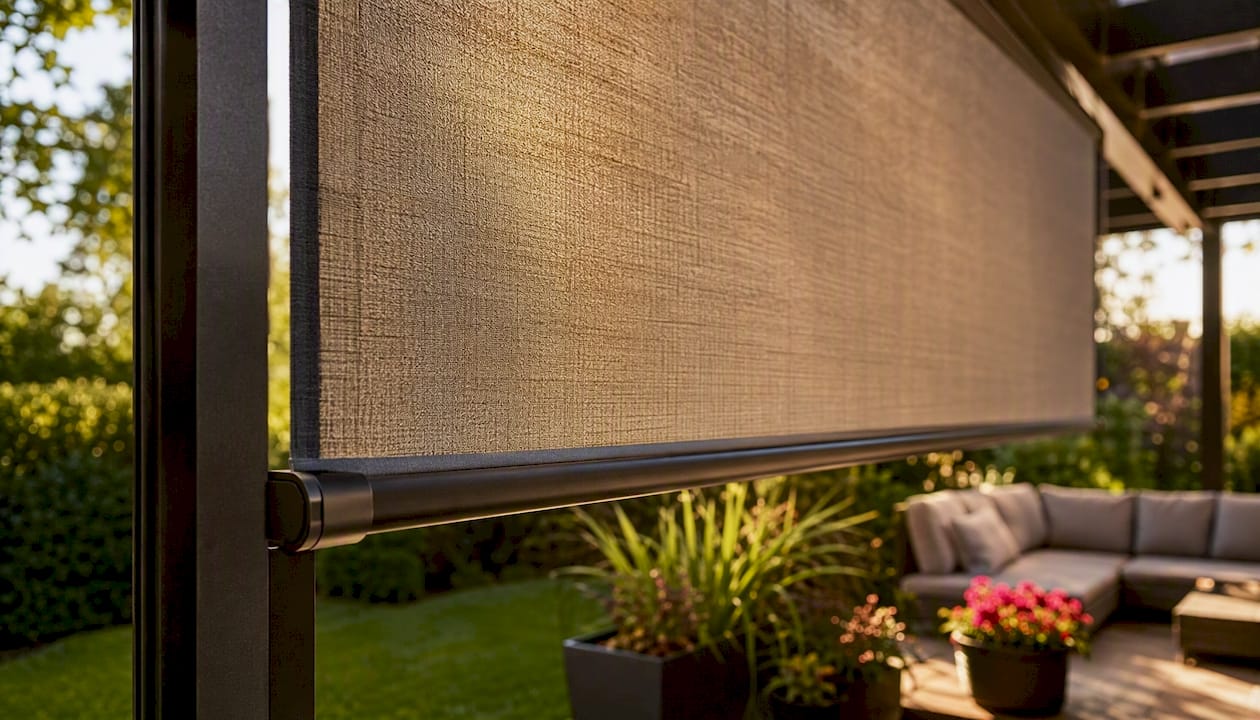
For most homeowners, a custom exterior solar roller shade or a motorized windproof sunshade is the smartest first choice. Both block UV rays before heat reaches your glass, they’re available in a range of openness factors for privacy or view-through, and they install on walls, soffits, or pergola beams without major construction. Your immediate next step: measure your opening (width at three points, then record the drop), then request free fabric swatches so you can see color and opacity in your actual light before you commit.
Two trust signals worth knowing up front: Valueblindsdirect offers a measurement guide and free swatches for its outdoor collection, and its motorized windproof sunshade line includes blackout-capable models built specifically for patio use. If your space is large, exposed to wind, or gets serious afternoon sun, motorized with a wind sensor is worth considering for the extra convenience and protection.
Key Takeaways
| Point | Details |
|---|---|
| Start with the right shade type | Exterior roller/solar screens fit most patios; motorized windproof systems suit large or wind-exposed openings. |
| Openness factor drives performance | A 1%–5% openness blocks the most heat and provides privacy; 10%–14% preserves your view but lets in more solar gain. |
| Measure three times, order once | Record width at top, middle, and bottom; use the smallest for inside mount or add overlap for outside mount. |
| Motorization pays off for large spans | Wind sensors extend shade life by preventing operation in unsafe gusts, especially on exposed decks. |
| Valueblindsdirect supports the full process | Free swatches, a measurement guide, a Perfect Fit Guarantee, and motorized windproof models are all available through the outdoor collection. |
Table of Contents
- What types of custom outdoor shades are right for your space?
- How does fabric choice affect heat, view, and durability?
- Manual, motorized, or somewhere in between?
- What do custom outdoor shades actually do for your home?
- How to measure for custom outdoor shades (step by step)
- DIY installation vs. hiring a pro
- What does a custom outdoor shade cost?
- Routine care, common problems, and what to check in warranties
- Your pre-order checklist before placing a custom shade order
- Why Valueblindsdirect is a practical choice for custom outdoor shades
- What homeowners actually end up choosing (and why)
- Valueblindsdirect makes ordering custom outdoor shades straightforward
- Sources
What types of custom outdoor shades are right for your space?
Not every shade type fits every situation, so matching the product to your space is the fastest way to narrow your options. Here’s a quick map:
- Exterior roller/solar screens: Best for sun control and glare on windows and covered patios. They mount flat against a wall or soffit, roll up out of the way, and come in dozens of fabric colors and openness levels. Great all-rounder for most homes.
- Motorized windproof patio shades: Best for large openings, frequent use, or wind-exposed decks. Sealed-track or cable-guided systems keep fabric taut in breezy conditions and pair well with remote or smart-home controls.
- Retractable awnings: Best for full overhead coverage on a patio or deck. Some motorized models reach custom frame widths of up to 40 feet, with optional LED lighting built in. More permanent feel, higher cost.
- Shade sails: Best for budget-conscious buyers who want a casual, airy look. Tensioned HDPE fabric can block up to 95% of UV rays while letting air circulate underneath, which keeps the space cooler than a solid canopy.
- Outdoor curtains: Best for privacy and style on a covered porch or pergola. Less effective for direct sun control, but they add softness and can layer with roller shades.
- Pergola/retractable canopy systems: Best for homeowners who want a semi-permanent outdoor room. Creative pergola shade combinations let you mix roller shades with a canopy roof for full coverage. Higher investment, but the result feels like a real room extension.
For windy locations, sealed-track systems and anchored structures are far more durable than free-standing umbrellas or simple sails. A pop-up canopy looks great until the first serious gust — and then it’s in your neighbor’s yard. 😅
How does fabric choice affect heat, view, and durability?
Fabric is where most of the performance lives, and the key number to understand is the openness factor: the percentage of open weave in the fabric.
You get maximum solar heat rejection and strong privacy, but your view through the shade is minimal. Valueblindsdirect’s style and efficiency guide walks through exactly how openness affects solar control and view-through for different orientations.
☀️ Heat reduction in perspective: According to The Spruce, shading strategies — from constructed overhangs to shade structures — can lower a home’s temperature by as much as 20°F in hot months. Exterior shades intercept solar heat before it reaches your glass, making them significantly more effective than interior blinds for cooling.
Material types and what they mean for you:
- HDPE/textilene mesh: Breathable, UV-stabilized, and resistant to mildew. Standard for solar roller shades and shade sails. Holds color well in high-UV climates.
- Coated polyester: Denser weave, often water-resistant or fully waterproof. Good for covered patios where rain occasionally blows in. Slightly less breathable than HDPE mesh.
- Blackout fabrics: Zero openness, full privacy, and maximum heat block. Ideal for a west-facing patio that turns into a furnace by 4 PM. Valueblindsdirect’s blackout outdoor solar shades are purpose-built for this scenario.
For coastal or high-wind sites, look for UV-stabilized HDPE or marine-grade coated polyester. These resist salt air and won’t degrade as quickly as standard fabrics. Pair them with weather-resistant windproof systems for the longest service life.
Pro Tip: Order swatches before you finalize your fabric code. Colors look very different in direct afternoon sun versus shade, and the openness factor feels different in person than it does on a screen.
Manual, motorized, or somewhere in between?
Control choice affects daily convenience more than almost any other decision. Here’s how the main options stack up:
| Control type | Best for | Upside | Downside |
|---|---|---|---|
| Manual roll | Small shades, low-use spaces | Lowest cost, no power needed | Inconvenient for large or high shades |
| Spring-assist / crank | Medium shades up to ~10 ft wide | Affordable, reliable | Still requires manual effort |
| Motorized (remote) | Large spans, frequent use | One-button convenience | Higher upfront cost |
| Motorized + wind sensor | Wind-exposed patios | Auto-retracts in gusts, extends shade life | Highest cost, needs power source |
| Solar/battery motor | Locations without hardwired power | No electrician needed | Battery maintenance, limited torque for very large shades |
| Smart-home integration | Tech-forward homes | Voice control, schedules, automation | Requires compatible hub/app |
Adding motorization and wind sensors does increase upfront cost, but it also protects the shade from operating in unsafe wind conditions, which extends product life. For a large deck shade you’ll raise and lower daily, the convenience alone justifies the upgrade. For a small window shade you adjust twice a season, a crank works fine.
Power options: hardwired 120V is the most reliable for large motorized shades. Low-voltage DC motors are quieter and easier to retrofit. Solar-charged battery motors are ideal when running a wire isn’t practical, though they have torque limits that make them better suited to shades under about 10 feet wide.
What do custom outdoor shades actually do for your home?
The short answer: they make your outdoor space usable for more hours of the day, protect what’s inside and outside, and can meaningfully reduce cooling loads. 🌿
🌡️ The cooling case: The Spruce notes that shading strategies can cut outdoor temperatures by up to 20°F. Exterior solar shades intercept radiant heat before it hits your glass — a position that makes them far more effective for cooling than any interior shade, which only blocks light after heat has already entered the room.
Beyond temperature, here’s what you actually get day-to-day:
- Glare reduction: A 3%–5% openness shade cuts screen-killing glare on a sun-facing patio without making the space feel dark.
- UV protection: HDPE shade sails block up to 95% of UV rays, protecting both your skin and your outdoor furniture from fading.
- Privacy: Lower openness fabrics and blackout options create a private outdoor room without a fence or wall.
- Furniture protection: Prolonged UV exposure bleaches cushions, warps wood, and degrades synthetic materials. A shade over your seating area extends the life of everything underneath it.
- Extended outdoor use: A west-facing patio is often unusable from 2 PM onward without shade. A well-placed exterior roller shade can reclaim those hours entirely.
For hot-climate homes or Texas-style sun exposure, the combination of a low-openness fabric and motorized control is the most practical setup for year-round comfort.
How to measure for custom outdoor shades (step by step)
Getting the measurements right is the single most important thing you can do before ordering. Custom shades are made to your exact dimensions, so a mistake here means a remake.
Step 1: Choose your mount type. Outside mount (shade covers the frame and surrounding wall) gives better light block and a cleaner look. Inside mount (shade fits within a recess) works for recessed openings. Most exterior patio shades are outside-mounted on a wall or soffit.
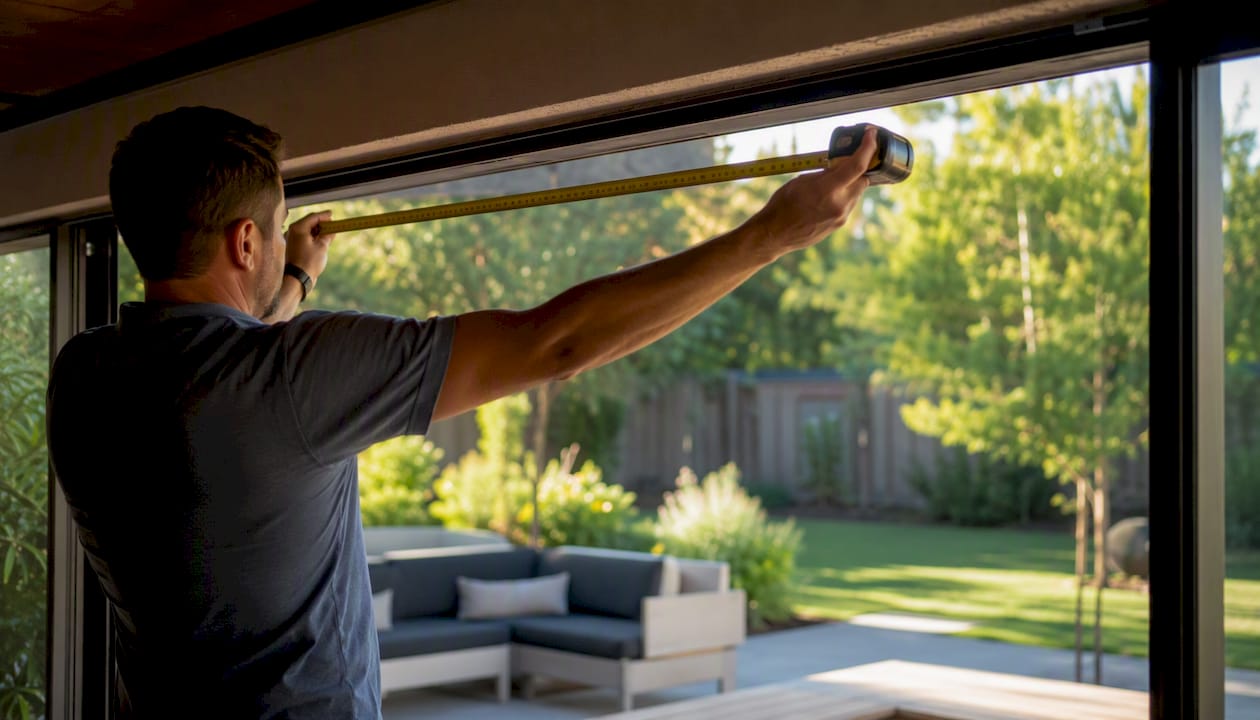
Step 2: Gather your tools. You need a steel tape measure (not a fabric one), a pencil, and a notepad or the measuring template below.
Step 3: Measure width at three points. Measure across the opening at the top, middle, and bottom. Record all three. Use the smallest measurement as your ordered width for an inside mount. For an outside mount, add the desired overlap on each side (typically 3–6 inches per side).
Step 4: Measure the drop. Measure from your intended mounting point (soffit, wall bracket, or pergola beam) straight down to where you want the shade to end. Add a few inches of clearance at the bottom if the shade will sit above a deck surface.
Step 5: Note your mounting surface and obstructions. Record whether you’re mounting to wood, stucco, concrete, or metal. Note any light fixtures, drain pipes, or door handles in the path of the shade.
Measurement template
Common mistakes to avoid:
- Measuring only once at one point — always measure at three heights.
- Forgetting to account for bracket depth (some brackets project 2–4 inches from the wall).
- Not recording the mounting surface — fastener type depends on it.
- Ignoring obstructions like door handles that the shade might catch when lowering.
Pro Tip: Many vendors, including Valueblindsdirect, offer a printable measuring sheet and video-assisted measure support. If your opening is unusually wide, has an angled soffit, or involves a pergola beam, request that support before ordering — it’s free and saves a costly remake.
DIY installation vs. hiring a pro
Most exterior roller shades under about 8 feet wide are genuinely DIY-friendly. The hardware typically includes wall brackets, a mounting bar, and screws. With a drill, a level, and a helper to hold the shade while you fasten brackets, you’re usually done in 1–3 hours.
When should you call a professional instead?
- Large spans (over 10–12 feet wide): heavy shades need precise bracket placement and often require two people plus a ladder.
- Sealed-track or cable-guided windproof systems: these require accurate track alignment; a few millimeters off and the fabric won’t travel smoothly.
- Hardwired motorization: running 120V wiring to an outdoor location is an electrician’s job in most jurisdictions.
- High-wind anchoring: coastal and exposed sites may need structural fasteners into masonry or steel framing, which requires knowing your wall construction.
🔧 Installation reality check: A professional installation typically adds scheduling time (a few days to a week for booking) plus onsite time of 2–4 hours for a standard patio shade. For windy patio situations, professional installation of a sealed-track system is often the difference between a shade that lasts a decade and one that fails in the first storm season.
Two common DIY pitfalls: using drywall anchors in stucco (they pull out under load — use masonry anchors instead) and spacing brackets too far apart for wide shades, which causes the tube to bow. Follow the manufacturer’s bracket spacing chart exactly.
What does a custom outdoor shade cost?
Price varies widely based on size, fabric, control type, and mounting complexity. Here are realistic ranges to help you budget:
These are illustrative ranges. Your actual quote depends on your specific dimensions, fabric selection, and local installation labor rates.
Before you finalize any order:
- Ask for an itemized quote that separates fabric, hardware, motorization, and installation.
- Confirm the production lead time in writing — custom manufacture takes time, and rush fees apply at some vendors.
- Ask about shipping method and damage policy (large shades ship as freight, not parcel).
- Confirm the return and warranty terms before you pay (see the next section).
For budget-minded buyers, pairing simple roller shades with low-cost outdoor decor can create a comfortable shaded space without a large upfront investment.
Routine care, common problems, and what to check in warranties
Custom outdoor shades are low-maintenance, but a little routine care goes a long way.
Routine care:
- Brush or rinse fabric with mild soap and water every few months. Avoid pressure washers on mesh fabrics — they can distort the weave.
- Lubricate roller tube bearings and track channels once a year with a silicone-based spray (not WD-40, which attracts dirt).
- In climates with hard freezes, retract shades fully and store fabric rolls indoors or in a weatherproof cover for winter.
- Check mounting brackets for rust or loosening fasteners each spring.
Common problems and quick fixes:
- Fabric fraying at edges: Usually caused by the shade rubbing against a rough bracket or track. Add a fabric edge tape or adjust bracket alignment.
- Motor not responding: Check the power source first (battery level or breaker). Most motors have a reset procedure — hold the up/down buttons simultaneously for 5 seconds.
- Sagging fabric: Often a sign the spring tension needs adjustment or the tube is bowing from inadequate bracket support. Add a mid-span bracket.
- Track binding: Clean the track channel and apply silicone lubricant. If binding persists, check that the track is still plumb — a shifted bracket can misalign the whole system.
What to check in warranty language before you buy:
- Does the fabric warranty cover fading and mildew, or just manufacturing defects?
- How long is the motor warranty? (Look for at least 2–3 years on motorized systems.)
- Is there a remake or Perfect Fit Guarantee if measurements are off?
- What’s the return window for custom orders, and are there restocking fees?
Your pre-order checklist before placing a custom shade order
Run through this before you click “order” — it takes five minutes and can save you weeks of back-and-forth. ✅
- [ ] Measured width at three points and recorded the smallest
- [ ] Measured drop from mounting point to desired bottom
- [ ] Confirmed mount type (inside vs. outside) and noted mounting surface
- [ ] Chosen fabric code and openness factor (and ordered swatches to confirm)
- [ ] Decided on control type (manual, crank, motorized, wind sensor)
- [ ] Confirmed power source for motorized option (hardwired, battery, solar)
- [ ] Noted any obstructions (door handles, lights, drain pipes)
- [ ] Confirmed lead time and production schedule in writing
- [ ] Asked about shipping method and damage policy
- [ ] Reviewed return policy and warranty terms
- [ ] Asked for technical specs (wind rating, UV rating, openness factor data sheet)
- [ ] Requested photos of similar installs from the vendor
Questions to ask your vendor:
- What’s the wind speed rating for this system?
- Can I see a sample photo of this fabric installed on a similar-sized opening?
- Is the warranty transferable if I sell the home?
Red flags to watch for:
- Vague warranty language (“covered at our discretion”)
- No swatch program — you should never buy outdoor fabric sight-unseen
- Unusually short lead times (under a week for custom manufacture) without a clear explanation
For a deeper look at what separates truly custom manufacturing from off-the-shelf options, this comparison is worth a read before you decide.
Why Valueblindsdirect is a practical choice for custom outdoor shades
Valueblindsdirect’s outdoor collection covers the full range of exterior shade options, from solar roller screens to motorized windproof systems, with product pages that list openness factor, UV ratings, and technical specs. That transparency matters when you’re comparing fabrics online without being able to touch them.
Here’s what stands out for buyers:
- Free fabric swatches: Order samples before committing to a fabric code. This alone prevents most color and opacity surprises.
- Measurement guide: Step-by-step instructions and support for inside vs. outside mount, with video-assisted options for tricky openings.
- Perfect Fit Guarantee: Remake coverage if your custom order doesn’t fit as specified.
- Motorized windproof product line: The Value Blinds™ Motorized Outdoor Windproof Sunshades, including blackout-capable models, address the two most common patio pain points: afternoon heat and wind instability.
- Professional installation support: Available where offered, with guidance on when to DIY and when to hire.
Pro Tip: *Use the free swatch program even if you’re confident about the color.
What homeowners actually end up choosing (and why)
Here’s the honest version of how most people land on their final choice.
For a large west-facing deck, motorized almost always wins. Manually rolling a 12-foot shade every afternoon gets old fast, and the convenience of a remote or a scheduled timer is something homeowners say they wish they’d done from the start. Wind sensors are the upgrade that feels unnecessary until the first time a gust shreds an unretracted shade.
The combination that surprises people most? A pergola with roller shades on two or three sides. It creates a genuinely enclosed outdoor room that feels private and cool, without the permanence of a full enclosure. Pair it with some thoughtful outdoor living design and you’ve essentially added a room to your home for a fraction of the cost of a real addition.
Order swatches. Seriously. 😊
Valueblindsdirect makes ordering custom outdoor shades straightforward
Getting the right shade for your patio doesn’t have to mean weeks of research and a contractor visit. Valueblindsdirect gives you free fabric swatches, a step-by-step measurement guide, and an online configurator so you can spec your shade, choose your openness factor, and select motorization options from your phone or laptop.
The Value Blinds™ Motorized Outdoor Windproof Sunshades are the standout product for homeowners dealing with wind exposure or intense afternoon sun. Blackout-capable models are available for patios that need full heat block, and the product pages include technical specs so you know exactly what you’re ordering. For design help or a guided consultation, the Window Treatment Design Studio walks you through fabric, size, and control options with expert support. Start by requesting your free swatches from the outdoor collection and take it from there.
Sources
- 33 Cool Shade Ideas for Your Patio or Backyard | The Spruce