
Different Styles of Blinds: Choose the Best for Every Room
The main blind styles every homeowner should know are Venetian/horizontal, vertical, roller, Roman, cellular/honeycomb, pleated, panel-track, woven/bamboo, sheer/zebra, mini/micro, exterior, and motorized/cordless. Each one solves a different problem, and picking the wrong style for your room is the most common (and most avoidable) mistake people make. Here’s a quick-match to get you started:
- Bedroom (blackout sleep): Blackout roller shades or cordless cellular shades
- Energy savings / insulation: Cellular or honeycomb shades featuring single or multiple cell construction
- Sliding doors or patio: Panel-track blinds or vertical blinds
- Bathroom or kitchen (humidity): Faux wood or PVC blinds suitable for moisture-prone areas
- Formal living room or dining room: Real wood Venetian blinds or Roman shades
- Home office (glare control): Sheer or zebra shades, or aluminum Venetian blinds
- Child safety: Options without exposed cords or motorized blinds in every room
- Covered patio or casual living: Woven or bamboo blinds and exterior shades
Not sure about your exact window size? Order free swatches before you commit, and use a measurement guide to avoid the ugh-moment of a blind that doesn’t fit.
Key Takeaways
Cellular/honeycomb shades deliver the best insulation of any blind style. Cordless options are the safest choice for homes with children, and faux wood or PVC is the only sensible pick for humid rooms like bathrooms and kitchens.
| Point | Details |
|---|---|
| Insulation winner | Cellular/honeycomb shades (double-cell) trap air and reduce heat transfer better than any other style. |
| Child safety default | Choose cordless or motorized blinds for every room where children or pets are present. |
| Humid rooms | Use faux wood or PVC blinds in bathrooms and kitchens; real wood warps with moisture exposure. |
| Sliders and wide windows | Panel-track or vertical blinds minimize stack-back and match sliding door motion best. |
| Measure before you order | Always measure at three points (top, middle, bottom) and order free swatches before finalizing a custom blind. |
| Valueblindsdirect | Offers custom blinds in every major style, with cordless, motorized, and moisture-rated options plus free swatches and warranty support. |
Table of Contents
- What counts as a “blind” and how it differs from a shade
- The different styles of blinds explained: a full catalog
- How to choose the right blind for your room
- Materials, light control, and energy efficiency: what actually matters
- Measuring, installation options, and what things cost
- Child safety, accessibility, and motorization basics
- Why this guide is reliable and what resources to use when ordering
- The one thing most homeowners get wrong about choosing blinds
- Valueblindsdirect makes custom blinds easy, from swatches to installation
- Sources
What counts as a “blind” and how it differs from a shade
The word “blind” gets used loosely, so let’s clear it up fast. A window blind is any window covering built from adjustable slats or panels that tilt, stack, or fold to control light. Venetian blinds (horizontal slats), vertical blinds, and mini blinds all fit this definition cleanly. Shades, by contrast, are made from a single piece of fabric or material that raises, lowers, or folds without individual slats. Roman shades, roller shades, and cellular shades are technically shades, not blinds.
In everyday American retail language, though, “blinds” covers both categories. You’ll see roller shades, Roman shades, and cellular shades sold right alongside Venetians on every major window-treatment site, including here. This guide uses the broader definition because that’s what you’re actually shopping for.
When do you pick blinds (slat-style) over shades? Slat blinds give you more precise light direction control, they’re easy to wipe clean, and they tend to look more structured. Shades offer a cleaner, more minimalist look and often provide better insulation (especially cellular styles). For privacy without total blackout, sheer shades or zebra shades are hard to beat. For a bathroom where you want moisture resistance and easy cleaning, faux wood slat blinds win. One more thing: shutters are a separate category entirely, with rigid frames and panels mounted to the window itself. They’re not covered in this guide, but they’re worth knowing exist so you don’t confuse them with blinds.
The different styles of blinds explained: a full catalog
Here’s every major style you’ll encounter, with the details that actually matter for your buying decision. Industry sources group these under the broad window blind umbrella, and for good reason: each one solves a distinct set of problems.
1. Venetian (horizontal) blinds
The classic. Venetian blinds use horizontal slats, typically in aluminum, real wood, or faux wood, that tilt to control light angle and stack neatly when raised. They’re the most recognized window covering in American homes.
Best for: Living rooms, home offices, bedrooms, and any room where you want precise control over light direction.
Materials: Aluminum (budget-friendly, moisture-tolerant), real wood (warm, premium look), faux wood (moisture-resistant, warp-proof).
Pros:
- Excellent light direction control via slat tilt
- Easy to clean (wipe with a damp cloth)
- Available in dozens of slat widths and finishes
Cons:
- Horizontal slats collect dust faster than fabric shades
- Real wood warps in humid rooms
Typical price range: Economy aluminum starts low; real wood custom sizes move into mid-to-premium territory.
Motorization: Available, especially on wider or heavier wood versions.
Pro Tip: Before ordering wood Venetians, hold a swatch near your window in both morning and afternoon light. Wood tones shift dramatically depending on the direction your window faces.
2. Vertical blinds
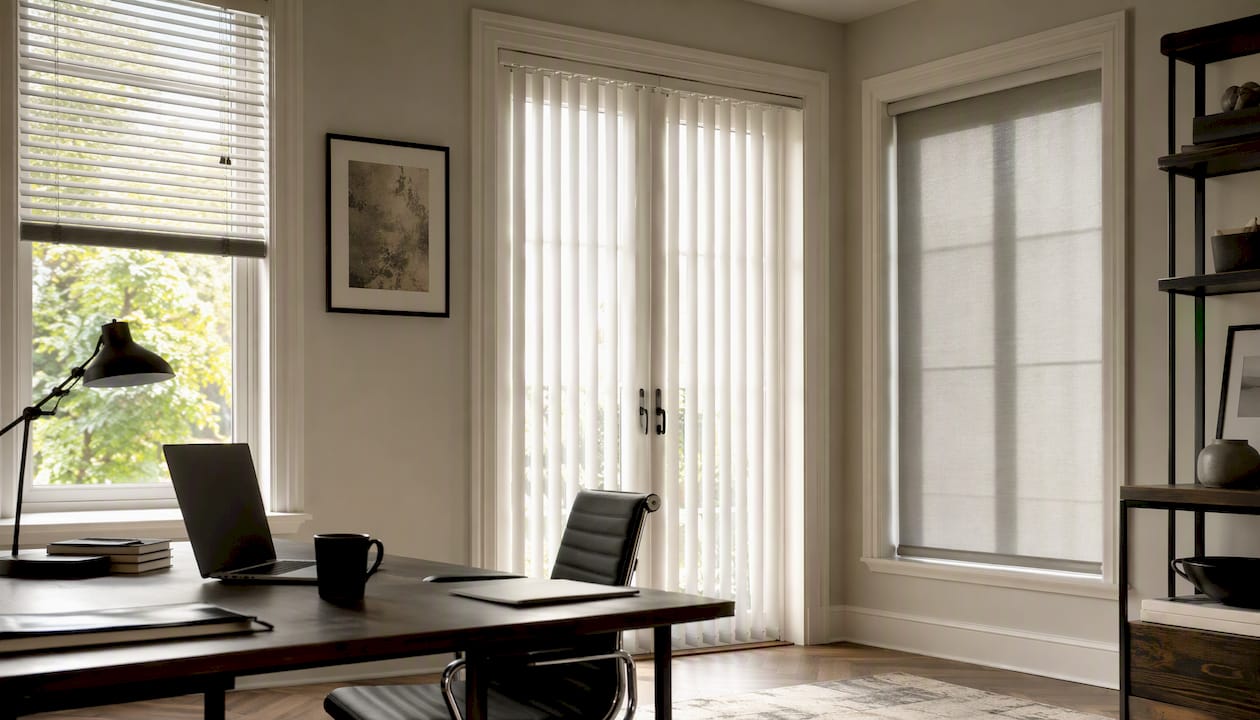
Vertical blinds hang from a top track and pivot on a vertical axis, making them the go-to for sliding glass doors and wide picture windows. As selection guidance confirms, large sliding doors perform best with vertical or panel-track styles because they match the door’s side-to-side motion.
Best for: Sliding doors, patio doors, floor-to-ceiling windows, and wide expanses.
Materials: Fabric, PVC, faux wood, or vinyl.
Pros:
- Minimal stack-back (they don’t eat up much window space when open)
- Easy to replace individual slats if one gets damaged
- Good light control for wide windows
Cons:
- Can feel dated in some interiors
- Fabric versions need more careful cleaning
Typical price range: Generally affordable; fabric upgrades push the price up.
Motorization: Available and increasingly popular for large patio doors.
3. Roller shades
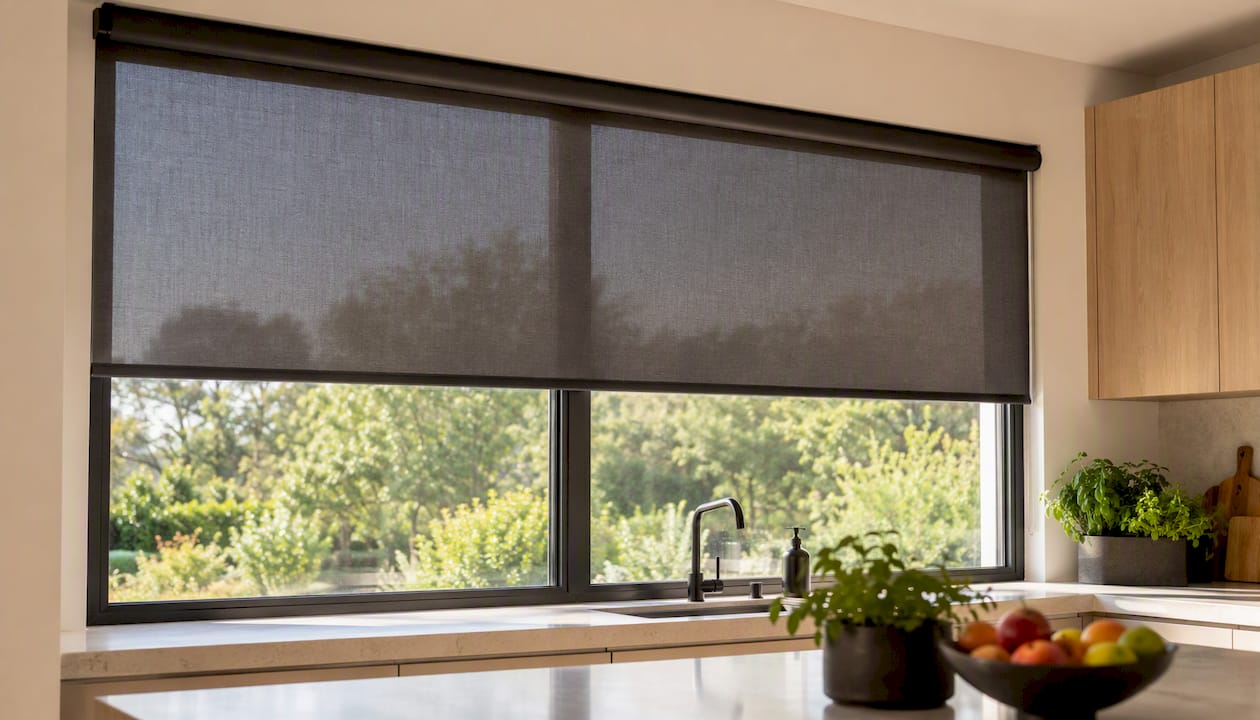
Roller shades are a single piece of fabric that rolls up onto a tube at the top of the window. Simple, clean, and incredibly versatile. Roller blinds are available in blackout, translucent, and sheer fabrics, and motorized versions integrate smoothly with smart-home systems like Google Home or Amazon Alexa.
Best for: Bedrooms (blackout), kitchens, bathrooms, home offices, and any room where you want a minimal look.
Materials: Polyester, PVC-coated fabric, solar mesh, or blackout-lined fabric.
Pros:
- Extremely low-profile when raised
- Easy to clean (wipe or spot-clean)
- Wide range of opacity options (sheer to full blackout)
Cons:
- No slat-tilt option, so light control is all-or-nothing unless you layer
- Basic versions can look plain in formal rooms
Typical price range: One of the most affordable styles; motorized versions add cost.
Motorization: Widely available and one of the most popular styles to motorize. 🤖
4. Roman shades
Roman shades fold into horizontal pleats when raised, creating a soft, tailored look that works beautifully in formal or transitional spaces. They’re technically a shade (single fabric panel), but they’re sold and styled alongside blinds everywhere.
Best for: Living rooms, dining rooms, bedrooms, and anywhere you want fabric softness with structure.
Materials: Cotton, linen, polyester blends, or blackout-lined fabrics.
Pros:
- Elegant, designer look
- Available with blackout or light-filtering linings
- Fabric options are nearly unlimited
Cons:
- More complex to clean than hard blinds
- Fabric can fade near south- or west-facing windows without UV protection
Typical price range: Mid-range to premium, depending on fabric and custom sizing.
Motorization: Available on many custom Roman shade options.
5. Cellular (honeycomb) shades
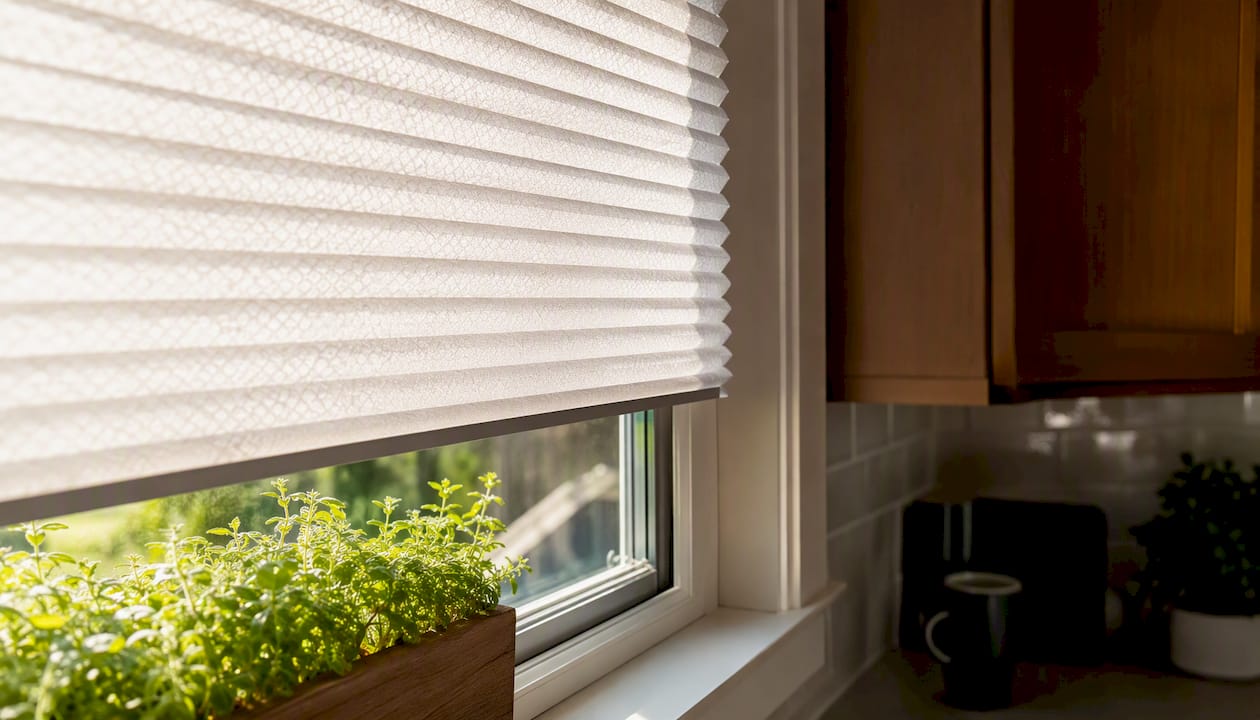
Cellular shades are the energy-efficiency standout of the group. Their pocketed honeycomb cell structure traps air between the window and your room, reducing heat transfer in both directions. Honeycomb shades use this pocketed cell construction to improve thermal performance when fitted correctly, and double-cell versions outperform single-cell on insulation. For a deep dive on how fit and cell count affect performance, Valueblindsdirect’s cellular shades insulation guide is worth reading before you order.
Best for: Bedrooms, living rooms, and any room where energy bills are a concern. Also great for odd-shaped windows.
Materials: Polyester fabric in various opacities (light-filtering to blackout).
Pros:
- Best insulation of any blind or shade style
- Available cordless, motorized, or top-down/bottom-up
- Soft, clean look
Cons:
- Harder to clean than hard blinds (fabric cells trap dust)
- Not ideal for very humid rooms without moisture-rated versions
Typical price range: Mid-range; double-cell and motorized versions move toward premium.
Motorization: Widely available. Motorized cellular shades are a popular upgrade for bedrooms and hard-to-reach windows.
6. Pleated shades
Pleated shades look similar to cellular shades but use a single layer of crisp, accordion-folded fabric instead of the honeycomb cell structure. They’re lighter, often less expensive, and still offer a clean, modern look.
Best for: Bedrooms, home offices, and rooms where you want a fabric look without the full cost of cellular.
Materials: Polyester or fabric blends, available in light-filtering or room-darkening options.
Pros:
- More affordable than cellular
- Compact stack when raised
- Good range of fabric colors and patterns
Cons:
- Less insulating than cellular (no air-trapping cell structure)
- Can look less substantial than Roman or cellular styles
Typical price range: Economy to mid-range.
Motorization: Available on select styles.
7. Panel-track blinds
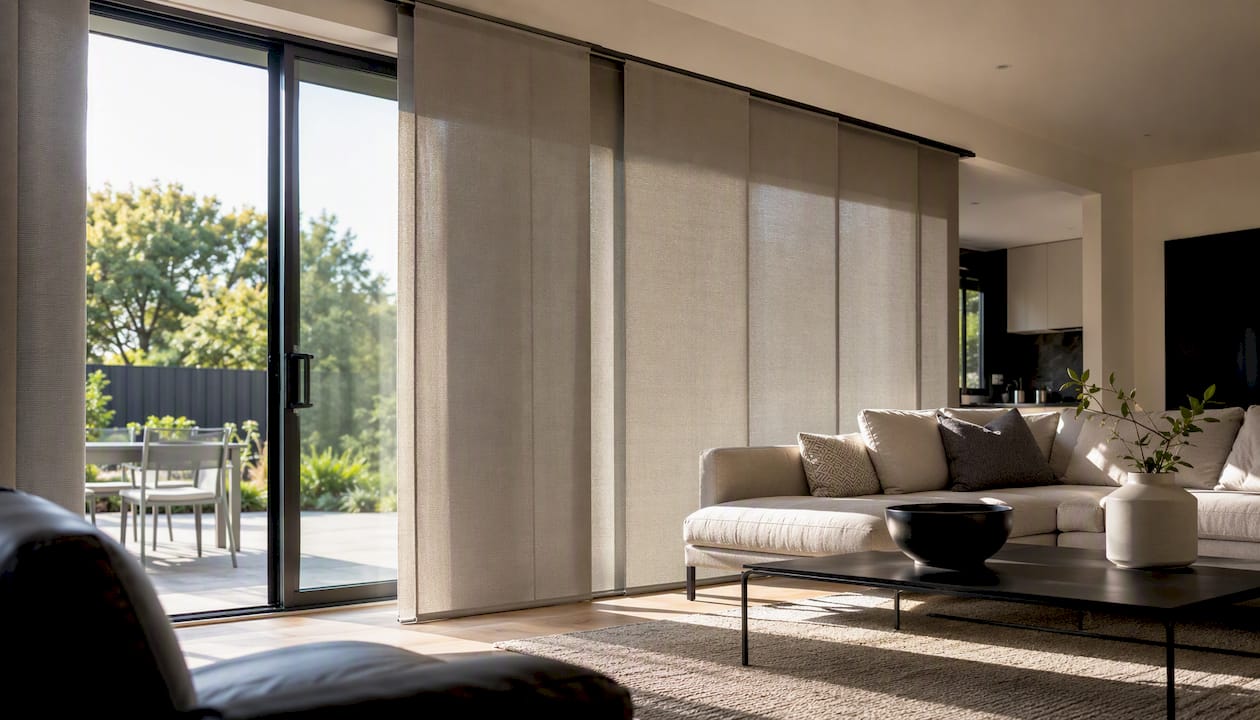
Panel-track blinds (sometimes called Japanese panels or sliding panels) use large fabric panels that glide along a top track. They’re the modern, design-forward answer to the sliding door problem, and they work equally well as room dividers. For sliding and bifold door setups, panel-track blinds minimize stack-back and match the door’s motion, which makes them far more practical than most alternatives. If you’re also thinking about your door style itself, it’s worth checking out how barn, sliding, and bifold doors compare before finalizing your window treatment plan.
Best for: Sliding doors, patio doors, large windows, and open-plan room dividers.
Materials: Fabric, woven grass, or solar mesh panels.
Pros:
- Clean, architectural look
- Easy to operate on wide openings
- Panels can be mixed for a layered effect
Cons:
- Requires adequate wall space for panels to stack when open
- Not ideal for small or standard-sized windows
Typical price range: Mid-range to premium depending on panel fabric.
Motorization: Available on motorized track systems.
8. Woven/bamboo/natural shades
Woven shades bring texture and warmth that no synthetic material can fully replicate. Made from bamboo, grasses, reeds, or jute, they filter light softly and add a casual, organic feel. Natural woven and bamboo-style blinds are valued for their texture and casual aesthetics, though material choice matters for outdoor or covered patio use. For a motorized option that keeps the natural look, woven shades with motorization are now widely available.
Best for: Living rooms, sunrooms, covered patios, and casual dining spaces.
Materials: Bamboo, jute, seagrass, rattan, or woven wood.
Pros:
- Unique texture and natural warmth
- Eco-friendly material options
- Pairs beautifully with linen, cotton, and natural fiber furnishings
Cons:
- Not moisture-proof (avoid in bathrooms or very humid kitchens)
- Light gaps at the edges (not a blackout option without a liner)
Typical price range: Mid-range; motorized versions move toward premium.
Motorization: Available on select woven shade collections.
9. Sheer/dual/zebra shades
Zebra shades (also called dual shades or day-night shades) alternate between sheer and opaque fabric bands. Slide the bands to align sheer-on-sheer for a soft, diffused look, or opaque-on-opaque for privacy. It’s a genuinely clever design that gives you two light settings in one shade. For a motorized version with blackout capability, zebra shades with smart control are worth a look.
Best for: Living rooms, home offices, and any room where you want flexible daylighting without sacrificing privacy.
Materials: Polyester fabric in various opacity combinations.
Pros:
- Flexible light control without switching shades
- Modern, layered look
- Available motorized for easy daily adjustment
Cons:
- Not a full blackout option (even in closed position, some light passes)
- Fabric requires gentle cleaning
Typical price range: Mid-range; motorized versions add cost.
Motorization: Widely available and highly recommended for this style. ✨
10. Mini and micro blinds
Mini blinds use 1-inch slats; micro blinds use 1/2-inch slats. Both are aluminum or vinyl, lightweight, and designed for smaller windows or spaces where a standard 2-inch Venetian would feel bulky.
Best for: Small windows, bathroom windows, studio apartments, and rental properties.
Materials: Aluminum or vinyl.
Pros:
- Very affordable
- Easy to install and replace
- Good light control for small windows
Cons:
- Can feel flimsy on wider windows
- Thin slats bend easily if handled roughly
Typical price range: Economy, one of the most budget-friendly options available.
Motorization: Rarely available; these are typically manual.
11. Exterior blinds and outdoor shades
Exterior blinds mount outside the window frame and block heat before it even enters the glass. That’s a meaningful difference from interior shades, which trap heat between the blind and the window. They’re also great for covered patios, pergolas, and outdoor living spaces.
Best for: South- and west-facing windows with heavy sun exposure, covered patios, and pergola enclosures.
Materials: Solar mesh, PVC, aluminum, or weather-resistant fabric.
Pros:
- Block heat at the source (before it enters the room)
- Protect furniture and flooring from UV fading
- Extend outdoor living space usability
Cons:
- Exposed to weather (require more durable materials and maintenance)
- Installation is more complex than interior options
Typical price range: Mid-range to premium, depending on size and material.
Motorization: Available and especially practical for large exterior shades.
12. Motorized and cordless blinds
Motorized and cordless aren’t a single style, they’re an upgrade available across most of the styles above. Cordless blinds eliminate the exposed lift cord entirely, which is the single most important child-safety upgrade you can make. Motorized roller blinds integrate with smart-home controls and eliminate cords altogether, improving both convenience and safety. Cordless options also simplify installation and are a great fit for renters who want a clean look without drilling. Browse cordless and no-drill options if you’re renting or just want a faster setup.
Best for: Homes with children or pets, hard-to-reach windows, smart-home setups, and accessibility needs.
Power options: Battery, rechargeable battery, hardwired, or solar-powered.
Pros:
- No exposed cords (child and pet safe)
- Works with Alexa, Google Home, and other smart-home systems
- Scene programming and scheduling available
Cons:
- Battery versions need periodic recharging or replacement
- Hardwired versions require an electrician
Typical price range: Adds a cost premium over manual versions of the same style.
Quick comparison: which style fits your situation?
| Criteria | Best style(s) |
|---|---|
| Best for sliding doors/patio | Panel-track, vertical |
| Best insulation/energy savings | Cellular/honeycomb (double-cell) |
| Best for humid rooms (bath/kitchen) | Faux wood, PVC, aluminum Venetian |
| Best blackout for sleep | Blackout roller, blackout cellular |
| Best formal/designer look | Roman shades, real wood Venetians |
| Best light flexibility | Zebra/dual shades, Venetian slats |
| Best for child safety | Cordless or motorized (any style) |
| Best budget option | Mini blinds, basic roller shades |
| Best for natural texture | Woven/bamboo shades |
| Best for large windows | Panel-track, vertical, wide Venetian |
| Best for energy-conscious upgrades | Cellular, exterior shades |
| Best for smart-home integration | Motorized roller, motorized cellular |
How to choose the right blind for your room
The biggest mistake homeowners make is starting with aesthetics and working backward to function. Flip that. Start with what the room actually needs, then find a style that looks great within those constraints.
Step 1: Function first. What does this room demand? A bedroom needs blackout capability and privacy. A kitchen needs moisture resistance and easy cleaning. A living room usually needs flexible light control, not full blackout. A home office needs glare reduction without losing daylight entirely. Nail this filter first and you’ll eliminate half the options immediately.
Step 2: Window type and size. Selecting a blind type should begin with the window kind and room use. Sliding doors point you straight to panel-track or vertical. Tall, narrow windows suit horizontal Venetians. Odd-shaped or arched windows often need pleated or cellular shades, which can be custom-cut to fit unusual shapes. Wide picture windows work well with panel-track or wide-slat Venetians.
Step 3: Material suitability. Humid rooms (bathrooms, kitchens, laundry rooms) need faux wood, PVC, or aluminum. Real wood warps. Fabric shades in high-humidity spaces can develop mildew. Rooms with heavy UV exposure benefit from solar mesh or UV-blocking fabrics that protect your furniture and flooring.
Step 4: Budget and installation. Here’s a realistic breakdown by band:
| Budget band | What you get | Common styles |
|---|---|---|
| Economy | Basic function, standard sizes, manual operation | Mini blinds, basic roller shades, PVC verticals |
| Mid-range | Custom sizing, better fabrics, cordless options | Faux wood Venetians, pleated shades, zebra shades, woven shades |
| Premium | Custom sizing, premium materials, motorization | Real wood Venetians, Roman shades, double-cell cellular, motorized options |
Step 5: Safety and automation. If you have kids or pets, cordless is non-negotiable. Motorized blinds go further, eliminating cords entirely and adding scheduling and voice control. For mobility-limited users, motorized options with remote or voice control make a real difference in daily comfort.
Your three next steps: Order swatches (free from Valueblindsdirect) before finalizing any custom order. Measure carefully using a measurement guide. And if you’re upgrading from corded blinds, consider cordless or motorized as your default.
For coordinating your blinds with your interior finishes, interior door style guidance can help you think through how door and window treatments work together in the same space.
Materials, light control, and energy efficiency: what actually matters
Cellular shades are the clear winner for insulation. Their honeycomb pocket structure traps air between the window glass and your room, slowing heat transfer in both directions. Cellular shades reduce heat transfer by trapping air, and double-cell versions outperform single-cell because they create two air barriers instead of one. Fit matters too: a cellular shade that’s too narrow leaves gaps at the sides where heat escapes freely.
Layering window coverings is another approach designers use to improve performance. Layered window coverings, cellular shades, and blackout linings can reduce seasonal heating and cooling losses and save money over time. A sheer roller shade paired with a blackout cellular shade gives you full flexibility: diffused daylight during the day, full insulation and blackout at night.
Here’s how materials break down by room and performance need:
- Real wood: Best for living rooms and dining rooms where humidity is low and aesthetics are a priority. Avoid in bathrooms, kitchens, and basements.
- Faux wood/PVC: The smart choice for bathrooms and kitchens where moisture is a constant. They look nearly identical to real wood but won’t warp or crack.
- Aluminum: Durable, easy to clean, and moisture-tolerant. Great for high-traffic areas and humid spaces. Not the warmest look, but hard to beat for practicality.
- Woven/natural fibers: Casual, textured, and beautiful in sunrooms and covered patios. Not moisture-proof, so keep them away from steamy kitchens and bathrooms.
- Solar mesh (roller shades): Blocks UV and glare while preserving your view. Ideal for home offices and south-facing windows where you want daylight without the heat.
- Blackout fabric: Worth the extra cost in bedrooms and media rooms. A blackout lining on a Roman shade or roller shade gives you fabric aesthetics with full light block.
For practical tips on reducing energy bills with your window treatment choices, Valueblindsdirect’s energy-efficient window coverings guide covers the specifics in detail.
Measuring, installation options, and what things cost
Getting the measurement right is the step most people rush, and it’s the one that causes the most returns. Here’s the short version: measure twice, order once.
Inside mount vs. outside mount. An inside mount sits within the window frame for a clean, recessed look. You need at least 2–3 inches of depth in the frame for most blinds (cellular and Roman shades need more). An outside mount covers the frame and can make a window look larger. It’s also the better choice when your frame is too shallow or when you want to maximize light blockage at the edges.
How to measure for inside mount:
- Measure the width at the top, middle, and bottom of the window opening. Use the narrowest measurement.
- Measure the height on the left, center, and right. Use the longest measurement.
- Most custom blind manufacturers (including Valueblindsdirect) will deduct a small amount for clearance, so order to your exact measurements.
For outside mount: Measure the area you want the blind to cover, adding at least 1.5–2 inches on each side and 2–3 inches above the frame for full light blockage.
Common measuring mistakes to avoid:
- Measuring only once (windows are rarely perfectly square)
- Forgetting to account for window handles or cranks that stick out
- Ordering inside mount without checking frame depth first
- Skipping the swatch step and ordering a color that looks different on screen than in your actual lighting
Installation options:
DIY installation works well for most roller shades, Venetians, and cordless blinds. Most come with a standard bracket system and a basic drill. Cordless and no-drill options are even easier and are a great fit for renters. Professional installation makes sense for motorized systems (especially hardwired), large exterior shades, and panel-track systems on wide openings.
Cost drivers: Custom sizing, motorization, premium fabrics (real wood, designer linen), and professional installation all push the price up. Standard-size roller shades and mini blinds are the most affordable entry points. Motorized double-cell cellular shades on a large window represent the premium end.
Pro Tip: Always order a free swatch before finalizing a custom order. Colors look different on a screen than they do in your actual room light, and fabric textures are impossible to judge from a photo.
Child safety, accessibility, and motorization basics
Cord safety is not optional if you have young children or pets in the home. Exposed lift cords on traditional blinds are a documented strangulation hazard, and the fix is straightforward: go cordless or motorized.
Child-safety checklist:
- Choose cordless blinds as the default for any room children use
- If corded blinds are already installed, secure cords with cord cleats or tensioners mounted high on the wall
- Keep furniture away from windows so children can’t climb near cords
- Check that any existing corded blinds meet current safety standards
Motorized blinds go a step further by eliminating cords entirely. Motorized roller blinds integrate with smart-home systems and are increasingly the standard for new installations in homes with children. The cordless and no-drill collection at Valueblindsdirect covers both safety and renter-friendly installation in one category.
Motorization power options:
- Battery-powered: Easiest to retrofit into existing windows. No wiring needed. Batteries typically last several months to a year depending on use. The tradeoff is periodic battery replacement or recharging.
- Rechargeable battery: A step up from disposable batteries. Most use a USB or solar charging cable. Good balance of convenience and low maintenance.
- Hardwired: No battery maintenance ever. Requires an electrician for installation, but once it’s in, it’s seamless. Best for new construction or full renovation projects.
- Solar-powered: Charges from sunlight through a small panel near the window. Works well for south- and east-facing windows with consistent sun exposure.
Pro Tip: Battery-powered motorized blinds are the right call for retrofitting an existing home without rewiring. Hardwired is worth the installation cost only if you’re already doing electrical work in the room.
For users with limited mobility, motorized blinds with remote control, voice control (Alexa, Google Home, Apple HomeKit), and scene programming make daily life genuinely easier. You can schedule blinds to open at sunrise and close at sunset without touching them. That’s not a luxury feature anymore; it’s a practical accessibility tool. ♿
Why this guide is reliable and what resources to use when ordering
This guide draws on industry buyer guides, independent home-design coverage, and technical resources covering blind construction, insulation performance, and safety standards. Every style recommendation is grounded in function, installation reality, and safety, not aesthetics alone.
When you’re ready to order, here are the trust signals worth looking for:
- Measurement guides: A good vendor provides step-by-step inside and outside mount instructions. Valueblindsdirect’s measurement resources walk you through both.
- Free swatches: Non-negotiable before a custom order. Colors and textures don’t translate accurately from a screen.
- Warranty information: Look for clear warranty terms on both the product and the hardware (brackets, motors). Valueblindsdirect includes warranty details with its products.
- Moisture-rated products: For bathrooms and kitchens, confirm the product is specifically rated for humidity. Faux wood and PVC options from Valueblindsdirect are designed for these environments.
- Motorization specs: Check whether a motorized blind uses battery, rechargeable, hardwired, or solar power before ordering. This affects installation complexity and long-term maintenance.
Valueblindsdirect’s Window Treatment Design Studio is a practical starting point if you want guided help with measurements and style selection before committing to a custom order.
The one thing most homeowners get wrong about choosing blinds
The conventional wisdom says: pick a style you like, then figure out the specs. That’s exactly backward, and it’s why so many people end up with beautiful Roman shades that warp in their steamy bathroom, or real wood Venetians that look stunning for six months and then buckle from humidity.
Function has to come first. Not because aesthetics don’t matter (they absolutely do), but because a blind that fails at its primary job is a blind you’ll replace in two years. Faux wood in a bathroom isn’t a compromise; it’s the smarter choice. A cordless cellular shade in a bedroom isn’t settling; it’s the option that actually performs.
The other thing that gets underestimated: layering. Designers who work with window treatments daily rarely spec a single shade and call it done. A sheer zebra shade for daytime privacy paired with a blackout roller for sleep is a combination that outperforms either option alone. It costs more upfront, but it gives you genuine flexibility instead of a one-size-fits-all solution that works okay in every situation and perfectly in none.
And one more thing: order the swatches. Every time. No exceptions. The number of custom orders that come back because the color looked different on screen than it did in the actual room is staggering. A swatch takes a few days and costs nothing. A wrong custom order costs real money and real time.
Valueblindsdirect makes custom blinds easy, from swatches to installation
Picking the right blind style is the hard part. Getting it ordered, measured, and installed doesn’t have to be. Valueblindsdirect offers custom blinds and shades across every major style covered in this guide, including cordless and motorized upgrades, blackout and light-filtering options, and moisture-rated faux wood for kitchens and bathrooms.
Start with free swatches so you can see exactly how a fabric or finish looks in your actual room light. Then use the Window Treatment Design Studio for guided measurement help and style selection. When you’re ready to browse, the full blinds collection covers everything from budget-friendly roller shades to premium motorized cellular options, all backed by warranty and expert support. Ready to upgrade? Order your free swatches and get your measurements in today.
Sources
- Window blind
- Window Blinds: Types, Materials and How to Choose
- Window Blinds: Which Style Is Best For You?
- 6 of the most popular types of blinds explained (plus style inspo)