
Dual Roller Shades: Stylish Versatility for Your Home
TL;DR:
- Dual roller shades combine light-filtering and blackout fabrics in one sleek system, offering independent control for versatile daylight and privacy management. They outperform single-layer shades in light spectrum, design flexibility, and room-specific functionality, especially in bedrooms and media rooms. Reliable, well-constructed, and customizable, these shades enhance comfort and style while ensuring lasting performance beyond smart features.
Most homeowners assume window shades come with a trade-off: go with a light-filtering fabric and lose privacy at night, or choose blackout and sit in total darkness during the day. That assumption is wrong, and dual roller shades prove it. These window treatments house two separate fabric layers in a single mounting system, giving you the power to control daylight, privacy, and ambiance at any time of day without swapping anything out or compromising on style. This article breaks down what dual roller shades are, how they work, how they compare to single-layer options, and what to consider before you buy.
Table of Contents
- What are dual roller shades?
- How dual roller shades work: Operation and control
- Comparing dual roller shades: Benefits versus single shades
- Design, customization, and practical considerations
- What most reviews won’t tell you about dual roller shades
- Explore dual roller shades for your home
- Frequently asked questions
Key Takeaways
| Point | Details |
|---|---|
| Flexible light control | Dual roller shades give you both blackout and filtered-light options in the same window system. |
| Independent operation | Each fabric layer can be operated separately, letting you easily switch between privacy and natural light. |
| Smart features optional | Motorized and smart controls are convenient but physical reliability matters most; choose tested models. |
| Broad customization | Dual roller shades offer many colors, fabrics, and style options to match your interior design. |
What are dual roller shades?
Dual roller shades are exactly what the name suggests: two roller shades installed together within one headrail (the mounting bar at the top of the window). One fabric is usually a light-filtering material that softens incoming sunlight while preserving your view. The other is a blackout layer that blocks light entirely for full privacy and darkness. Instead of choosing one or the other, you get both in a clean, unified package.
What makes them genuinely useful is the independent control. Both fabrics can be controlled independently or together, which means you can lower just the light-filtering layer during the afternoon for a soft, diffused glow, then add the blackout layer at night for complete privacy. You can also raise both fully to enjoy an unobstructed view on a beautiful day.
From a design standpoint, dual roller shades look streamlined and modern. Because both fabrics sit within the same headrail, there is no bulky layering of curtains and blinds, no mismatched hardware, and no visual clutter. They suit a wide range of interior styles, from minimalist apartments to cozy family rooms.
Here is a quick summary of what you get with a dual roller shade system:
- Two fabrics in one unit: Light-filtering and blackout layers in a single headrail
- Independent operation: Raise or lower each layer separately or together
- Full-range light control: Soft ambiance, filtered daylight, or complete blackout
- Modern aesthetic: Clean lines that complement any room style
- Custom sizing: Available in exact dimensions to fit your specific windows
For a deeper look at how fabrics affect your daily light experience, our light filtering roller shades guide walks you through the most popular fabric weights and their effects on room brightness. If you are just starting to explore this product category, the custom roller shades guide covers the fundamentals from measurement to material selection.
How dual roller shades work: Operation and control
Understanding the mechanics helps you choose the right system for your lifestyle. Dual roller shades come in two primary operational styles: manual and motorized. Each has real advantages, and the right choice depends on how you live in your home.
Manual operation uses a chain, pull cord, or simple pull bar to raise and lower each fabric independently. The system is mechanical and straightforward. You pull one chain to lower the light-filtering shade during the day, then pull a second chain in the evening to bring down the blackout layer. Manual systems are reliable, require no power source, and rarely break down. They are often the smarter choice for rooms where you want simplicity without the added cost of motors.
Motorized operation replaces the chains with quiet electric motors embedded in the headrail. You control both shades using a handheld remote, a wall switch, or a smartphone app. Motorized dual shades also support smart-home integrations with platforms like Google Home, Amazon Alexa, and Apple HomeKit. That means you can program your shades to open automatically at sunrise or close at sunset, all without lifting a finger.
Here is how a typical daily routine looks with motorized dual roller shades:
- Morning: Schedule the light-filtering layer to rise automatically at 7 a.m., letting natural light wake you up gently.
- Midday: Use the app to lower the light-filtering shade halfway to reduce glare on screens while keeping the room bright.
- Afternoon: Raise both layers fully to enjoy an open view and maximum natural light during a sunny afternoon.
- Evening: Lower the light-filtering layer first for a warm, ambient glow during dinner.
- Night: Drop the blackout layer with a single tap for complete darkness and privacy.
One important reality check: smart-home automations can be less reliable than the physical shade mechanism itself. Wi-Fi outages, app updates, or integration hiccups can disrupt scheduled routines, but your remote or wall switch will almost always still work. Physical operation is the backbone of any motorized system. Treat the smart features as a bonus layer of convenience, not the foundation.
Pro Tip: If you are setting up smart control shades for the first time, pair them with a dedicated remote rather than relying entirely on app connectivity. Remotes work even when your Wi-Fi is down. For energy-conscious homeowners, remote roller shades that respond to sunlight levels can meaningfully lower your heating and cooling bills by blocking heat gain in summer or retaining warmth in winter.
Comparing dual roller shades: Benefits versus single shades
After understanding how dual roller shades work, it helps to see them next to the traditional alternatives. The comparison is not always flattering for single-layer shades.
“The system can operate a light-filtering shade and a blackout shade as separate elements within one unit, giving homeowners full control at every hour of the day.”
This capability is the single biggest functional advantage dual shades hold over traditional options. Here is how the two compare across the factors that matter most to homeowners:
| Feature | Dual roller shades | Single roller shades |
|---|---|---|
| Light control range | Full spectrum, blackout to soft filter | Limited to one setting |
| Privacy options | Layered, adjustable at any time | Fixed to fabric choice |
| Design flexibility | Two coordinating fabrics in one unit | One fabric per window |
| Installation complexity | Moderate, same headrail for both | Simple |
| Motorization option | Yes, available for both layers | Yes, one layer only |
| Cost | Higher upfront, greater long-term value | Lower upfront |
| Aesthetic impact | Clean, layered, modern look | Simple, functional |
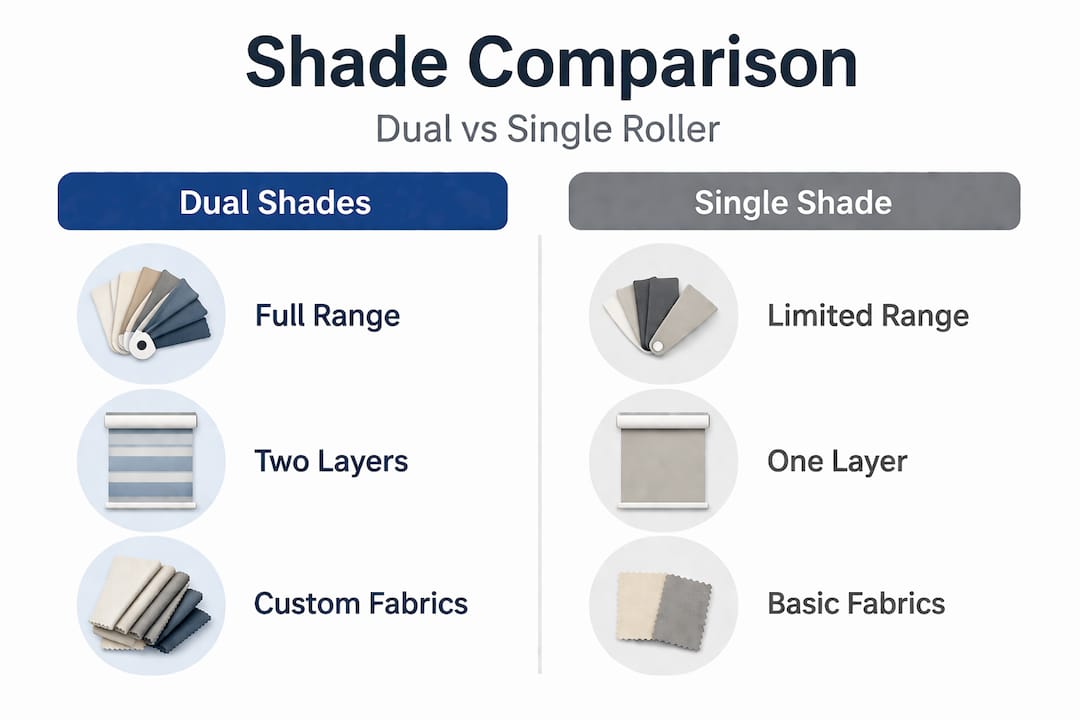
Single roller shades are not bad products. They do their job well when your needs are straightforward. But if you want morning softness and nighttime blackout from the same window without installing two separate treatments, a single shade simply cannot deliver that.
Here are the specific scenarios where dual shades clearly outperform single options:
- Bedrooms: You need total darkness for sleep but soft morning light to wake up naturally
- Living rooms: Glare reduction in the afternoon without sacrificing your evening view
- Home offices: Consistent, adjustable light throughout the workday without constant manual adjustment
- Media rooms: Instant blackout when the screen goes on, natural light when it goes off
Explore the full range of roller shade fabric options to see how different textures and weaves affect light diffusion. And if you are weighing your options for a specific room, the comfort and style roller shades resource shows how fabric selection directly affects ambiance.
Design, customization, and practical considerations
Once you decide dual roller shades are the right fit, the fun part begins: choosing how they will look and function in your space. The customization options available today are genuinely impressive and go far beyond picking a color.
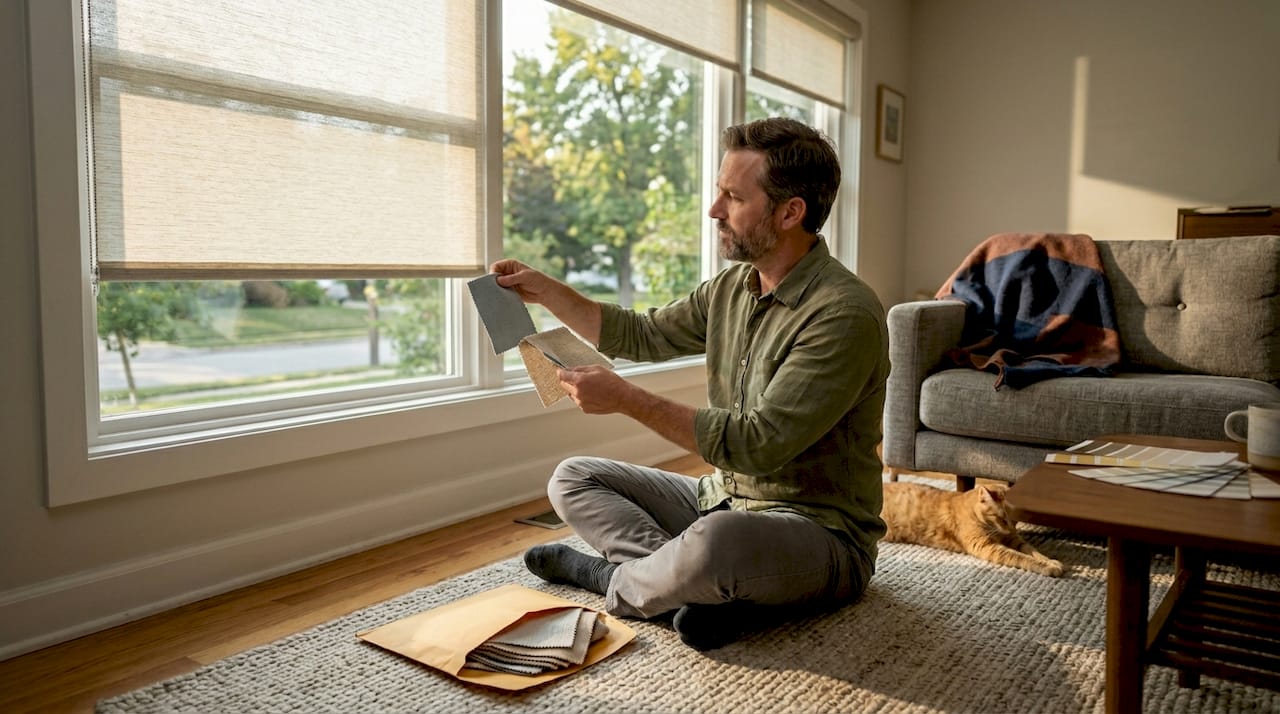
Both fabrics in a dual roller system can be chosen separately, meaning your light-filtering layer might be a warm linen texture while your blackout layer is a clean white or charcoal. This lets you create a layered visual effect that looks intentional and polished rather than mismatched.
Here is a breakdown of the key design and customization factors to consider:
| Customization factor | What to think about |
|---|---|
| Fabric type | Sheer, light-filtering, or blackout for each layer |
| Color and texture | Coordinate with your wall color, furniture, and flooring |
| Headrail finish | White, black, or brushed aluminum to match hardware |
| Mount type | Inside mount for a clean look, outside mount for larger coverage |
| Operating system | Chain, cordless, motorized, or smart-enabled |
| Width and height | Exact custom dimensions to fit your window precisely |
Installation is worth thinking through early. Many dual roller shades ship with straightforward mounting brackets and can be installed DIY in under an hour per window. Motorized versions require either battery packs or hardwired connections, so if you want a hardwired system, plan for an electrician. Always measure your window twice before ordering custom sizes. An inside mount requires very precise measurements, while an outside mount gives you a little more room for error and also creates the illusion of a larger window.
Pro Tip: If you are ordering custom dual roller shades for the first time, request fabric swatches before you commit to a full order. Seeing and feeling the material in your actual space, under your specific lighting, is completely different from viewing it on a screen.
Maintenance is refreshingly simple. Most fabrics can be dusted with a dry microfiber cloth or lightly vacuumed with a brush attachment. Avoid soaking the fabric or using harsh cleaners, as this can affect the blackout coating on the reverse layer. A quick weekly dust-off keeps them looking new for years. For motorized systems, check the battery level or motor function every few months to ensure smooth operation.
Common pitfalls to avoid:
- Mismatched fabric weights: A very heavy blackout fabric paired with an extremely sheer light-filter can create tension in the rolling mechanism over time
- Ignoring room humidity: In high-moisture areas like bathrooms, choose moisture-resistant fabrics to prevent mold or warping
- Over-relying on automation: Smart features are convenient but should never be your only control method
- Skipping swatches: Colors look different on screen versus in your actual room
For a premium experience that combines elegance with smart motorization, explore premium roller shades that are engineered with both aesthetics and long-term durability in mind.
What most reviews won’t tell you about dual roller shades
Most buyers focus almost entirely on features when shopping for dual roller shades. They compare app ecosystems, automation schedules, and fabric patterns. That is understandable, but it misses the most important factor: physical reliability.
A dual roller shade is, at its core, a mechanical product that you interact with every single day. The motor will run thousands of cycles over its lifetime. The fabric will roll and unroll constantly. The brackets will hold weight through seasonal temperature changes. These physical elements matter far more than whether your shade syncs with a particular smart-home platform.
Here is what the focus on smart features often obscures: app and automation features should be treated as “nice to have” unless reviews and warranty terms clearly confirm stable connectivity and long-term support. Technology platforms change. Apps get discontinued. Smart-home ecosystems shift. But a well-built shade with a solid motor and quality fabric will keep working regardless of what happens to the app.
Before you buy, we recommend reading verified reviews from customers who have owned the product for at least six months to a year. Short-term reviews often miss recurring issues like fabric fraying at the edges, motor slowdowns, or mounting hardware loosening over time. A warranty that covers both parts and labor for at least two to three years is a strong signal that the manufacturer stands behind the physical product.
The biggest mistake buyers make is buying a dual roller shade primarily for its smart features and then being disappointed when the app has connectivity issues. The smart comfort at home experience you want starts with a mechanically excellent product. The smart features are the icing, not the cake.
Explore dual roller shades for your home
You now know how dual roller shades work, what to look for in quality and design, and how to avoid the most common pitfalls. The next step is finding the right shades for your specific windows, rooms, and lifestyle.
At Value Blinds, we offer a wide selection of custom roller shades, including dual-layer day and night options, cordless systems, motorized upgrades, and blackout fabrics. Every shade is built to your exact dimensions, so you get a perfect fit without the guesswork. Our free swatch program lets you see and feel materials in your own home before you order, and our design studio makes it easy to visualize different fabric combinations on your windows. Expert support is available if you need guidance on measurement, mounting, or motorization. Browse our full collection at valueblindsdirect.com and start customizing today.
Frequently asked questions
Can dual roller shades be motorized and integrated into smart homes?
Yes, dual roller shades are available with motorized systems that support smart-home integration, but the physical operation is more reliable than app connectivity, so always confirm that remote controls are included as a backup.
Do dual roller shades need professional installation?
Many dual roller shades are designed for DIY installation and come with clear instructions and all necessary hardware, but motorized or hardwired systems benefit from professional installation to ensure safe and accurate setup.
What types of fabric are available for dual roller shades?
Both fabrics can be chosen separately, so you can mix a sheer or light-filtering front layer with a full blackout rear layer to match your privacy and aesthetic preferences.
How do dual roller shades improve privacy and light control?
Both fabrics can be controlled independently or together, meaning you can dial in exactly the right combination of softened daylight, filtered privacy, or complete blackout based on the time of day and your current needs.