

Bulk Window Treatment Orders: 3 Checks Retail Buyers Must Confirm
A bulk window treatment order is a large, made-to-spec purchase that lives or dies on three checks: whether the minimum order quantity (MOQ) applies per order, per SKU, or per color; whether you have approved physical samples; and whether the supplier will commit to a written production schedule. Confirm those three before you send a deposit, and everything else gets easier.
TL;DR:
- Check whether minimums apply per order, SKU, or color; consolidating SKUs can reduce a high per SKU commitment, while multiple colorways may make totals unworkable.
- Ask suppliers to price your planned volume and the next discount tier, then calculate landed cost using units received in sellable condition, not units shipped.
- Put the approved sample photo, fabric code, measurement responsibility, acceptance criteria, spare units, and delivery lot dates in the purchase order to prevent disputes.
- For phased deliveries, label every box by size, color, and destination, separate spare units, and build schedule buffers around sample approvals and shipping delays.
- Before full production, approve physical samples in writing and choose a pilot run, finished unit photos, or third party factory inspection as your quality check.
Table of Contents
- What does a bulk order involve from start to finish?
- How do you find and vet wholesale suppliers?
- How do MOQs, lead times, samples, and packaging work?
- What should you budget for, and how do discounts work?
- How do you handle measurement, customization, and quality control?
- What is the step-by-step checklist for placing a bulk order?
- Why do documented schedules and packaging rules reduce risk?
- What are the most common buyer mistakes?
- How can we support your bulk or custom order?
- FAQ
- Sources
What does a bulk order involve from start to finish?
Think of a bulk order as a relay race. Each phase hands off to the next, and a fumble early on shows up as a delay or a bill later. Here is the usual sequence:
- Specification: you define SKUs, sizes, fabrics, colors, and mounting types.
- Sample approval: you review physical swatches or a finished unit and sign off in writing.
- Production: the factory cuts, assembles, and tests against your approved spec.
- Packing and labeling: units are boxed, marked by product and room or size, and counted.
- Shipping: freight is booked, tracked, and cleared through customs if it crosses a border.
- Receiving: your team counts, inspects, and reports damage within the agreed window.
- Installation: crews or customers mount the product, ideally using the supplier’s instructions.
The actors are simpler than they look. You own the spec and the acceptance decision. The supplier owns fabrication, quality control, and packing. The freight carrier owns transit. An installer, whether yours or a contractor, owns fit and finish on site.
The bottlenecks cluster in two places: sample approval, where silence from either side can stall the clock for weeks, and shipping, where port or carrier delays are outside anyone’s control. Build buffer time into both, and never promise your own customers a delivery date until the factory has confirmed its schedule in writing.
How do you find and vet wholesale suppliers?
Start with three channels: trade shows where you can handle fabric and hardware in person, vetted B2B marketplaces, and referrals from other retailers who have already survived a full order cycle. Referrals are the most underrated of the three, because a peer will tell you how a supplier behaved when something went wrong.
Then run every candidate through the same checklist:
- Sample quality: do the fabric, stitching, and hardware match what the catalog promised?
- Production schedules: will they put dates in writing, or only give a vague estimate?
- Quality control: do they inspect before shipping, and will they share the reports?
- MOQs: are minimums stated per order, per SKU, or per color?
- Warranty and returns: what happens when units arrive with the wrong bracket?
- Responsiveness: how fast and how specifically do they answer your questions?
That last item matters more than most buyers expect. Industry guidance holds that transparent, project-specific communication predicts a good supplier relationship better than chasing the lowest price does.
Ask each shortlisted supplier for material specification sheets, factory photos, and a template sample sign-off form. A supplier who hesitates to share any of these is telling you something.
Pro Tip: Send every candidate the same three-line test question about MOQs, lead time, and sample cost, then compare how complete and how fast the answers come back.
How do MOQs, lead times, samples, and packaging work?
MOQ is where bulk orders get tricky, so pin down which kind you are dealing with:
- Per order: one total quantity across everything. This is the friendliest option for a mixed catalog.
- Per SKU: each style or size must hit the minimum on its own. A large number of SKUs with a per-SKU minimum can create a substantial commitment.
- Per color: each fabric colorway must hit the minimum. A total order can be infeasible if the supplier enforces a minimum per color and you want several colors.
If you stock a wide range, consolidating SKUs is often the cheapest way to clear a high per-SKU minimum.
Samples deserve the same rigor. Ask whether samples are free, charged, or credited against the order, and how long each approval round takes. Revision rounds can easily consume the buffer you planned for production.
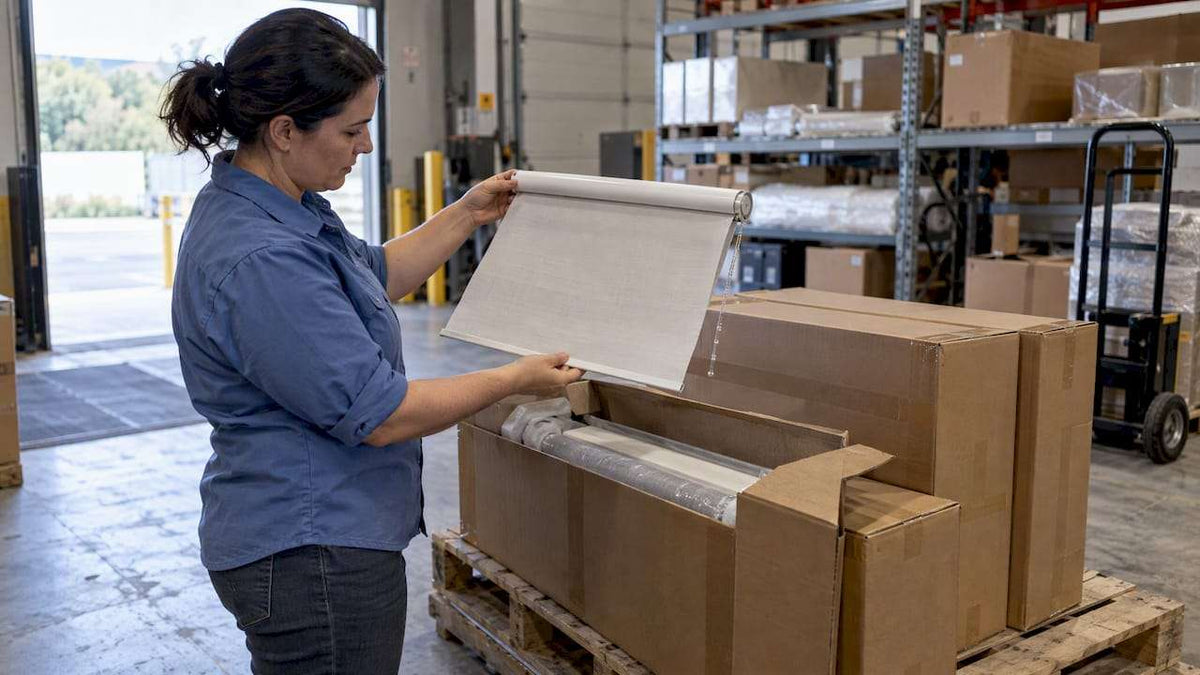
Packaging is the part retailers forget until a pallet shows up unlabeled. For phased site deliveries, require boxes marked by size, color, and destination so crews can grab what they need without opening everything. Also require spare units to be packed and labeled separately, so replacements are not mixed into the installed count.

What should you budget for, and how do discounts work?
A unit price is never the whole price. Build your budget from these components:
- Per-unit product cost at your committed volume.
- Customization charges (special sizes, motors, premium fabrics).
- Freight, duties, and insurance.
- Packaging, labeling, and handling fees.
- Installation labor and any measuring services.
- Warranty terms or the cost of covering replacements yourself.
Volume discounts usually step down in tiers, so ask for a price at your planned quantity and at the next tier up. Sometimes adding a modest number of units drops the per-unit cost enough to pay for them. Other levers you can negotiate include consolidated SKUs, longer lead times, flexible payment terms, and repeat-order commitments.
For a quick margin check, use this landed-cost formula: landed cost per unit = (product + customization + freight + duties + packaging + handling) ÷ units received in sellable condition. Divide by sellable units, not shipped units, so damage and rejects are priced in. Then confirm your retail price still clears your target margin after installation support and expected returns.
Supplier selection also protects your budget. As the supplier-communication guidance puts it, documented schedules and quality protocols shield buyers from fabrication errors, and fabrication errors are the most expensive line item no one budgets for.
How do you handle measurement, customization, and quality control?
Decide up front who owns measurement. If you measure, errors are yours. If the supplier or an installer measures, get that responsibility in writing. A wrong measurement on a made-to-order shade usually means remaking the shade, so the mistake costs the full unit plus the delay.
Your spec sheet should list:
- Exact width and height, with inside or outside mount noted
- Mounting hardware and bracket type
- Fabric name and color code (not just “white”)
- Control side, chain or cordless operation, and motor details if applicable
- Room or location labels that match the packing labels
Our own roller shade measuring guide shows the measuring rules we use, and you can borrow them as a standard to hand your crews or require from a supplier.
Before full production, choose one inspection method: a small pilot run, photographic sign-off of finished units, or a third-party inspection at the factory. Pilot runs cost more per unit but catch problems while they are still cheap.
Pro Tip: Put your approved sample’s photo and fabric code into the purchase order itself, so “matches the sample” is a checkable standard, not an opinion.
What is the step-by-step checklist for placing a bulk order?
Use this as an operating template, from request for quote through installation:
- Define SKUs and quantities.
- Confirm MOQs per order, SKU, and color.
- Request and approve samples in writing.
- Finalize the spec sheet.
- Get a firm purchase order (PO) with a production schedule attached.
- Agree on payment terms and milestones.
- Verify packing and labeling instructions.
- Track the shipment.
- Inspect on arrival and report issues inside the agreed window.
- Schedule installation.
Your PO should carry the spec sheet, the approved sample reference, the delivery dates, the spare-unit requirement, acceptance criteria, and remedies for late or defective goods. For phased deliveries or multi-site rollouts, split the PO into delivery lots with their own dates and labels, so one late lot does not freeze the rest.
Why do documented schedules and packaging rules reduce risk?
Two sources point the same direction. On communication, supplier guidance finds that reputable suppliers provide documented production schedules and quality control protocols that protect buyers from fabrication errors:
Transparent communication about project-specific needs, such as phased site delivery, is more predictive of success than seeking the lowest price.
On packaging, the Construction Specification Manual calls for roller shades delivered in factory packages marked with the manufacturer and product name, plus extra materials for each size, color, and shadeband material. It also asks for installation and alignment instructions to ship with the goods. Put acceptance criteria and QC checkpoints in the contract, and disputes at delivery have much less room to grow.
What are the most common buyer mistakes?
The mistakes repeat. Buyers ignore per-color MOQs, skip samples to save a week, and forget to require packing and spare-unit rules. Each one feels small at signing and expensive at delivery.
My rules of thumb: insist on a small pilot run before the full order, keep an appropriate supply of spares for each SKU, and consolidate SKUs wherever your catalog allows it. Before every PO, ask yourself whether anything in it depends on a verbal promise. If it does, get it written down.
— Sunny
How can we support your bulk or custom order?
We build custom, made-to-order window treatments, and we back them with a Window Treatment Design Studio for drafting detailed specs, free fabric swatches, measurement guides, and professional measuring and installation options. If you are planning a retail or multi-room order, send us your SKU list and we will discuss your project and next steps. Browse our full catalog and order swatches today.
FAQ
How quickly can I get blinds installed?
It depends on the product and whether it is made to order. Custom units are fabricated after you approve specs, so the schedule is set by production and shipping, not by the installer. Ask for a written production schedule and book installation only after the shipping date is confirmed.
Do all window treatments have to match?
No. Matching hardware and a consistent color family usually look cohesive, but different styles can suit different rooms. For a retail rollout, limiting the number of SKUs also helps you reach lower MOQs and simplifies spare-unit tracking.
Can you get blinds with different colors on each side?
Options vary by product, so check the available colorways before ordering. Treat each colorway as its own SKU when you check per-color MOQs, since a two-tone option can raise your minimum quantity.
What type of blinds look most expensive?
Solid wood blinds and layered or motorized shades tend to read as premium, because the materials and clean operation are visible. Match the product to your retail price point, and check how customization affects lead time and cost before committing.





%20applies%20per%20order,%20per%20SKU,%20or%20per%20color;%20...)