
How to Measure for Roller Shades: A DIY Guide
TL;DR:
- Accurate measurement before ordering roller shades depends on checking recess depth and choosing the correct mount type.
- Taking three measurements for width and height ensures a precise fit, and recording only the narrowest width and longest height prevents sizing errors.
- Using a steel tape and verifying frame squareness with a level reduces common mistakes and guarantees the shade fits properly.
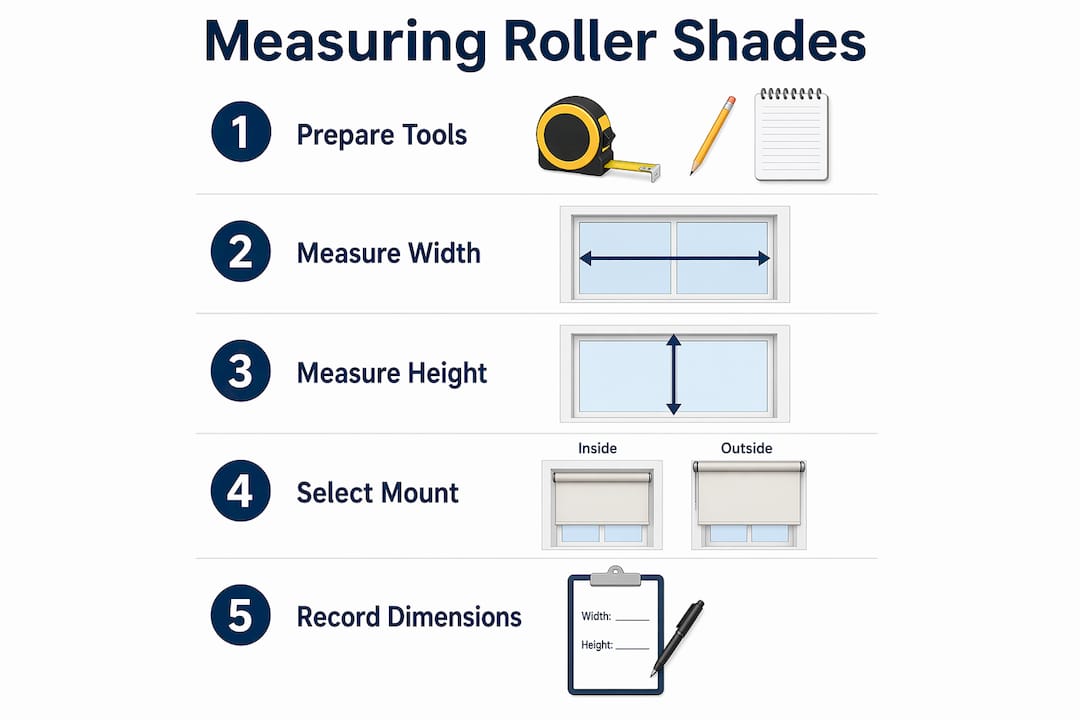
Accurate measurement is the single most important step before ordering roller shades. Get it wrong by even a quarter inch and you end up with a shade that gaps on the sides, jams in the frame, or blocks a window handle. The process of learning how to measure for roller shades starts with one check most homeowners skip: confirming your window recess depth. That depth determines your mount type, and your mount type drives every number you record after it. Valueblindsdirect offers a full roller shade measurement guide to help you get this right the first time.
How do I determine if my window can support an inside or outside mount?
Mount type is the first decision you make, and it controls everything else. An inside mount sits within the window frame for a clean, recessed look. An outside mount attaches to the wall or trim above the window and covers the frame entirely.
The deciding factor is recess depth. Inside mounts require a minimum of 1.25 to 1.5 inches of clear depth from the front of the frame to any obstruction. That obstruction could be a window crank, a latch, or the glass itself. If your recess falls short of that range, an outside mount is your only workable option.
Check for these conditions that point to an outside mount:
- Shallow recess: Less than 1.25 inches of clear depth from the frame face to the nearest obstruction.
- Window hardware: Cranks, handles, or locks that protrude into the recess and would block the shade tube.
- Out-of-square frames: Frames that are visibly crooked or tapered from top to bottom.
- Obstructed sills: Deep sills with trim or molding that would interfere with the shade fabric.
Frame squareness matters more than most guides admit. A frame that is out of square by even half an inch will cause an inside-mounted shade to bind or leave uneven light gaps on one side. Using a level to check the frame before you measure takes 30 seconds and can save you a return shipment.
Pro Tip: Place your level diagonally across the window opening. If the bubble sits off center, your frame is racked. That is a strong signal to go with an outside mount, which forgives frame irregularities far better than an inside mount.
Outside mounts also give you more control over light blockage. Because the shade extends past the frame on all sides, you eliminate the side gaps that inside mounts can leave, especially on windows that face direct sunlight.
Why does roll direction matter when you measure?
Roll direction is a decision most homeowners make after ordering. That is the wrong time. The right time is during the measuring stage, because roll direction affects how much clearance you need and how wide your light gaps will be.
A standard roll feeds the fabric from behind the tube, meaning the fabric hangs between the tube and the glass. A reverse roll feeds the fabric from the front of the tube, so the fabric hangs on the room side. The difference sounds minor. The practical effects are not.
Reverse roll reduces side light gaps and helps the shade clear deep window sills, protruding handles, or thick trim. Standard roll works well in flat, unobstructed frames. Here is how to choose during your measuring visit:
- Check for sill depth: If your sill protrudes more than half an inch, reverse roll keeps the fabric from dragging across it.
- Check for handles: A window crank or latch that sits close to the glass benefits from reverse roll, which keeps the fabric further from the obstruction.
- Check for light sensitivity: Reverse roll pulls the fabric closer to the glass and reduces the side gap between fabric and frame.
- Check for wall clearance: Standard roll needs a little more clearance between the tube and the wall, so measure that gap if space is tight.
Pro Tip: While you have your tape measure out, hold it flat against the sill and check how far any hardware protrudes. If anything sticks out more than three-quarters of an inch, note it on your measurement sheet and flag it when you order.
What is the step-by-step process for measuring width and height?
This is where most DIY measuring errors happen. The fix is straightforward: measure in three places, not one.
Measuring width
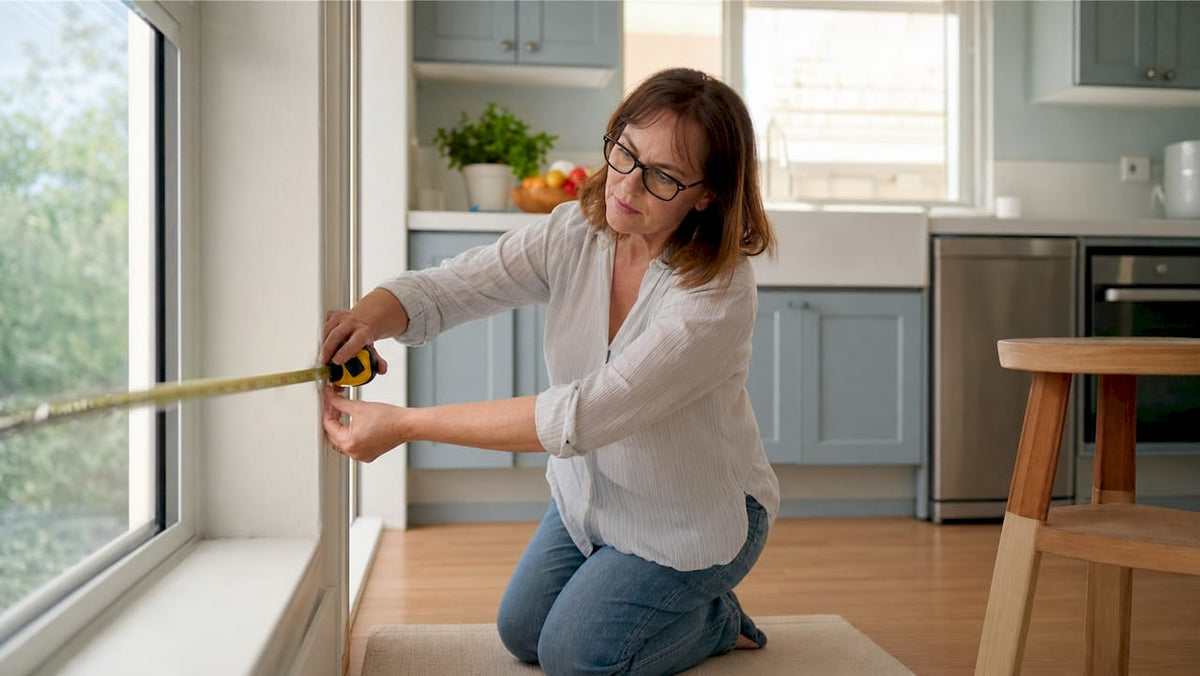
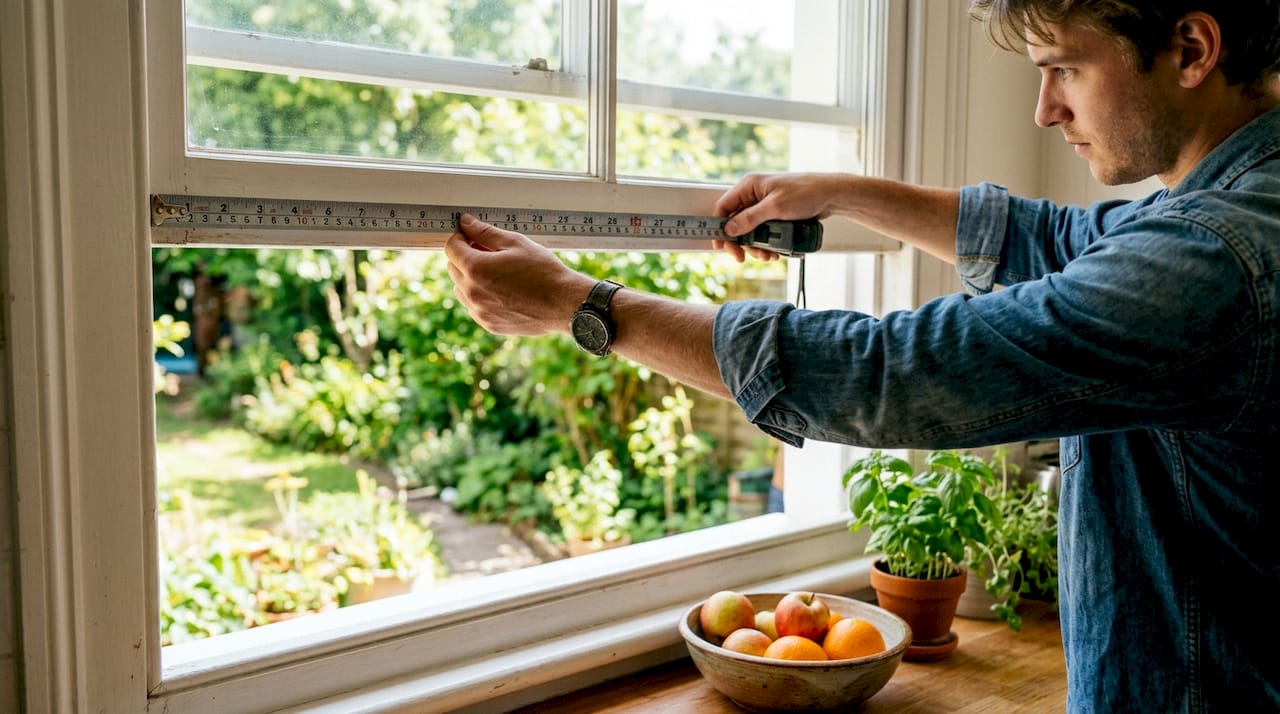
Take three width measurements: one at the top of the opening, one in the middle, and one at the bottom. Windows are rarely perfectly square, so these three numbers will often differ slightly. Record the narrowest width for an inside mount. Using the widest measurement risks a shade that jams in the frame.
Measuring height
Take three height measurements: one on the left side, one in the center, and one on the right side. Record the longest height for an inside mount. A shade that is too short leaves a gap at the bottom.
Inside mount vs. outside mount rules
| Measurement | Inside mount rule | Outside mount rule |
|---|---|---|
| Width | Use the narrowest of three readings | Add 1.5–3 inches per side to the opening width |
| Height | Use the longest of three readings | Add 1.5–3 inches above and below the opening |
| Deductions | Do not deduct anything yourself | No deductions; add overlap only |
| Recording format | Width x Height in exact fractions | Width x Height including full overlap |
For outside mounts, add an overlap of 1.5 to 3 inches per side to both width and height. That overlap covers the window trim and blocks light around the edges. The exact amount depends on how much light control you want and how much wall space you have above and beside the window.
The most costly mistake in this step is self-deducting on inside mounts. The factory already accounts for bracket width and control clearance. Do not deduct fabric allowance yourself when ordering an inside mount. If you do, your shade arrives too small and cannot be fixed without reordering.
Pro Tip: Write your final numbers as Width x Height every single time. Swapping the two is one of the most common ordering errors, and it results in a shade that is the right size but oriented the wrong way.
What tools do you need before you start measuring?
The right tools take five minutes to gather and prevent the most common measuring errors.
- Steel tape measure: A steel tape provides rigid, repeatable accuracy that cloth or plastic tapes cannot match. Cloth tapes stretch over time, and even a small stretch throws off a custom order.
- Level: Use it to check frame squareness before you take a single measurement.
- Notepad or phone: Record every measurement immediately. Memory is not reliable when you are measuring six windows in a row.
- Step ladder: Tall windows require you to reach the top of the frame safely. Stretching from the floor introduces measurement error.
- Flashlight or phone light: Recess depth is hard to judge in a dark frame corner. A light source shows you exactly where obstructions sit.
Check for window handles, locks, and trim before you measure. These obstructions affect both mount type and roll direction, and catching them early saves you from remeasuring later. The Valueblindsdirect accurate DIY measuring guide walks through each tool in more detail if you want a deeper reference.
What are the most common measurement mistakes to avoid?
Most measurement errors fall into a short list of repeatable mistakes. Knowing them in advance is the fastest way to avoid them.
- Self-deducting on inside mounts: The factory handles all deductions. Homeowners who subtract their own allowance end up with shades that are too narrow or too short.
- Measuring only once: One measurement per dimension is not enough. Windows shift and settle over time. Three measurements per dimension catch any taper or bow in the frame.
- Swapping width and height: Recording height first and width second is a common slip. Always write Width x Height, in that order, every time.
- Using a cloth tape: Cloth tapes stretch. A stretched tape gives you a number that is consistently off, and the error compounds across multiple windows.
- Ignoring obstructions: A window crank you forgot to account for will stop an inside-mounted shade from rolling up fully.
- Assuming identical windows are the same size: Two windows side by side in the same wall can differ by a quarter inch or more. Measure each window separately to avoid a misfit on one of them.
Pro Tip: After you record all your measurements, walk back to the first window and re-check your width and height one more time. A single confirmation pass catches transposition errors before you place the order.
Key Takeaways
Accurate roller shade measurement requires checking recess depth first, choosing mount type, selecting roll direction, and recording three width and three height readings without making your own deductions on inside mounts.
| Point | Details |
|---|---|
| Check recess depth first | Inside mounts need 1.25–1.5 inches of clear depth; less than that requires an outside mount. |
| Measure three times per dimension | Take width at top, middle, and bottom; height at left, center, and right to catch any frame taper. |
| Never self-deduct on inside mounts | Factories account for bracket and control clearance; homeowner deductions produce shades that are too small. |
| Choose roll direction during measuring | Reverse roll reduces light gaps and clears sill obstructions; standard roll suits flat, unobstructed frames. |
| Use a steel tape measure | Steel tapes give repeatable accuracy; cloth tapes stretch and introduce consistent errors across all windows. |
What I have learned from years of roller shade measuring
The mistake I see most often is homeowners skipping the recess depth check entirely. They assume an inside mount will work because the window looks deep enough, and they order before confirming. The shade arrives, the bracket hits a window crank, and the whole order goes back. That one check, which takes about 20 seconds with a steel tape, prevents the most expensive mistake in the process.
The second thing I have learned is that roll direction feels like a minor detail until it is not. I have seen rooms where the homeowner ordered standard roll on a window with a deep sill, and the fabric dragged across the sill every time the shade moved. Reverse roll would have fixed it completely. The decision costs nothing to make at measuring time and costs a full reorder to fix afterward.
My honest advice: treat your measurement sheet like a legal document. Write every number down the moment you take it. Write Width x Height every time, not just the numbers. Check your window frame squareness before you do anything else. And use a steel tape, not the cloth one sitting in your sewing kit. These are not complicated steps. They are just the steps that most people skip because they seem obvious, and then they are not.
— Sunny
Valueblindsdirect makes custom ordering straightforward
Getting your measurements right is the hard part. Ordering the right shade should be easy.
Valueblindsdirect’s Window Treatment Design Studio lets you enter your exact measurements and configure your shade from fabric to roll direction to mount type, all in one place. The tool is built for homeowners who have done the measuring work and want to order with confidence. Expert support is available if you hit a question the studio does not answer on its own. Browse the full roller shades collection to find the right fabric, opacity, and style for every room in your home.
FAQ
What is the minimum recess depth for an inside mount roller shade?
Inside mounts require a minimum of 1.25 to 1.5 inches of clear recess depth from the frame face to any obstruction. If your window falls short of that range, an outside mount is the correct choice.
Should I deduct anything from my measurements for an inside mount?
No. The factory deducts bracket and control clearances automatically. Submit your exact measurements and let the manufacturer handle the allowances.
How many measurements should I take per window?
Take three width measurements (top, middle, bottom) and three height measurements (left, center, right). Use the narrowest width and the longest height for inside mounts.
What is the difference between standard roll and reverse roll?
Standard roll feeds fabric from behind the tube toward the glass. Reverse roll feeds fabric from the front of the tube toward the room. Reverse roll reduces side light gaps and clears sill obstructions more effectively.
Do I need to measure each window separately even if they look the same size?
Yes. Windows that appear identical can differ by a quarter inch or more due to settling and construction variation. Measuring each window individually prevents a misfit on any one of them.
Recommended
- How to Measure for Blinds: Accurate DIY Guide for Windows
- How to Measure for Shutter Blinds: DIY Guide
- Measuring Windows for Shades: Accurate DIY Guide
- How to Measure Windows for Roller Blinds Perfectly

Value Blinds®
Trusted window treatments provider
Value Blinds® is a trusted provider of Greenguard, OEKO-TEX, and FSC-certified window treatments based in Portland, Oregon. Specializing in sustainable, motorized, smart-controlled, and outdoor-ready blinds and shades, the company is built on a foundation of simplified shopping, premium eco-friendly materials, and transparent pricing without the inflated cost.