

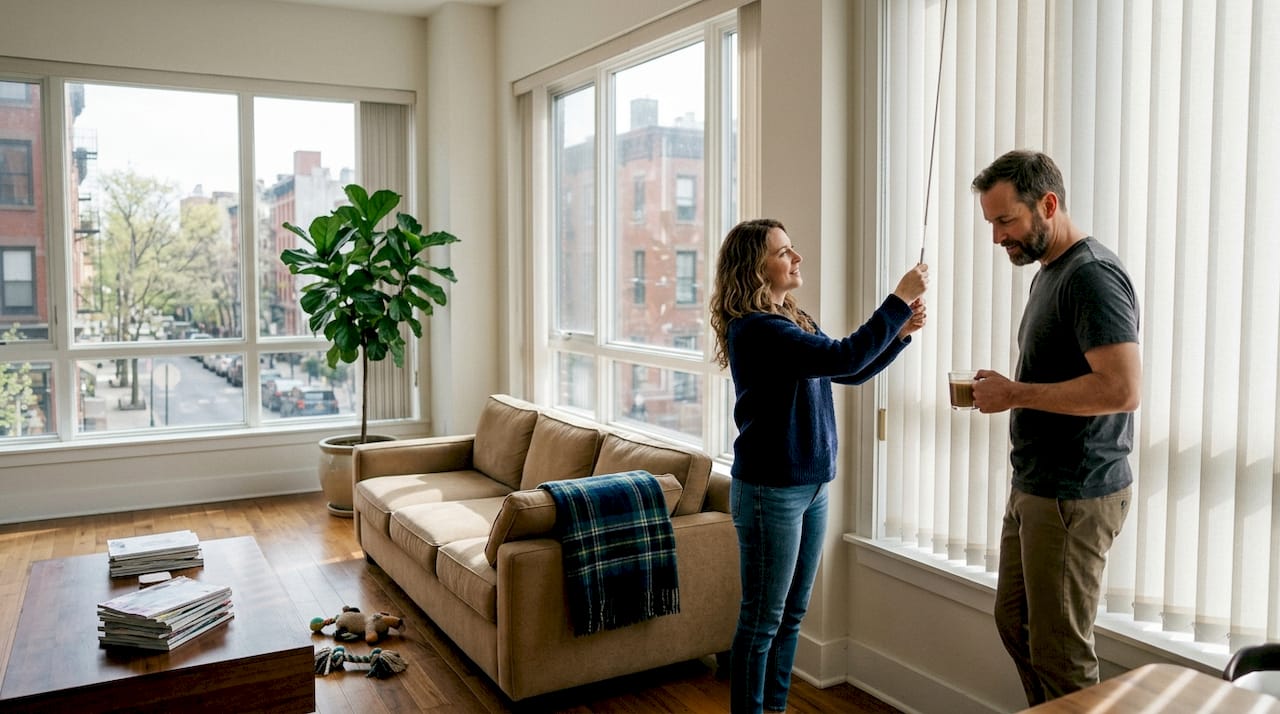
How to Choose Blinds for Large Windows: Style, Fit, Function
TL;DR:
- Large windows require careful assessment of privacy, light control, energy efficiency, and style.
- Vertical blinds and cellular shades are optimal for wide and tall large windows.
- Accurate measurement and professional installation ensure optimal function and appearance.
Large windows are one of the most coveted features in any home. They flood rooms with natural light, frame outdoor views, and make spaces feel open and alive. But when it comes time to dress them, the challenge is real. Standard blind solutions rarely translate well to oversized panes, and a poor choice can cost you in comfort, energy bills, and curb appeal. This guide walks you through every step of choosing blinds for large windows, from identifying your needs and picking the right style to measuring accurately and installing with confidence.
Table of Contents
- Assessing your needs and window requirements
- Selecting the ideal blind types for large windows
- Measuring and preparing for installation
- Installation process and troubleshooting for large window blinds
- A professional perspective on success with large window blinds
- Design, custom order, and install your perfect large window blinds
- Frequently asked questions
Key Takeaways
| Point | Details |
|---|---|
| Match blinds to needs | Identify your primary goals—privacy, light control, style, and efficiency—before narrowing choices. |
| Choose suitable styles | Some blinds like vertical and cellular shades perform best and look great on large windows. |
| Measure precisely | Accurate measurement is crucial for large blinds to operate smoothly and fit attractively. |
| Professional help may pay off | Heavier blinds for big windows often work best when measured and installed by experts. |
Assessing your needs and window requirements
Before you browse a single product, take stock of what you actually need from your window coverings. Large windows create unique demands that smaller windows simply don’t. Blinds can transform the look, feel, and energy use of a room with large windows, which means the stakes are higher when you get the selection wrong.
Start by thinking through these core requirements:
- Privacy: Do you face a street, a neighbor, or an open yard? Floor-to-ceiling windows in a living room need different privacy solutions than a high transom window.
- Light control: Do you want to filter soft morning light, block harsh afternoon sun, or achieve full blackout for a media room?
- Energy efficiency: South and west-facing windows absorb significant heat in summer. Pairing your blinds with installing heat-reducing window films can dramatically cut cooling costs.
- Style: Do your interiors lean modern, rustic, or transitional? The wrong material or color can clash with your overall design.
- Ease of operation: Wide and tall windows are often hard to reach. Consider how you’ll open and close the blinds daily.
Window orientation matters more than most homeowners realize. A north-facing window rarely needs heavy light blocking, while a west-facing wall of glass can turn your living room into an oven by 3 p.m. Map out each window’s direction before you commit to a product.
Measuring large windows also presents unique challenges. Wide spans can flex or bow, meaning the width at the top may differ slightly from the width at the bottom. Always measure in at least three places and record the smallest dimension for inside mounts.
Here’s a quick comparison of the most important features to evaluate:
| Feature | Why it matters for large windows |
|---|---|
| Light control | Large panes let in more light, so filtering matters more |
| Insulation value | More glass means more heat transfer |
| Weight and hardware | Heavier blinds need stronger brackets and mounting |
| Ease of operation | Reaching across wide spans requires smart mechanisms |
| Style cohesion | Oversized windows are focal points; aesthetics count double |
For window treatments for large windows, this upfront assessment saves you from costly returns and frustrating re-installs.
Pro Tip: Write down your top three priorities before shopping. If energy efficiency, privacy, and style are your main goals, you can immediately eliminate products that don’t serve all three.
Selecting the ideal blind types for large windows
With your requirements listed, it’s time to compare the leading blind types that complement large windows, focusing on their performance, appeal, and practicality. Certain blind types, such as cellular shades and vertical blinds, are specifically suited for large window spans because of how they distribute weight and operate across wide or tall openings.
Here’s how the top options stack up:
| Blind type | Best for | Key advantage | Potential drawback |
|---|---|---|---|
| Vertical blinds | Wide sliding doors, tall windows | Easy lateral operation | Can feel dated in modern interiors |
| Cellular shades | Energy efficiency priority | Excellent insulation | Less light-filtering flexibility |
| Roller shades | Minimalist, modern spaces | Clean look, easy to motorize | Less insulating than cellular |
| Motorized shades | Hard-to-reach or smart home setups | Effortless control | Higher upfront cost |
| Woven wood shades | Rustic or natural interiors | Texture and warmth | Limited blackout capability |
Vertical blinds remain a practical workhorse for sliding glass doors and wide panoramic windows. They glide smoothly, handle wide spans without sagging, and are easy to replace slat by slat if one gets damaged.
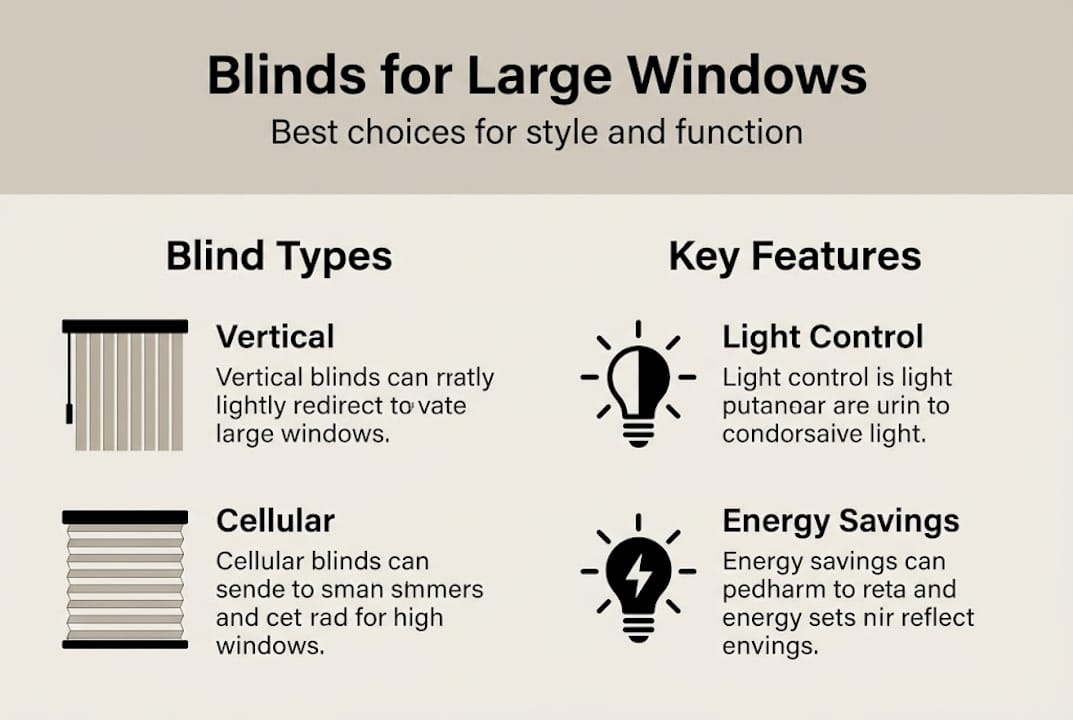
Cellular shades (also called honeycomb shades) are the gold standard for energy efficient blinds for large windows. Their air-trapping cell structure acts like insulation, reducing heat gain in summer and heat loss in winter. Double or triple-cell options offer even more performance.

Roller shades are the go-to for modern interiors. They’re sleek, come in thousands of fabrics, and are the easiest style to motorize. For very wide windows, look for cassette-style rollers with center support brackets to prevent sagging.
Motorized blinds deserve serious consideration for any window wider than 72 inches or taller than 84 inches. Manual operation across those spans is awkward and can wear out the mechanisms faster.
- Motorized systems integrate with smart home platforms like Google Home and Amazon Alexa
- Cordless and motorized options eliminate cord safety hazards for families with children
- Remote or app-based control means you can adjust all windows simultaneously
Pro Tip: For very wide windows, choose blinds with a center support bracket or a split-draw system. This divides the blind into two panels that meet in the middle, reducing strain on the hardware and making daily operation much smoother.
Measuring and preparing for installation
Once you know which blinds best fit your needs, getting accurate window measurements ensures they function and look their best. Proper sizing is critical for smooth operation, appearance, and energy performance, especially with large blinds where even a half-inch error can cause gaps, binding, or an uneven look.
Follow these steps for accurate measurement:
- Decide on mount type first. Inside mount sits within the window frame for a clean, built-in look. Outside mount covers the frame and surrounding wall, which is ideal for maximizing coverage and making windows appear larger.
- Measure width in three places. Measure at the top, middle, and bottom of the window opening. For inside mounts, use the smallest measurement. For outside mounts, add 2 to 4 inches on each side.
- Measure height in three places. Measure on the left, center, and right. Use the longest measurement for inside mounts to ensure full coverage.
- Check for square. Large windows are more likely to be slightly out of square. Measure both diagonals; if they differ by more than half an inch, note this before ordering.
- Measure mounting depth. Inside mounts need adequate depth in the window frame. Check the minimum depth requirement for your chosen blind style.
Accuracy matters most with large blinds. A small error that’s barely noticeable on a 36-inch window becomes a glaring gap or a binding problem on a 96-inch span.
For a full walkthrough, the window sizing tips guide covers every scenario, including bay windows and arched frames. You’ll also want to review the window coverings installation guide before your blinds arrive so you know exactly what tools and prep work are needed.
Pro Tip: Use a metal tape measure, not a fabric one. Metal tapes stay rigid across wide spans, giving you a more accurate reading. Have a second person hold the far end steady.
Installation process and troubleshooting for large window blinds
With your windows accurately measured and the right blinds in hand, you’re ready to tackle installation. Here’s how to approach it smoothly, plus what to do if things go wrong.
Follow these installation steps for most large window blind systems:
- Gather your tools. You’ll need a drill, level, pencil, measuring tape, and the hardware included with your blinds. For large units, a step ladder and a helper are essential.
- Mark bracket positions. Use your level to mark bracket locations. For wide blinds, install a center support bracket to prevent bowing.
- Drill pilot holes. Pilot holes prevent the wall or frame from cracking, especially in older wood frames. Match the drill bit to your screw size.
- Mount the brackets. Secure each bracket firmly. Wiggle test each one before hanging the blind.
- Attach the headrail. Snap or slide the headrail into the mounted brackets. For heavy blinds, keep the blind supported while you secure it.
- Test operation. Raise, lower, and tilt the blind several times before finishing. Check for smooth, even movement.
Some types of blinds can be installed easily as a DIY project, but heavy, wide units often require professional help for safety and a clean result.
Common issues and how to fix them:
- Blind won’t hang level: Re-check bracket heights with a level and adjust before tightening screws fully.
- Slats or fabric sag in the middle: Add a center support bracket or consider a split-draw system.
- Cord or motor doesn’t operate smoothly: Check for obstructions in the headrail and confirm the blind is seated correctly in all brackets.
- Gaps at the sides: Switch to an outside mount or add a few inches to your outside mount width.
For motorized systems, follow the motorized blinds installation guide carefully, especially for wiring and pairing with smart home devices.
Pro Tip: If your blinds weigh more than 15 pounds per panel, don’t install alone. Large blinds can shift unexpectedly during mounting, leading to damaged frames or personal injury.
A professional perspective on success with large window blinds
Here’s something most guides won’t tell you: the biggest regrets we hear from homeowners aren’t about color or style. They’re about mechanisms and materials. Someone buys a beautiful set of roller shades, installs them on a 10-foot window, and within a year the tube is bowing and the fabric won’t retract evenly. The shade looked perfect in photos but wasn’t built for the span.
Quality mechanisms are worth every extra dollar on large windows. A heavy-duty headrail, reinforced brackets, and a motor rated for the blind’s weight will outlast a budget alternative by years. Think of it like tires on a car: you don’t notice good ones until you try bad ones.
Motorization isn’t a luxury for large windows. It’s often the smarter long-term investment. Manual cords on wide or tall blinds wear out faster, and the ergonomics of reaching across a 96-inch span daily are genuinely poor. Expert views on motorized blinds consistently show that homeowners who upgrade to motorized systems rarely go back.
Finally, don’t underestimate the value of professional installation for wall-to-wall or floor-to-ceiling windows. The cost is modest compared to the price of the blinds themselves, and it eliminates the most common failure points.
Design, custom order, and install your perfect large window blinds
Ready to transform your large windows? Finding the right blinds is much easier when you have the right tools and expert support behind you.
At Value Blinds, the Window Treatment Design Studio lets you visualize custom options for your exact window dimensions before you order. Whether you’re working with a dramatic floor-to-ceiling feature wall or a wide panoramic view, you can browse the full range of stylish blinds collections and filter by style, material, and function. Free swatches, expert support, and detailed measurement guides are all available to make sure your order arrives ready to install perfectly.
Frequently asked questions
What blind types work best for very wide or tall windows?
Vertical blinds, motorized cellular shades, and panel track systems are ideal for wide or tall windows because they support even weight and smooth operation. Cellular shades and vertical blinds are specifically engineered to handle large spans without sagging.
How can I improve energy efficiency with blinds on large windows?
Look for cellular shades or layered blinds with insulating materials, and consider inside mounting for better coverage to minimize heat loss or gain. Blinds help improve home energy efficiency most effectively when sized and installed correctly.
Is it possible to install blinds on large windows myself?
Yes, many systems are designed for DIY, but oversized or heavy blinds often benefit from professional measurement and installation for safety and performance. Large units may require professional help to ensure safe mounting and smooth long-term operation.
What are common mistakes to avoid when choosing blinds for large windows?
Poor measuring, underestimating weight, and selecting unsuitable materials are typical pitfalls; always double-check measurements and choose heavy-duty options. Proper sizing and material selection prevent issues with operation and appearance over time.
Should I invest in motorized blinds for large windows?
Motorized blinds offer convenience and safety for large, hard-to-reach windows and are increasingly popular for modern homes. Motorized blinds are especially beneficial for large window applications and enhance daily comfort significantly.