

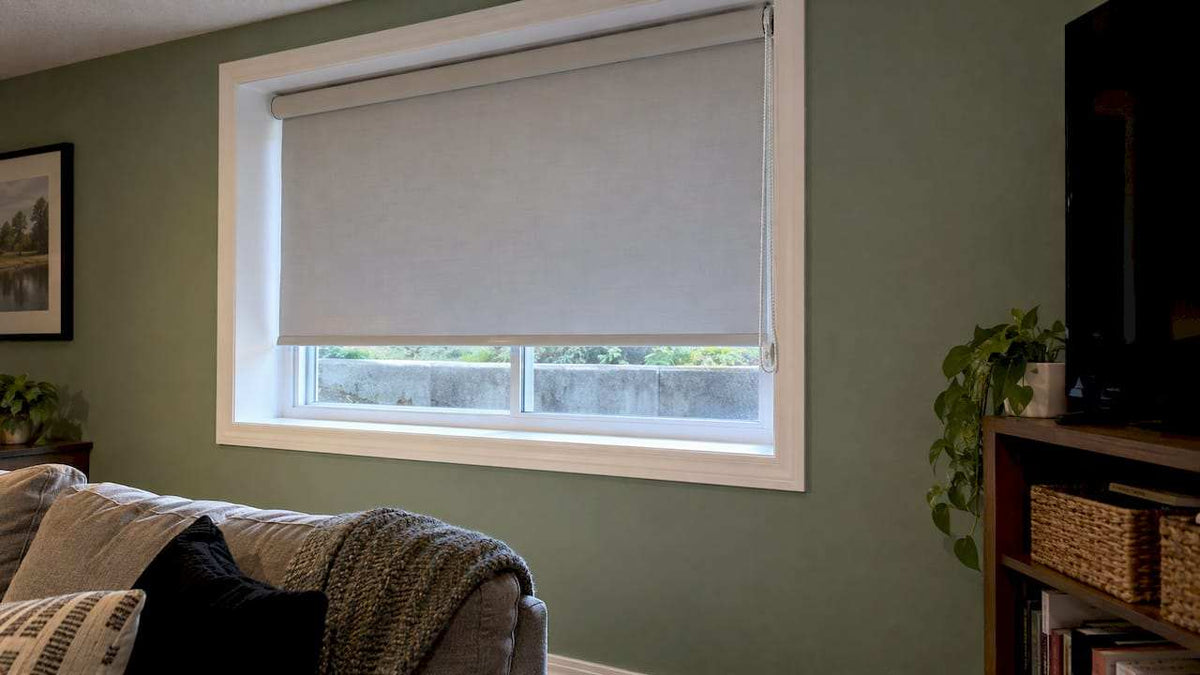
What Are Continuous Loop Blinds? How They Work and Stay Safe
Continuous loop blinds are blinds or shades run by one endless cord, or beaded chain, that turns a small clutch inside the headrail. Pull one side of the loop down and the covering rises. Pull the other side and it lowers. They are common on wide or heavy windows, and they only stay safe when a tension device anchors the loop to the wall or floor. If you want the same convenience without a hanging loop, we make cordless and motorized options too (more on that below 🙂).
TL;DR
- A continuous loop is an endless cord or chain that drives a clutch in the headrail. One side lifts, the other side lowers.
- It suits larger, heavier coverings such as roller shades, cellular shades, roman shades, vertical blinds and draperies.
- The loop is a known strangulation hazard, so a tension device screwed into a solid surface is not optional.
- In the U.S., a federal rule effective 30 May 2023 covers custom window coverings, and continuous loops are allowed only with a compliant restraining device.
- Homes with babies, toddlers or pets are usually better served by cordless or motorized blinds, which have no loop at all.
Table of Contents
- What continuous loop blinds are
- How continuous loop blinds work
- Which window coverings use a continuous loop
- The safety side: why the loop matters
- What the tension device does
- How continuous loop blinds are installed
- Quick safety habits for every home
- Continuous loop vs. cordless vs. motorized
- Planning a safer home beyond the blinds
- Our take
- Find your next blinds with Value Blinds
- FAQ
- Sources
What continuous loop blinds are
Picture a cord tied end to end, like a necklace, hanging beside your window. That is a continuous loop. It passes through a clutch or sprocket hidden in the headrail. When you tug, the clutch turns the mechanism that winds the covering up or lets it down.
There are two common versions:
- Cord loop: a braided cord, often used on roller shades and cellular (honeycomb) shades.
- Bead chain loop: small metal or plastic balls linked together, common on vertical blinds, roller shades and draperies.
You may also see the term “continuous cord loop shades” or “cord loop cellular shades.” Same idea, different product name. The loop exists for a practical reason: a wide, heavy covering is hard to lift by pulling a single cord straight down, while a loop gives you steady, even leverage with little effort.
How continuous loop blinds work
The action is simple once you know which side does what.
- To raise the covering, pull down on the front side of the loop (the side facing into the room).
- To lower it, pull down on the back side, the one closer to the window.
- To stop, just let go. The clutch holds the covering in place at any height.
On vertical blinds, the loop usually rotates the vanes or traverses them across the window rather than lifting anything. The principle is the same: pull one way, the mechanism moves one way, and pull the other way to reverse it.
Because the cord is endless, you never lose the pull. There is no knot to reach for and no dangling single end. That is the convenience. It is also exactly why the loop needs to be restrained, which brings us to safety.
Which window coverings use a continuous loop
The U.S. Consumer Product Safety Commission (CPSC) describes how roller shades are raised and lowered by a roller mechanism operated by a continuous cord loop control system, and it notes that the same applies to roman shades, vertical blinds and draperies. In practice you will meet loops most often on:
- Large roller shades
- Cellular shades on wide windows
- Roman shades
- Vertical blinds for sliding doors and patio openings
- Traverse draperies
Small windows with lightweight blinds rarely need one. A loop earns its place when the covering is wide, tall or heavy.
The safety side: why the loop matters
We love a good window treatment, but this part is worth reading slowly.
A free-hanging loop can form a noose shape. The CPSC reviewed 66 fatal incidents involving window coverings and found that 24 of them (36%) involved a continuous loop control system, most often vertical blinds and drapes. Of those 24 cases, 20 involved a free-hanging loop that is part of the product’s design, and 4 involved a loop created by modifying the cord. The review covered 1996 to 2002.

The CPSC’s page on window blind cords adds that about 40 percent of incidents involved continuous loop systems typical to vertical blinds and draperies. It also says blinds that meet the voluntary standard can still pose a hazard if cords are tied up or loose cords become entangled.
The takeaway is not panic. It is that the loop must be restrained and kept out of reach, every time.
What the U.S. rule requires
A CPSC final rule, effective 30 May 2023, requires that operating cords on custom window coverings meet the same requirements as stock ones. Under it, continuous loop systems are allowed only if the product includes a loop cord or bead chain restraining device that meets revised requirements, including UV, cyclic and deflection tests. Older blinds installed before that rule may not have such a device, so check them.
What other countries specify
Rules differ by country, and the specifics are useful as a benchmark. In Australia, a loose cord must not form a loop of 220 mm or longer at or below 1,600 mm above the floor, and a cleat used to secure a cord must sit at least 1,600 mm above the floor. The same page says pull-cords on certain vertical blinds or curtains need a continuous loop to work and cannot be cut, so a safety device must secure them out of children’s reach. In the United Kingdom, regulations say cords, chains and ball-chains must not form a hazardous loop or must carry an integral safety device.
Those are Australian and UK figures, not U.S. law. For a U.S. home, follow the manufacturer’s instructions and the CPSC standard referenced above.
What the tension device does
The tension device (sometimes called a tensioner or loop restraint) keeps the bottom of the loop pulled taut and fixed in place. A taut loop cannot be lifted away from the wall into a noose shape, and it cannot be draped over a child’s head or a pet’s neck.
It does three jobs:
- Anchors the loop to the wall, window frame or floor.
- Keeps tension so the cord stays snug and the clutch works smoothly.
- Prevents slack that could otherwise form a hazardous loop.
The CPSC notes that the ANSI/WCMA A100.1-2012 standard includes durability and performance testing for tension and hold-down devices, covering anchoring, installation instructions and warnings, cord accessibility, hazardous loops and the durability of safety devices.
Our own guide walks through a 5 step safety check for continuous loop cord systems if you already have one at home.
How continuous loop blinds are installed
There are two parts: the blind itself and the tensioner. Always follow the instructions that came with your product, since mounting details vary by brand and style.
- Mount the headrail or brackets. Fix the brackets level, inside or outside the window frame, into solid material. Hang the blind on them.
- Position the loop on the correct side. The loop usually hangs at one end of the headrail. Confirm which side raises and which lowers by testing it gently before anchoring.
- Place the tension device. Hold the loop straight and mark where the tensioner sits so the cord is taut but not stretched. It should be low enough to be reachable for operation but secured so the loop cannot lift away.
- Screw it in. Use the screws provided, driven into a stud, solid frame or masonry anchor rather than just drywall. Tug firmly to confirm it holds.
- Check operation. Raise and lower the covering fully. The cord should run smoothly without twisting or going slack.
Where it goes wrong: tensioners screwed into thin drywall that pull out, plastic parts that weaken, and loops left loose because the tensioner was never fitted. Australian guidance says that where cleats or cord guides are needed, steel or metal devices are preferable because plastic can turn brittle in sunlight, and devices needing more than one screw are stronger. It also says any guide installed lower than 1,600 mm must withstand a 70 N force in any direction for 10 seconds.
If you would rather not do it yourself, our Pro Measure & Install service covers professional measuring and installation. A pro measures the window first, so the blind fits and the hardware lands where it should.
Quick safety habits for every home
- Never tie, wrap or knot the loop to shorten it. Tied-up cords are a hazard even on compliant blinds.
- Keep cribs, beds, sofas and furniture away from windows with cords.
- Teach older children that cords are not toys.
- Re-check the tension device once a year. Look for loose screws, cracked plastic and slack in the loop.
- Never cut a continuous loop to make it “single cord.” It is built to operate as a loop.
If a loop is already damaged or the tension device is missing, take the covering down or fit a proper restraint before anyone uses it again.
Continuous loop vs. cordless vs. motorized
| Feature | Continuous loop | Cordless | Motorized |
|---|---|---|---|
| How you operate it | Pull the endless cord or chain | Lift or lower by hand on the bottom rail | Remote, app or smart control |
| Hanging cord or loop | Yes, must be restrained | None | None |
| Good for wide or heavy windows | Yes | Best on small to medium sizes | Yes |
| Needs a tension device | Yes | No | No |
| Fit for homes with babies and pets | Only with a correctly installed restraint | Strong fit | Strong fit |
The loop does its job well, and for tall or wide windows it is a reliable mechanism when properly anchored. But if your goal is a clean look and no cord near little hands, a cordless or motorized blind removes the question altogether.
We cover this in our parent’s guide to cordless window treatments and in our guide to cordless blinds safety for kids and pets.
Planning a safer home beyond the blinds
Window cords are one item on a bigger list. If you are expecting or have a toddler, a full babyproofing checklist helps you sequence safety jobs room by room, and swapping out loops and loose cords is a natural early step.
Our take
We think a window treatment should make life easier the moment you touch it, and never leave you wondering about a cord.
That is why we put so much into cordless and motorized options. Our catalog spans roller, zebra, cellular and roman shades, plus wood, bamboo, faux wood, aluminum and vertical blinds, and our range includes cordless, motorized and smart-control choices. For families, that means you can pick the look you love and skip the hanging loop entirely.
If you already own continuous loop blinds, keep that tensioner firmly anchored and check it each year. When it is time to replace them, we would love to help you find something cordless that fits your windows just right.
Sunny
Find your next blinds with Value Blinds
Ready to retire a hanging loop? We offer cordless and no-drill blinds, motorized shades with smart control, and a wide range of styles, from roller and zebra shades to cellular, roman, wood and bamboo. Free fabric swatches let you see colors and textures in your own light before you order, and our measurement guides help you get the size right.

Browse our cordless and no-drill collection, explore zebra shades or cellular shades, or start at Value Blinds. If you want help with the install, ask about Pro Measure & Install. Our step-by-step guide to installing cordless blinds shows what the process looks like.
FAQ
What are continuous loop shades?
They are window shades operated by a cord or bead chain formed into an endless loop. Pulling one side raises the shade and pulling the other side lowers it. They are mostly used on larger or heavier coverings, where a loop makes lifting easier.
Are continuous loop blinds safe?
They are safe only when the loop is restrained by a properly installed tension device and kept out of reach of children and pets. The CPSC has documented fatal incidents tied to continuous loop systems, mostly with free-hanging loops. Never tie or knot the loop, and re-check the anchor each year.
Can I cut a continuous loop cord?
No. The loop is how the mechanism works, and cutting it breaks the system. Australian guidance also says cords on certain vertical blinds or curtains need a continuous loop to work and cannot be cut, so a safety device must secure them instead.
What is the safest alternative?
Cordless blinds and motorized blinds have no hanging cord or loop. Cordless works well on small to medium windows, and motorized suits wide or tall ones. Both are easy to find in styles from roller shades to wood blinds.
Where should the tension device go?
Follow the manufacturer’s instructions. In general it is screwed into a stud, frame or properly anchored solid surface so the loop stays taut, and it should be checked for tightness once a year.
Sources
- CPSC: Analysis of Fatal Incidents Associated with Window Covering Cords
- CPSC: Window Blind Cords
- U.S. Federal Register: custom window covering cord rule, 28 Nov 2022
- NSW Government: Blind and curtain safety
- Australian Competition and Consumer Commission: Corded internal window coverings installation guide
- UK safety requirements for internal blinds and corded window coverings