

Article: 5 Step Safety Check for Homeowners' Continuous Loop Cord Systems
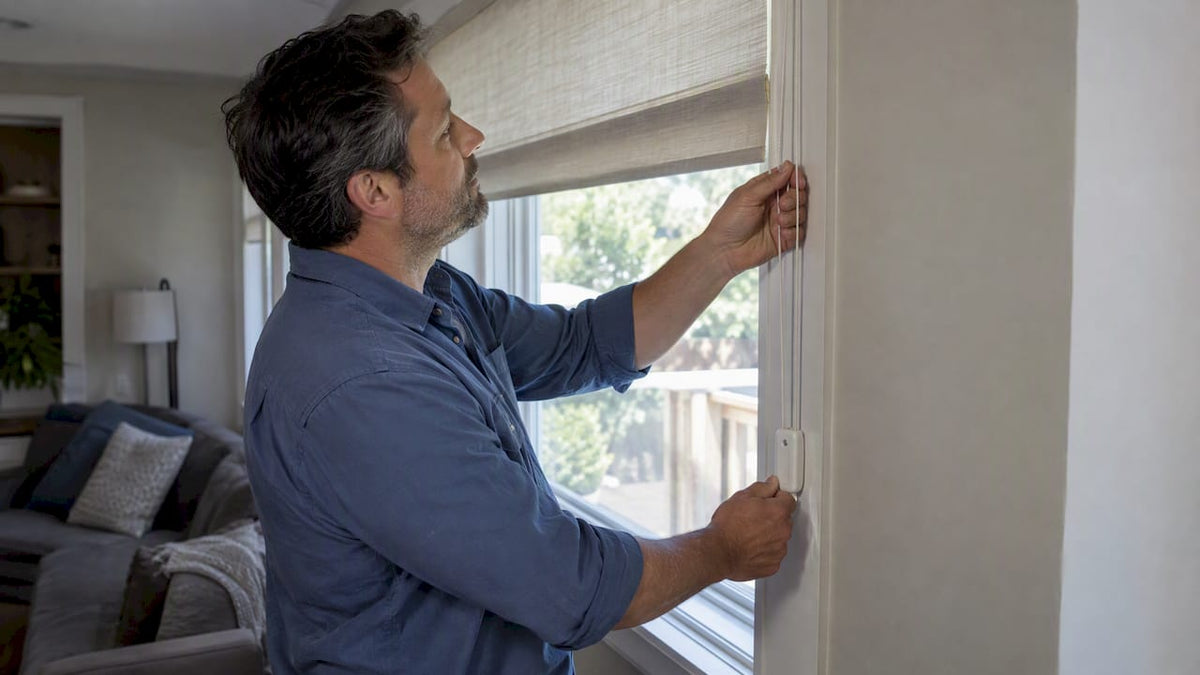
5 Step Safety Check for Homeowners' Continuous Loop Cord Systems
A continuous loop cord system is an endless cord or beaded chain that turns an internal clutch to raise, lower, or tilt a blind or shade, and it stays safe only when its tension device is correctly installed and anchored. If you have one in your home, the quickest safety check is making sure that tensioner is screwed to the wall or floor and can’t be pulled loose by hand. We’ll walk through how the mechanism works, where you’ll find it, what regulators say about it, and when it’s smarter to switch to cordless or motorized options instead.
TL;DR:
- Continuous loop cords stay safe only when their tension devices are correctly installed and anchored to a solid surface to prevent slack or detachment.
- Many incidents involve improperly installed or missing tensioners, especially on vertical blinds and drapery systems, highlighting the importance of proper hardware and routine checks.
- Homeowners should verify tensioners are screwed into the wall or floor and perform annual inspections for wear, correct tension, and secure fasteners before fully trusting the system.
- Replacing damaged or worn loops involves measuring the loop drop precisely, ordering a matching replacement, and re-threading it through the clutch, ideally with professional help if unsure.
- Considering cordless or motorized shades offers a safer alternative, especially in homes with children or pets, since these eliminate exposed loops and reduce risks.
Table of Contents
- How a continuous loop cord system actually works
- Where you’ll find continuous loops in your home
- Safety, standards, and what regulators recommend
- Installation, tensioners, and a periodic inspection checklist
- How to fix or replace a damaged continuous loop
- Safer alternatives and how to choose one
- Balancing functionality and safety
- How Value Blinds Direct can help you switch with confidence
- FAQ
- Sources
How a continuous loop cord system actually works
Picture two kinds of cord setups on a window covering: a single pull cord that you tug and release, and a continuous loop that forms an unbroken circle you rotate like a bicycle chain. The loop version is the one we’re talking about here, and once you see how it’s built, the safety requirements make a lot more sense.
Inside the headrail sits a small clutch or sprocket. The loop wraps around that sprocket, and pulling one side rotates it one direction, pulling the other side reverses it. A patented looped-cord mechanism describes exactly this: the external loop doesn’t get longer or shorter as you operate the blind, because it’s not pulling the fabric or slats directly. It’s turning a gear. That gear then raises, lowers, or traverses the covering through an internal cord or tape system you never touch.
This matters for a few practical reasons:
- Loop length stays constant no matter how far the shade travels, which is why measuring for a replacement is different from measuring a standard pull cord.
- The clutch gives mechanical advantage, so a light pull on the loop can move heavy fabric, wide drapery panels, or a long run of vertical slats.
- Because the loop never changes length, manufacturers can build tension devices around it with predictable placement, which is the whole point of the safety hardware we’ll cover later.
That mechanical advantage is exactly why continuous loops became popular for products that a basic pull cord would struggle with: wide verticals, drapery traverses, and heavier cellular or roman shades. The trade-off is that you now have a loop of cord hanging within reach, which is where the safety conversation starts.
Where you’ll find continuous loops in your home
If you’re trying to figure out whether your own window coverings use this system, check how the cord behaves. A continuous loop forms an unbroken circle and returns to the same spot every time, rather than hanging loose and retracting into a cleat.
Products that commonly use continuous loops include:
- Vertical blinds, where the loop traverses the vanes left and right.
- Drapery traverse systems, where pulling the loop slides panels across a track.
- Roller shades with a continuous loop control instead of a spring roller.
- Some cellular and roman shades, particularly wider or heavier custom sizes.
The function the loop performs depends on the product. On verticals and traverses, the loop usually moves the covering side to side. On roller and cellular shades, it typically raises and lowers the fabric, and a second cord or chain nearby might control tilt on blinds with slats. If you see a continuous loop hanging near the floor or anchored partway down the window with a small plastic or metal device, that’s the tensioner, and it’s doing more work than it looks like.
Safety, standards, and what regulators recommend
Regulators have looked closely at continuous loops because they’re one of the few window covering components designed to hang within a child’s reach. A CPSC staff letter to the Window Covering Manufacturers Association documented fatal and nonfatal incidents tied to continuous loop systems and flagged a consistent problem: tension devices only work when they’re actually installed and left in place.
One of the clearest patterns in CPSC’s incident analysis is that continuous loop control products, especially vertical blinds and drapery traverse systems, accounted for a meaningful share of reported incidents, and many involved a missing or improperly installed tension device. That single fact explains most of what follows in the voluntary standards.
The ANSI/WCMA voluntary standard and related Federal Register materials list exposed continuous loops among cord configurations of concern and lay out specific requirements:
- Tension devices, loop restrainers, or rigid shrouds are required for many stock and custom products with exposed loops.
- Some product categories now prohibit exposed continuous loops entirely rather than relying on an add-on device.
- Tension devices supplied with a product are expected to be difficult to remove without tools, because CPSC guidance notes that easily removable devices get removed, which re-creates the hazard.
Here’s the part that trips people up: having a tensioner on the box doesn’t mean your installation is safe. A tensioner that’s screwed into drywall with the wrong anchor, mounted loosely, or left unscrewed by a previous owner provides none of the protection it was designed for. That’s a recurring theme in CPSC’s findings, where devices that could have prevented an incident simply weren’t attached correctly or had been removed.
A quick safety checklist worth running through in any room with continuous loops:
- Is the tension device physically screwed to the wall or floor, not just resting against it?
- Does the loop stay taut and short when the device is engaged, with no slack hanging loose?
- Are the fasteners rated for your wall type (drywall anchors differ from what masonry or plaster needs)?
- Is the cord free of fraying, stretching, or bead separation that could signal it’s near failure?
If you answered “no” to any of those, it’s worth addressing before anything else on your home improvement list.
Installation, tensioners, and a periodic inspection checklist
Getting a tensioner or rigid shroud installed correctly is less about the hardware itself and more about where and how it’s anchored. A tension device that isn’t fastened to a solid surface can slide, tilt, or detach entirely, and at that point it’s just decoration.
Run through this sequence once a year, or any time you move into a new home with existing blinds:
- Locate every tension device in the house and confirm each one is screwed into the wall, floor, or window frame, not just hooked on.
- Pull-test the device gently to see if it moves, wobbles, or pulls away from its anchor point.
- Check the loop for wear, looking for frayed cord, cracked beads, or a chain that’s starting to separate at the links.
- Confirm the tensioner keeps the loop short and snug against the wall, with minimal slack hanging free.
- Replace missing or damaged fasteners with the type recommended for your wall material rather than whatever screw happens to be in the junk drawer.
Pro Tip: If a tensioner has ever been removed and you’re not sure where the original screws went, treat it as missing entirely and reinstall it with proper anchors before using the blind again.
Signs that your current setup isn’t protective include a device you can slide along the cord by hand, visible gaps where it should be flush against the wall, or a loop that hangs noticeably lower than when it was first installed. Any of those is a sign to call in professional reinstallation rather than guessing at a fix, especially in a home with young kids or pets who might tug at low-hanging cords.

How to fix or replace a damaged continuous loop
Before replacing anything, figure out what’s actually failing. Common signs include bead wear or splitting, a cord that’s fraying at the clutch entry point, a loop that slips without engaging the mechanism, or a chain that’s stretched enough to skip teeth on the sprocket.
If you’ve confirmed the loop itself is the problem rather than the tensioner, here’s the general sequence:
- Measure the loop drop, the distance from the headrail to where the loop sits in normal use, rather than the full circumference of the loop.
- Order a manufacturer-matched replacement cord or chain, since bead size and cord diameter need to match the clutch exactly or the loop will slip or bind.
- Access the headrail according to your product’s design, usually by removing an end cap or bracket cover.
- Disconnect the old loop from the clutch and thread the new one through in the same path.
- Re-engage the clutch and test the loop through a full range of motion before reinstalling the tension device.
If the clutch itself is worn, the headrail is damaged, or you’re not confident working inside the mechanism, that’s the point where a simple cord swap turns into a job for a professional, and attempting it anyway risks damaging a product you’d otherwise have repaired cheaply.
Safer alternatives and how to choose one
Once you’ve inspected what you have, the real question is whether to keep fixing a continuous loop or move to something with no exposed loop at all. CPSC staff have specifically pointed to cordless and integral safety designs as alternatives worth considering, particularly in homes with young children.
A few paths worth weighing:
- Cordless shades use a spring or clutch you operate by hand on the shade itself, removing the hanging loop entirely. They work well for most standard widths, though very heavy or oversized coverings can be harder to operate cordless. Our cordless and no-drill collection covers common configurations.
- Motorized shades remove cords altogether and add remote or app control, which is convenient but requires either battery charging or a nearby power source, plus a bit more planning during installation.
- An integral tensioner or rigid shroud can be an acceptable middle ground for continuous loops that can’t easily be replaced, but only when it’s permanently anchored and genuinely can’t be removed without tools.
Pro Tip: If you’re retrofitting an older window, measure twice and consider professional measurement before ordering, since cordless and motorized mechanisms sometimes need slightly different headrail depth than a continuous loop system.
Balancing functionality and safety
Continuous loops earned their place for a real reason: that clutch-driven design gives you smooth, controlled movement on blinds and shades that a basic pull cord couldn’t handle well, especially wide verticals and heavy drapery panels. We’re not going to pretend that history away.
But the honest read on where things stand now is that the industry itself has been moving away from exposed loops for years, not because the mechanism is flawed, but because a hanging cord within reach is a risk that’s hard to fully control through hardware alone. A properly anchored tensioner helps a lot. It’s just not a substitute for routine checking, and it’s not a reason to skip considering cordless or motorized options when you’re due for a replacement anyway.
If you’re not sure whether what’s on your windows right now is safe, that uncertainty is itself useful information. When in doubt, get a professional to look at it.
— Sunny
How Value Blinds Direct can help you switch with confidence
If your continuous loop system has you second-guessing safety, we make switching simple. We carry cordless and motorized shades across our full collection, plus vertical blinds for anyone replacing an older traverse system, and our Pro Measure & Install service handles the technical part for you.

- Free swatches let you check color and texture before you commit to an order.
- Expert support is available while you’re deciding between cordless, motorized, or integral tensioner options.
- A warranty backs your purchase once your new shades are installed.
Ready to make the switch? Explore our Pro Measure & Install service and get your windows set up safely and correctly.
FAQ
How do you fix a continuous cord loop?
Start by identifying whether the cord, the tensioner, or the clutch is the actual problem, since each needs a different fix. For a worn or frayed loop, measure the loop drop, order a manufacturer-matched replacement, and re-thread it through the clutch before reinstalling the tension device.
What does continuous loop mean on a blind or shade?
A continuous loop is an endless cord or beaded chain that forms an unbroken circle and operates a blind by turning an internal clutch, rather than pulling the covering directly. Pulling one side raises, lowers, or traverses the covering, and pulling the other side reverses the motion.
Can you still buy window blinds with cords?
Yes, corded options including continuous loop systems remain available, though many now ship with required tension devices, loop restrainers, or rigid shrouds under current voluntary safety standards. If cord-free operation matters to you, cordless and motorized shades are widely available as alternatives.
What is a loop cord, and how is it different from a regular pull cord?
A loop cord is a continuous, circular cord or chain that drives a clutch inside the headrail, while a regular pull cord is a single strand you tug and release that isn’t connected end to end. The loop design gives more mechanical advantage for heavy or wide coverings, which is why it shows up on verticals, traverses, and larger shades.
Sources
- CPSC staff letter to WCMA (March 2022)
- Federal Register: Substantial Product Hazard List: Window Covering Cords (2022)
- Looped-cord system for window coverings (Patent)
Recommended
- Cordless Blinds Safety: Guide to Child and Pet Protection
- Keep kids safe: Parent’s guide to cordless window treatments
- Your Complete Home Safety Checklist for Every Room
- Upgrade to Cordless Shades: Style, Safety & Savings

Value Blinds®
Trusted window treatments provider
Value Blinds® is a trusted provider of Greenguard, OEKO-TEX, and FSC-certified window treatments based in Portland, Oregon. Specializing in sustainable, motorized, smart-controlled, and outdoor-ready blinds and shades, the company is built on a foundation of simplified shopping, premium eco-friendly materials, and transparent pricing without the inflated cost.