
How Window Treatments Affect Your Listing Photos
Window treatments change how bright, spacious and well kept your home looks in listing photos. Windows are usually the brightest thing in the frame, so crooked blinds, mismatched heights or tired fabric show up in every shot. Tidy, consistent, light-friendly coverings do the opposite: they balance the light and tell buyers the home has been cared for. 📸
This guide covers what the camera does with your windows, how to prep them before shoot day, which styles tend to photograph well, and how all of it ties into curb appeal and buyer perception.
TL;DR
- A camera records one exposure, so a bright window next to a dim room can turn into a blown-out rectangle and a dark corner. Coverings that soften light help.
- Raise every blind to the same height in every room, and pull curtains fully past the window frame.
- Keep the look consistent, clean and neutral. Bent slats, sagging fabric and sun-faded panels read as deferred maintenance.
- Window treatments mostly shape buyer perception and “move-in ready” feel rather than adding a line item to the appraisal.
- Fix or replace the worst offenders early, because made-to-order products take time to arrive.
Table of Contents
- Why windows are the hardest part of a listing photo
- Open, closed or in between?
- Your pre-photo window checklist
- Which window treatments photograph well
- What buyers read into your windows
- Curb appeal starts at the street-facing windows
- Do window treatments add value, or just help the sale?
- Our perspective
- Ready to refresh your windows before you list?
- FAQ
- Sources
Why windows are the hardest part of a listing photo
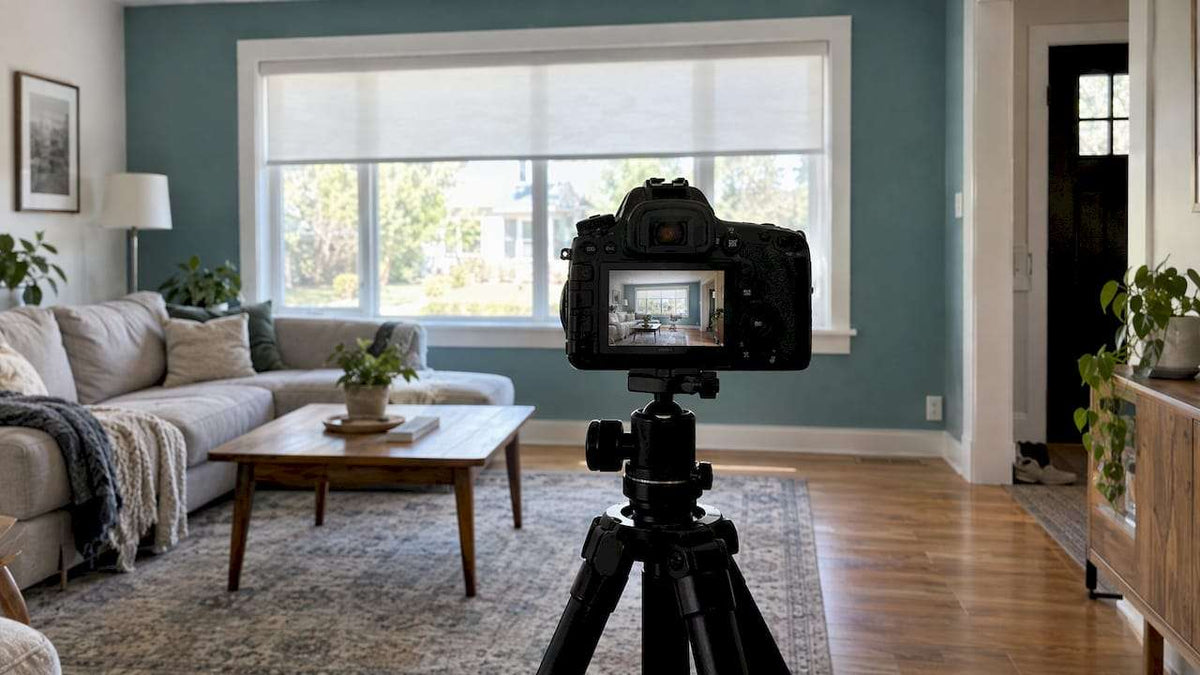
Your eyes adjust constantly. Walk into a sunny living room and you see the view outside, the cozy shadowed corner and the sofa all at once. A camera can’t do that. According to real estate photographer Dustyn Reno, a camera captures one exposure at one moment, so the same room can show up as a blown-out window and a black hole.
That is why window coverings matter so much in photos. Estate Agent Today notes that natural light is the biggest factor in how a room photographs, and that coverings give photographers and stylists a way to balance both too little and too much light. Soft, even light tends to make rooms feel larger, so coverings that diffuse daylight rather than block it usually work best for listing images.
In plain terms, your windows are doing two jobs in every photo:
- Setting the light. They decide whether the room looks airy and welcoming or harsh and uneven.
- Telling a story about care. They are big, visible and impossible to ignore, so buyers read them as a clue about the whole house.
Open, closed or in between?
Photographers do argue about this. Some forum threads make the case that closed blinds are easier to expose for technically, since the white balance isn’t thrown off by bright daylight. But most staging guidance for sellers points the other way. Matterport recommends maximizing natural light by opening curtains and blinds so sunlight can fill the rooms, plus turning on interior lights and making sure all bulbs have the same warmth.
A practical way to settle it:
- Open fully in most rooms, especially if the view is pleasant and the window isn’t facing a neighbor.
- Use a soft partial close or a light-filtering layer in rooms where direct sun creates glare. Estate Agent Today suggests soft partial closing in glaring rooms and raising blinds fully for daytime inspections.
- Ask your photographer. They know how their camera handles bright windows and which rooms need a different approach.
The one thing that doesn’t work is a random mix. Reno describes a shoot where the blinds were up in some rooms and down in others, and the whole house read dark. In his words it was a house with the light turned off in half of it. Raising the closed blinds also uncovered cobwebs, which told him plenty about how the property had been kept. Ugh. Don’t let that be your listing.
Your pre-photo window checklist
This takes an afternoon, and it can change how every photo looks.
- Clean everything. Wipe slats, vacuum fabric shades, dust the headrails and wash the glass. Look behind the blinds too, since that’s where the dust and cobwebs hide.
- Repair or remove damage. Bent slats, broken cords, stained fabric and sun-faded panels all draw the eye.
- Match heights. Raise every blind to the same level in every room, and pull curtains all the way back past the frame. This is a simple tip from Reno’s staging advice.
- Keep the front rooms consistent. Estate Agent Today recommends a consistent look across the front rooms, which also helps the exterior shot.
- Choose calm colors. The same source points to neutral whites, creams and soft greys that match the room.
- Check privacy. Bedrooms and bathrooms that face neighbors need coverings that still look good open or partly closed.
- Look outside the window. The National Association of Realtors points out that the outside of the windows will be seen in photos. Piles of trash under blue tarps will come through, so clean the area up or consider a frosted film if you can’t.
- Turn on the lights. Matching bulb warmth keeps the interior from clashing with daylight.
If you are working through a bigger prep list, our step-by-step staging guide covers the whole house. For budget-friendly fixes beyond windows, this walkthrough of home staging fixes on a budget is a handy companion.
Which window treatments photograph well
Every home is different, but here is how common styles tend to come across in photos. This is our practical read, based on how light, lines and texture behave on camera.
| Style | What it does in photos | Best for |
|---|---|---|
| Roller shades | Clean, flat look with minimal visual noise | Modern living rooms, home offices, kitchens |
| Zebra shades | Alternating sheer and solid bands that let you dial in light | Rooms with strong sun and big windows |
| Cellular shades | Soft, tidy look with a neat stacked profile | Bedrooms and anywhere you want a calm feel |
| Roman shades | Soft folds that add warmth and texture | Dining rooms, primary bedrooms, living spaces |
| Faux wood blinds | Crisp horizontal lines that feel classic | Kitchens, bathrooms, family rooms |
| Solid wood blinds | Warm, natural, upscale feel | Studies, living rooms, traditional homes |
| Vertical blinds | Strong vertical lines that suit wide openings | Sliding doors and large patio doors |
A few patterns hold across all of them. Light-filtering fabrics in white, cream or soft grey keep windows glowing without a glare. Flat, simple profiles photograph cleaner than busy ones. And matching treatments across sightlines (say, the living room and dining room you see in one shot) make the space feel planned.
Not sure which light level fits which room? Our guide to light control labels breaks it down, and room by room picks can speed up the decision.
What about bare windows or sheers?
In rooms with a beautiful view and no privacy concerns, leaving windows bare or hanging simple sheers can work. Stage My Own Home suggests that exact approach, and it also cautions against wildly patterned or garish coverings when a house is for sale. For most homes, though, a simple covering that you can set evenly is the safer bet for consistent photos.

What buyers read into your windows
Buyers rarely say “nice blinds.” They say a house feels light, move-in ready, cared for. The Institute of Home Staging describes this well: buyers notice details they can’t quite articulate, and window treatments are frequently the reason a room feels light, spacious and considered.
The flip side matters just as much. Estate Agent Today observes that bent slats, sagging fabric or sun-faded curtains can suggest other maintenance has been put off, while tidy, consistent coverings support confidence in everything the buyer can’t see.
So before you list, scan your home for:
- Yellowed, warped or cracked plastic or vinyl slats
- Mismatched colors between rooms that share sightlines
- Cords that dangle, tangle or hang at different lengths
- Fabric that is faded on the sun side
- Heavy, dark drapes that shrink a room in the photos
- Bare, uncovered windows in bedrooms facing a neighbor
Designer Celerie Kemble told The New York Times that leaving flimsy, junky blinds up advertises that a place is only worth halfhearted practicalities. Her suggestion for sellers who don’t want to spend: at least take the old blinds down rather than leave them up. That quote dates from 2011 and the dollar figure she gave then is not a current price, but the logic still holds.
Curb appeal starts at the street-facing windows

The first photo in most listings is the exterior, and the windows are a big part of it. Curb appeal is simply how inviting your home looks from the street, and coverings you can see from outside are part of that picture.
A few simple rules:
- Make the front uniform. From the sidewalk, every covering should look like it belongs to the same home. Matching colors or backings facing out keep the facade tidy.
- Keep heights even. Half-raised blinds at random levels look careless in a wide exterior shot.
- Choose a calm, neutral color. Coverings that blend with trim and siding let the architecture shine.
- Think outdoors too. Porches and patios photograph beautifully with the right shade. Our exterior shades, retractable awnings and pergolas are made for that kind of outdoor living space.
Architectural details like shutters also add character. One 2026 roundup of curb appeal ideas says that properly proportioned decorative shutters can add perceived value when coordinated with the door and trim. Treat that as a styling idea rather than a guaranteed return.
Do window treatments add value, or just help the sale?
Honest answer: mostly they shape perception. The Institute of Home Staging says window treatments contribute indirectly to sale price, by adding to the sense of quality and finish buyers use to judge value. The Curtain reports that agents and appraisers say well-chosen treatments make homes more attractive, help them photograph better online and support a move-in ready perception.
That is why it pays to think of window treatments as part of your marketing. They are one of the quicker, lower-cost updates compared with a renovation, and they show up in every photo. If you want to see how appraisers and agents think about it, read our piece on window treatment ROI for home sales, and our explainer on why neutral blinds help stage homes.
Our perspective
We see window treatments as the cheapest way to change the whole mood of a listing photo. A window is the brightest spot in any frame, so whatever hangs there gets a lot of attention, good or bad.
Our advice is simple: pick calm, neutral, light-friendly styles, make them match across the rooms people see together, and make them fit the window properly. A made-to-measure shade that sits square in the frame looks planned. A store-bought blind that is an inch too short looks like an afterthought.
That’s why we built our catalog around custom sizing, free swatches so you can see the fabric in your own light, and options like cordless operation for a clean, safe look. Motorized shades add something extra for photo day: every shade in the house can be set to exactly the same height with the press of a button. No more half-raised blinds in the background of your kitchen shot. 🙌
If you are listing soon, start with the windows buyers see first: the front of the house, the living room and the primary bedroom.
Sunny
Ready to refresh your windows before you list?
If your current coverings are tired, mismatched or missing, a quick refresh can lift every photo in your listing. We make custom blinds and shades in styles from roller and zebra shades to cellular, Roman, wood and bamboo, with options for motorization, cordless operation and blackout. You can order free swatches to check colors in your own light, and we offer professional measuring and installation if you’d rather not do it yourself.
Browse the full range on our Value Blinds homepage, and give yourself plenty of lead time, since made-to-order products need time to be made and shipped before photo day. Measuring? Our blog also covers maximizing natural light and staging window treatments in more detail.
FAQ
Should blinds be open or closed in real estate photos?
In most rooms, open them fully and to the same height, so daylight fills the space. In rooms with harsh glare, a soft partial close or a light-filtering shade can keep the window from blowing out. Ask your photographer which rooms need special handling.
What window treatments appeal to buyers?
Clean, contemporary and consistent coverings in neutral colors such as white, cream and soft grey tend to appeal most. Avoid wild patterns and anything damaged or faded. The goal is for the windows to feel light and cared for, not to be the star of the room.
Do window treatments increase home value?
They mainly influence buyer perception rather than adding a separate line to the appraisal. Well-chosen treatments help a home look finished, move-in ready and better in online photos, which supports how buyers judge its overall quality.
Is it better to remove old blinds than leave them up?
If the existing blinds are bent, stained or faded, taking them down is better than leaving them in view. A designer quoted in The New York Times gave the same advice. Replacing them with a clean, matching set is better still when the budget allows.
How early should I order new window coverings before photos?
Order as early as you can. Custom coverings are made to your measurements, so they need production and shipping time. Order free swatches first, confirm your sizes, and plan for installation before the photographer arrives.
Sources
- Dressing the Windows: How Window Coverings Shape First Impressions at Inspections
- Staging Tips Before Real Estate Photography | Camera vs Eye
- 7 Expert Tips to Get a House Ready for Listing Photos
- Top Tips for Staging a Home for Photos, National Association of Realtors
- Window Treatments in Property Styling
- Do Upgraded Blinds or Curtains Help Sell a Dwelling? The New York Times
- Window Treatments for Home Staging
- Curb Appeal Ideas: 13 Proven Ways to Boost Home Value
- Do Window Treatments Increase Home Value?