
Article: Homeowners: Large Windows Over 96 Inches Need Blinds That Don't Sag

Homeowners: Large Windows Over 96 Inches Need Blinds That Don't Sag
For large windows, the best options are panel track blinds, motorized roller shades, and cellular shades. Panel track handles wide sliding doors without stacking bulk, motorized roller shades manage heavy spans without straining a cord system, and cellular shades add insulation across tall openings. All three need a reinforced headrail and accurate three-point measuring. If your window runs past 96 inches wide or 84 inches tall, get a professional measure before you order anything.
TL;DR:
- Cellular shades, panel track systems, and motorized roller shades perform best on spans from roughly 78 to 153 inches due to their lightweight materials and sturdy lift mechanisms.
- Support features like reinforced headrails, center supports, and split panels are essential to prevent sagging in wide spans exceeding 96 inches.
- Layering blinds with drapery involves mounting the curtain rod wider and higher than the window frame to add visual weight and scale to large openings.
- Accurate three-point measurements, considering inside or outside mount suitability, are critical for proper fit and function on oversized windows.
- Professional installation is recommended for large, complex, or heavy spans, especially when out-of-square frames, arches, or ceiling mounts are involved.
Table of Contents
- What Are the Best Window Blinds for Large Windows?
- How Do You Layer Blinds With Drapery on a Big Window?
- How Do You Measure and Mount Blinds on Wide Windows?
- Should You Choose Motorized, Cordless, or Manual Operation?
- Which Materials Give the Best Light Control and Insulation?
- Why Do Wide Blinds Sag, and How Do You Prevent It?
- How Do You Style Blinds So a Big Window Looks Intentional?
- What Drives the Cost of Blinds for Large Windows?
- Should You Install Large Window Blinds Yourself or Hire a Pro?
- How Valueblindsdirect Helps You Get Large-Window Blinds Right
- Two Mistakes I See Homeowners Make on Large Windows
- Ready to Order Custom Blinds for Your Large Windows?
- Sources
- FAQ
What Are the Best Window Blinds for Large Windows?
Not every blind style holds up when the window in question is bigger than a standard door. Weight, sag, and stacking bulk become real problems once you cross into “large window” territory, so the type you pick matters more than the color or the price tag.
- Panel track blinds: These work like sliding fabric panels on a track system, which makes them the go-to for wall-to-wall openings and patio doors. They glide open into a stack at one side instead of piling up in the middle, and wider tracks can be split into two or three panels to keep the stack manageable.
- Roller and motorized roller shades: A roller shade gives you a clean, almost architectural look, and you can order it in custom widths that would look strange on a traditional blind. On spans over 8 feet, motorization does the heavy lifting literally, since a heavier fabric roll puts real strain on a manual clutch.
- Cellular (honeycomb) shades: These are lightweight relative to their size, which is exactly why they perform so well on tall windows where a wood slat blind would sag. Top-down/bottom-up versions let you drop light in from above while keeping the bottom section closed for privacy.
- Vertical blinds: An older category, but still one of the most reliable large vertical blinds solutions for sliding glass doors, since the vanes rotate and stack to one side without bunching.
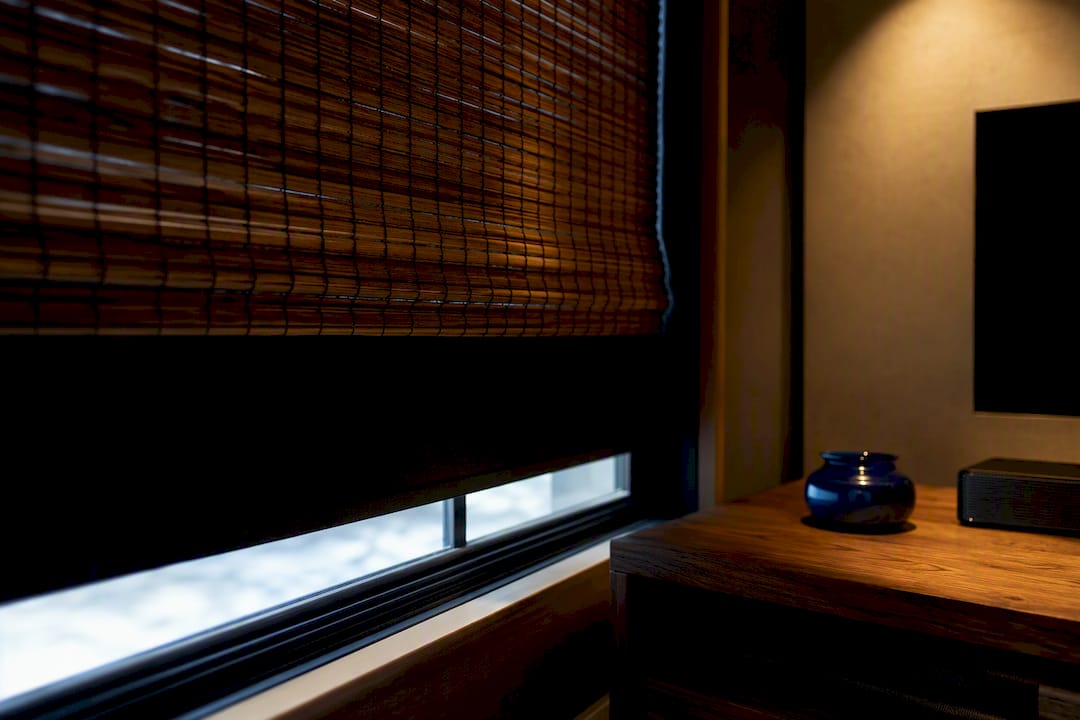
- Roman shades and woven wood: These bring texture and warmth that flat fabrics can’t match, but only choose them for large windows when the panel width stays moderate. Heavy natural materials on a very wide single span tend to bow at the center.
Testing across wide-window installations consistently points to cellular shades, panel track systems, and motorized roller shades as the top performers on spans from roughly 78 to 153 inches, mainly because of lightweight materials paired with sturdier lift mechanisms. For a broader rundown on matching styles to your window’s shape, our guide on how to choose blinds for large windows breaks down the tradeoffs further.
How Do You Layer Blinds With Drapery on a Big Window?
Designers call it the “workhorse and statement” approach: one layer does the functional job, the other does the visual one. Your blind is the workhorse, handling privacy and light control every single day. Your drapery is the statement, adding softness, color, and the illusion of a taller, grander window.
The trick that makes this work is mounting the drapery rod wider and higher than the window frame itself, typically extending it 12 to 18 inches past each side. Floor-length panels (or even a half-inch of “kiss” on the floor) add visual weight that keeps a large window from feeling like a bare hole in the wall.
- Two-layer setup: Blind for daily privacy, drapery for evening warmth and framing.
- Three-layer setup: Sheer fabric closest to the glass for daytime softness, blind in the middle for full privacy or blackout, and a heavy drape on the outside for scale and insulation on cold nights.
- Top treatments: A valance, cassette, or cornice box hides the headrail and cords, giving the whole installation a built-in, custom look rather than an obviously off-the-shelf one.
Professional guidance on furnishing large-window rooms leans hard into this layering habit, pairing a functional blind with statement drapery to create scale that a single treatment can’t achieve alone.
Pro Tip: If you’re not sure which mode you’ll use most, order your blind in a light-filtering fabric rather than full blackout. You can always add a blackout liner or a heavier drape layer later, but you can’t lighten up a fabric that’s already too dark.
How Do You Measure and Mount Blinds on Wide Windows?
Getting the measurements right matters more on a large window because small errors multiply across a wider surface. Here’s what to check before you place any custom order:
- Measure width in three places: top, middle, and bottom of the opening. Use the smallest number for an inside mount so the blind clears the frame; use the largest for an outside mount so coverage is complete.
- Measure height in three places: left, center, and right. Same rule applies. Wood frames settle over time, and older large windows are rarely perfectly square.
- Decide inside vs. outside mount. Inside mount tucks the blind into the window recess for a clean, built-in appearance, but it needs at least 2 to 3 inches of depth. Outside mount covers the whole frame and any gaps, and it’s usually the better call on very wide or uneven openings since it hides hardware and preserves the full view when the blind is raised.
- Check headrail support. Wide spans need a reinforced headrail, and openings beyond a single manufacturer’s maximum width often require a center support bracket or a split into two tracks.
- Flag special cases up front. Bay windows need angle measurements at each corner, arched windows need a custom template, sliding doors need clearance for the stack, and ceiling-mounted systems need blocking installed in the ceiling before the blind arrives.
Our full walkthrough on how to measure windows for custom blinds covers the tools and step-by-step process in more detail, and the bay window measuring guide is worth a look if your opening isn’t a simple rectangle.
Should You Choose Motorized, Cordless, or Manual Operation?
Once a shade gets wide or tall enough, lifting it by hand or cord stops being a minor inconvenience and starts being a genuine daily chore.
- Motorized: This is where large windows really shine. A motor lifts even a heavy fabric roll evenly across its full width, which puts less wear on the lift mechanism over time compared to a manual system fighting the same weight. Motorization is increasingly treated as a near-necessity on very wide or tall shades, not just a luxury upgrade.
- Cordless and wand systems: These are the safer manual option, especially with kids or pets around, but they have real limits. A cordless spring lift can handle moderate widths comfortably; push it past a certain size and the pull becomes noticeably harder.
- Battery vs. plug-in vs. hardwired: Battery motors are the easiest retrofit and work well for occasional use. Hardwired motors suit windows you’ll open and close daily, since there’s no battery to recharge.
- Smart integration: Ecosystems like PowerView by Lutron let you set schedules, scenes, and voice commands, which becomes genuinely useful once you’re controlling multiple panels across one big window or a wall of them.
Check the warranty terms on the motor and drive system separately from the fabric warranty. They’re often different, and the motor is the part most likely to need service down the road. Our motorized blinds guide walks through the remote and app options in more detail.
Which Materials Give the Best Light Control and Insulation?
Fabric choice on a large window affects a lot more than looks. It changes how much heat escapes through the glass, how much glare hits your couch at 4 p.m., and how private the room actually feels.
- Cellular shades: The honeycomb structure traps air in pockets, which helps insulate against both summer heat and winter cold. This is one of the biggest reasons designers reach for cellular fabric on tall windows specifically, where surface area (and heat loss) is greatest.
- Solar fabrics: These preserve your view while cutting glare and UV exposure, rated by an “openness factor” that tells you how much you’ll still see through the fabric when it’s down.
- Blackout systems: Bedrooms and media rooms usually need a dedicated blackout fabric or a layered solution (blackout roller behind a decorative drape) rather than relying on a single light-filtering shade to do double duty.
- Woven and natural shades: These bring texture and warmth that synthetic fabrics can’t fake, but the weave itself lets in small light gaps around the edges, and natural fibers need more careful cleaning than vinyl or polyester.
Top-down/bottom-up cellular configurations are especially popular on large windows because they let in daylight from the top while keeping the lower half closed for privacy, which solves the classic large-window problem of choosing between light and privacy.
Why Do Wide Blinds Sag, and How Do You Prevent It?
Weight is the enemy of a wide span, and it’s the detail most people underestimate until their blind starts drooping in the middle. Testing across large-window installations found that material weight matters more than most buyers expect: heavy wood or thick faux-wood slats bow under their own weight once a single panel stretches much past 72 to 96 inches, while lightweight cellular fabric and roller material hold their shape.
A few fixes prevent this before it becomes a problem:
- Reinforced headrails add rigidity along the full width, which matters more as width increases.
- Center supports bolt to the wall or ceiling at the midpoint of an especially wide track, catching the sag before it starts.
- Multiple tracks or split panels break one oversized span into two or three manageable sections, each carrying its own weight.
For sliding doors, plan your panel stack width against your actual clearance. A stack that’s too tight blocks the door track; too loose and you lose fabric coverage at the edges. Center supports and multi-track systems are a routine part of professional large-window installs for exactly this reason.
How Do You Style Blinds So a Big Window Looks Intentional?
Color changes how a large window reads in a room. Dark tones on a big blind make the window feel grounded and architectural; light neutrals let it recede so the view or the light becomes the focus instead of the hardware.
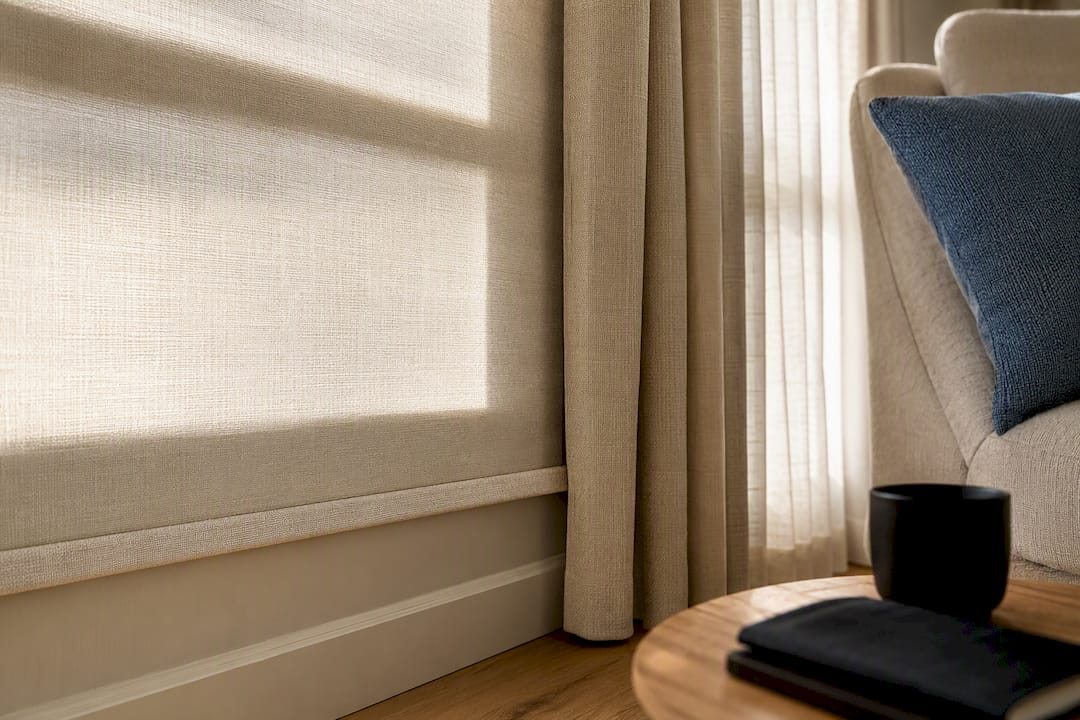
Hiding the headrail matters more on a large installation because there’s simply more of it to see. A cassette valance or a paintable headrail cover, matched to your trim color, turns an obviously store-bought blind into something that looks built into the wall.
Coordinate your blind and drapery with your floor tone and your furniture, not just each other. If your window already has a great view or interesting architecture, let the treatment stay simple and quiet rather than competing with it. A valance or cornice at the top finishes the whole look and gives a wide installation the same polish you’d expect from a custom drapery job. Our best blinds for large windows roundup has more side-by-side comparisons if you’re still deciding on a direction.
What Drives the Cost of Blinds for Large Windows?
Custom sizing is the first cost driver, since a window outside standard stock dimensions almost always means a made-to-measure order rather than an off-the-shelf panel. Extra-wide roller blinds and panel-track systems are frequently built to custom specs precisely because standard sizing runs out before the window does.
Motorization adds cost on top of the fabric and frame price, but it’s worth the investment on any shade you’ll operate daily, or on any span too heavy to lift comfortably by hand. Premium fabrics (real wood, natural woven materials, high-openness solar screens) cost more per square foot than basic vinyl or polyester, and professional installation adds a line item too, though it protects your investment against a bad mount.
A few ways to keep costs sensible without cutting corners on function:
- Stick to standard widths where your window allows it, saving custom fabrication fees for openings that truly need them.
- Choose lightweight fabrics over heavy wood on any span approaching your manufacturer’s maximum width.
- Order multiple windows in the same project together, since bundled orders often reduce per-unit costs.
Request free fabric swatches before committing to a color or opacity level, and get an actual quote rather than guessing, since large-window pricing varies enough by fabric and mechanism that estimates rarely hold up.
Should You Install Large Window Blinds Yourself or Hire a Pro?
DIY installation makes sense for shallow, standard-shaped windows with a lightweight shade and a straightforward inside or outside mount. If you’re comfortable with a level, a drill, and following a template, a single roller shade or cellular shade on a normal window is a reasonable weekend project.
Hire a professional once you’re dealing with a bay window, an arch, a ceiling mount, or any span heavy enough to need center supports. A professional measure-and-install service typically includes:
- Precise, on-site three-point measurements that account for out-of-square frames.
- Reinforced mounting hardware sized correctly for the span and weight.
- A workmanship warranty that a self-install usually won’t carry.
Before requesting a quote, have your rough measurements, your preferred operation (motorized, cordless, manual), and the room’s actual use (bedroom needing blackout, living room needing daylight control) ready to share. And on genuinely large installations, particularly anything requiring a tall ladder or ceiling work, professional installation is the safer call over a DIY attempt on an unfamiliar surface.
How Valueblindsdirect Helps You Get Large-Window Blinds Right
Getting a big window right on the first try comes down to accurate measuring and picking hardware built for the span you actually have. Valueblindsdirect specializes in custom window treatments, including the motorized options that matter most once a blind gets wide or tall.
Before you order, the site’s measurement guides and design tools walk you through the exact three-point measuring process covered above, so you’re not guessing at width and height on an oversized opening. Fabric swatches allow checking color and opacity in actual room lighting before committing to a custom order, which matters more on large windows where mistakes are costly to correct.
For anything beyond a standard shallow window, the Pro Measure & Install service and product warranties take the guesswork (and the ladder risk) out of fitting reinforced hardware on a wide or tall span. If you’re still deciding on a fabric or style, start with a free swatch order and the measurement guide before you finalize your large-window order.
Two Mistakes I See Homeowners Make on Large Windows
Working through large-window projects again and again, the same two mistakes keep showing up. First: choosing an outside mount purely for looks on a window where an inside mount would’ve hidden more hardware, or vice versa, without checking actual frame depth first. Measure your reveal depth before you decide.
Second: underestimating support needs on anything past 96 inches wide. A standard headrail without a center support will eventually sag on a heavy fabric, and by then you’re paying to fix a problem a $20 bracket would’ve prevented. If your span is wide, ask about center supports before you order, not after installation.
— Sunny
Ready to Order Custom Blinds for Your Large Windows?
Once you know which approach fits your window, the next step is turning that decision into an actual order, and this is where Valueblindsdirect earns its place over a generic big-box blind rack. Standard stores stop at standard sizes; a large or oddly shaped window usually needs the kind of made-to-measure fit that only a custom order provides.
Browse the roller shades and cellular shades collections to see custom widths and motorization options built for exactly the spans covered in this guide, or check the full blinds collection if you’re still comparing styles. Every custom order comes backed by a warranty, and free swatches let you confirm color and opacity before you commit. If your window is wide, tall, or an unusual shape, schedule Pro Measure & Install through Valueblindsdirect so your hardware gets fitted and reinforced correctly the first time.
Sources
The measurement rules, layering technique, and material comparisons in this guide draw on professional design sources covering large-window styling, extra-wide made-to-measure options, and tested performance across wide-window blind types, linked throughout the sections above for readers who want the fuller detail.
- 16 Ideas for Dressing Large Windows with Blinds & Curtains
- 10 Best Blinds for Large Windows (August 2026) In-Depth Reviews
- Expert Guide to Extra Long & Extra Wide Blinds for Large Windows
- Home with large windows: how to furnish it
FAQ
Which blinds are best for large windows?
Panel track blinds, motorized roller shades, and cellular shades consistently perform best on large windows because they balance light weight with strong lift mechanisms across wide spans. Panel tracks suit sliding doors and wall-to-wall openings specifically, while cellular shades excel on tall windows where insulation matters.
What is the best window covering for large windows?
There’s no single best covering for every large window; the right choice depends on whether the window is wide, tall, or a sliding door. A layered setup combining a functional blind with drapery, following the workhorse and statement approach, tends to work best for both function and finished appearance.
What is the best way to cover a large window?
Start with an accurate three-point measurement, then choose a blind style matched to the window’s shape: panel track for sliding glass, cellular for height and insulation, motorized roller for heavy manual lifting. Add a drapery layer mounted wider and higher than the frame to add visual scale.
Do you put blinds on big windows?
Yes, and blinds are actually a better functional choice than drapery alone on big windows since they offer precise light and privacy control that fabric panels can’t match on their own. Most professional installations pair a blind as the primary function layer with drapery added for style, rather than choosing one or the other.
Do large windows need professional installation?
Not always. Standard-shaped windows with lightweight shades are reasonable DIY projects, but bay windows, arches, ceiling mounts, and very wide spans needing center supports are better handled through a professional measure-and-install service to avoid sag and mounting errors.