

Custom window treatments: Essential basics for stylish homes
Window treatments are one of the most underestimated elements in any home. Most people pick curtains for looks alone, but the right window covering also shapes how much light enters a room, how private your space feels, and how much you spend on heating and cooling. Window treatments impact privacy, energy efficiency, and comfort in ways that go far beyond decoration. Whether you’re furnishing a new home or refreshing a single room, understanding your options makes all the difference. This guide walks you through everything you need to know.
Table of Contents
- Understanding custom window treatments
- Comparing window treatment types: Options and features
- How custom window treatments enhance home functionality
- Essential customization tips: Measuring, layering, and installation
- Maintenance basics: Keeping your custom window treatments fresh
- Upgrade your home with custom window treatments
- Frequently asked questions
Key Takeaways
| Point | Details |
|---|---|
| Types of treatments | Drapes, blinds, shades, and shutters each have distinct features for customization. |
| Functional benefits | Custom window treatments enhance privacy, energy efficiency, and home comfort. |
| Measuring tips | Proper measurement and installation are critical for achieving a truly custom fit. |
| Maintenance matters | Regular cleaning and mindful care extend the lifespan and performance of window treatments. |
| Layering enhances design | Using layers increases both visual appeal and practical performance for residential windows. |
Understanding custom window treatments
The word “custom” gets thrown around a lot in home decor, so let’s be precise about what it actually means. A custom window treatment is made to your exact window measurements, your chosen fabric or material, and your specific functional needs. It is not a standard size pulled off a store shelf and trimmed to fit.
Off-the-shelf treatments are designed for average windows. The problem? Most windows are not average. Older homes especially tend to have irregular dimensions, and even new construction can surprise you with windows that are a few inches off from standard sizing. Custom treatments solve this by fitting perfectly every time.
Before you start shopping, it helps to know the basic vocabulary:
- Drapes and curtains: Soft, fabric-based panels that add warmth and a decorative layer to any room
- Blinds: Hard-slatted coverings that give you precise control over light and privacy
- Shades: Single-piece fabric coverings that roll, fold, or stack, including Roman, roller, and cellular styles
- Shutters: Rigid, architectural panels mounted inside or outside the window frame
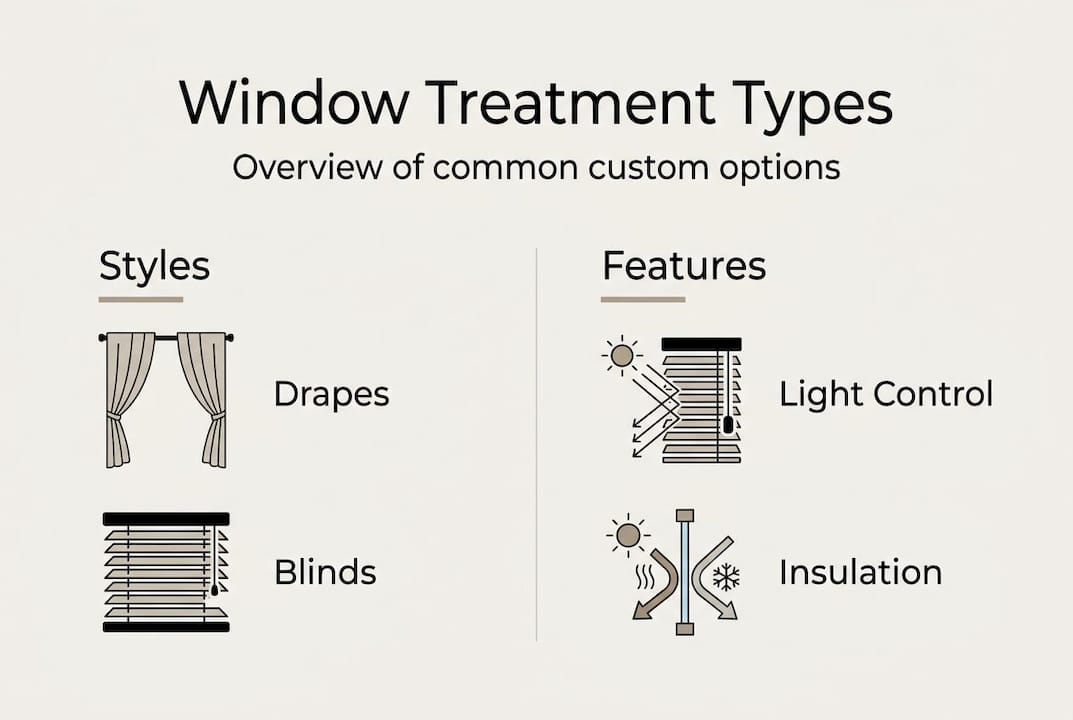
Common types include drapes and curtains for soft decoration, blinds for precise light control with slats, shades for insulation, and shutters for durability and architectural appeal. Knowing these four categories helps you narrow down what fits your lifestyle. You can explore the full range of styles and benefits to see how each type performs in real homes, or read how the right choice can transform your living space from ordinary to polished. When style meets function, the result is a room that works as well as it looks.
Comparing window treatment types: Options and features
With a solid understanding of the terminology, let’s explore how each treatment type stacks up and which options make sense for your home.
Drapes and curtains are the most versatile option. They come in hundreds of fabrics, patterns, and lengths. They layer beautifully over blinds or shades, adding softness and visual height to a room. The downside is that heavy drapes can be harder to clean and may block too much light in smaller spaces.

Blinds give you the most precise light control. You can tilt the slats to let in a sliver of sunlight or close them completely for full privacy. Wood, faux wood, and aluminum are the most popular materials. Wide slats read as more modern and architectural; narrow slats feel more traditional.
Shades are the workhorses of the window treatment world. Roman shades fold into neat horizontal pleats. Roller shades retract into a slim tube. Cellular shades (also called honeycomb shades) trap air in their pockets, making them the top choice for insulation.
Shutters are the most permanent option. They add real architectural value and are especially popular in coastal and Mediterranean-style homes. They are also the most expensive, but they last for decades.
| Treatment type | Customization | Light control | Insulation | Best for |
|---|---|---|---|---|
| Drapes/curtains | High | Moderate | Moderate | Living rooms, bedrooms |
| Blinds | High | Excellent | Low | Kitchens, offices |
| Shades | High | Good | Excellent (cellular) | Any room |
| Shutters | Moderate | Good | Moderate | Coastal, traditional homes |
Custom treatments allow you to fit unique window shapes, adjust for light control, and maximize aesthetic impact in ways that off-the-shelf products simply cannot match. When you’re ready to compare options side by side, our guide to choosing treatment styles breaks it down clearly. You can also learn more about [layering window treatments](https://valueblindsdirect.com/blogs/value-blinds/understanding-layering-window treatments) to combine types for maximum performance.
How custom window treatments enhance home functionality
Now that we’ve compared the main treatment types, let’s see how customization directly improves how your home feels and functions.
Customization is not just about looks. It solves real problems. Here are five ways custom treatments make a measurable difference:
- Privacy on your terms. Blackout liners block all outside visibility. Top-down, bottom-up shades let you open the top for light while keeping the lower half closed for privacy. This is a game-changer for street-facing rooms.
- Precise light control. Specialty shapes like arched or angled windows are nearly impossible to cover with standard products. Custom treatments are cut and fitted to match any geometry.
- Energy savings. Cellular shades offer superior insulation, cutting energy costs by trapping air between the window glass and your living space. Insulated drapes add another layer of thermal protection.
- Perfect fit for unusual windows. Bay windows, arched windows, and oversized picture windows all need custom solutions. A standard shade will gap, sag, or simply not fit.
- Visual harmony. Matching materials, colors, and textures across a room creates a cohesive look that feels intentional rather than assembled from whatever was on sale.
“The right window treatment does not just cover a window. It completes a room.”
Pro Tip: If you have a room with both large and small windows, use the same fabric or color family across all treatments to create visual unity, even if the styles differ slightly.
For deeper guidance on saving energy through your window choices, check out our resource on energy efficient window coverings and the science behind cellular shades insulation.
Essential customization tips: Measuring, layering, and installation
After learning how custom window treatments boost functionality, it’s time to tackle the key steps for measuring, layering, and installing them like a pro.
Getting the measurements right is the single most important step. A beautiful shade installed at the wrong size looks worse than a basic one that fits perfectly. Follow these steps:
- Measure width first. For an inside mount (treatment sits inside the window frame), measure the exact width at the top, middle, and bottom. Use the narrowest measurement.
- Measure height. Measure from the top of the frame to the sill, again at three points. Use the longest measurement.
- For outside mounts, add 4 to 12 inches above the frame and 2 to 4 inches beyond each side. This makes windows look larger and blocks more light.
- Hang rods high and wide. Rods hung 4 to 12 inches above and beyond the frame make ceilings feel taller and windows feel grander. This is one of the easiest ways to elevate a room.
- Layer for depth and performance. A sheer roller shade paired with a blackout drape gives you full flexibility: diffused light during the day, complete darkness at night.
Pro Tip: Always double-check your measurements before submitting a custom order. Measure twice, order once. Most custom treatments are non-returnable once cut to size.
Common mistakes include hanging rods too low (makes ceilings feel shorter), choosing treatments that are too narrow (leaves gaps on the sides), and overcrowding a window with too many layers of heavy fabric. Our easy install guide walks you through the process step by step, and the design studio offers personalized advice if you want expert input before you order. For layering inspiration, our [layering tips](https://valueblindsdirect.com/blogs/value-blinds/understanding-layering-window treatments) resource covers the best combinations for every room type.
Maintenance basics: Keeping your custom window treatments fresh
Once your window treatments are installed, it’s important to maintain them for lasting beauty and function.
Custom treatments are an investment. Treating them well extends their life significantly. Here’s what to keep in mind:
- Dust weekly. Use a soft brush attachment on your vacuum or a microfiber cloth. Dust buildup is the number one enemy of fabric treatments and can trigger allergies.
- Spot clean promptly. For small stains, use a mild detergent diluted in water and a soft cloth. Blot, don’t rub.
- Avoid harsh chemicals. Bleach and solvent-based cleaners can strip color from fabrics and damage motorized components. Always check the manufacturer’s care label first.
- For motorized treatments, wipe the motor housing with a dry cloth only. Never spray liquid near the motor or battery pack.
- Rotate drapes seasonally. Sunlight fades fabric unevenly. Rotating panels every few months keeps the color consistent across the full width.
Overcrowding fabric and failing to clean window treatments leads to reduced lifespan and performance, which means you end up replacing them sooner than you should.
Pro Tip: For cellular shades, use a hair dryer on the cool setting to blow dust out of the honeycomb pockets. It’s faster and more effective than wiping.
For a full breakdown of care methods by treatment type, our guide to cleaning window treatments covers everything from delicate silks to faux wood blinds.
Upgrade your home with custom window treatments
Everything covered in this guide points to one clear conclusion: the right custom window treatment makes your home more comfortable, more efficient, and more visually cohesive. Getting there is easier than most people expect, especially with the right tools and support.
At Value Blinds, we make the customization process straightforward. Start with our window treatment design studio for personalized guidance on styles, fabrics, and sizing. Browse our full collection of high-quality blinds or explore our cellular shades for the best in energy efficiency and clean design. Free swatches, expert support, and detailed measurement guides are all available to help you get it right the first time.
Frequently asked questions
What are the main types of custom window treatments?
The main types are drapes and curtains, blinds, shades, and shutters, each offering unique advantages in style, light control, and installation flexibility.
How do I measure for custom window treatments?
Measure your window width and height at three points each, and for outside mounts, hang rods 4 to 12 inches above and beyond the frame to maximize the visual impact.
Can custom window treatments help save on energy costs?
Yes. Cellular shades offer superior insulation by trapping air in honeycomb pockets, and insulated drapes add an additional thermal barrier to reduce heat loss.
What is the best way to clean custom window treatments?
Dust weekly, spot clean with mild detergent, and always avoid harsh chemicals. Follow the manufacturer’s care instructions, especially for motorized or specialty fabric treatments.
Why layer window treatments?
Layering treatments combines aesthetic depth with practical benefits, giving you flexible control over light levels and privacy throughout the day.