
Article: Double Roller Shades Buying Guide: Day and Night Control
Double Roller Shades Buying Guide: Day and Night Control
The best double roller shades pair one light-filtering fabric with one blackout or solar fabric on a single headrail, giving you total control over privacy and glare from one window treatment. Look for cordless or motorized operation if you have kids, pets, or just hate wrestling with cords. Here’s how to start:
- Pick your room’s job: bedroom, living room, or media room each need a different fabric pairing.
- Choose your opacities: light-filtering, solar, or blackout, or a mix of two.
- Decide on controls: cordless, chain loop, or motorized.
- Order free swatches before you commit to a color or opacity.
Valueblindsdirect offers a full measurement guide, free fabric swatches, and a professional measure-and-install option, so you’re never guessing.
Key Takeaways
Double roller shades work best when one fabric handles daytime privacy and the other handles full blackout, controlled cordlessly or by motor for daily ease.
| Point | Details |
|---|---|
| Pair opposite opacities | Combine a light-filtering or solar front layer with a blackout rear layer for full day-to-night control. |
| Match control to household | Choose cordless or motorized shades in homes with kids or pets to avoid exposed cord hazards. |
| Measure before you order | Record width at three points for inside mounts, and confirm bracket clearance for outside mounts. |
| Watch for wide-window sag | Headrails past 60 inches often need a center support bracket to prevent bowing. |
| Order swatches through Valueblindsdirect | Valueblindsdirect provides free fabric swatches, measurement guides, and professional measure and install for custom dual-roller shades. |
Helpful Links for Measuring, Installing, and Verifying Vendors
- How to measure for roller shades for precise inside and outside mount dimensions.
- How to install roller shades for bracket placement and tool checklists.
- The Window Treatment Design Studio to configure and order your dual-roller shades.
- BBB business profiles offer a way to check standing and complaint history for window-covering retailers before you buy.
- For securely mounting brackets on trim or door-adjacent frames, this door and frame installation guide covers fastener choices for different surfaces.
Table of Contents
- What Are Double Roller Shades and How Do They Work?
- Choosing Fabrics and Opacities for Light Control
- Cordless, Chain, or Motorized: Which Control Fits Your Home?
- How to Measure and Install Double Roller Shades
- How to Choose the Right Dual-Roller Setup and Place Your Order
- Recommended Double Roller Setups by Room
- What to Expect From Order to Installed Shade
- Ready to Order? Here’s How Valueblindsdirect Makes It Easy
- Frequently Asked Questions
- Sources
What Are Double Roller Shades and How Do They Work?
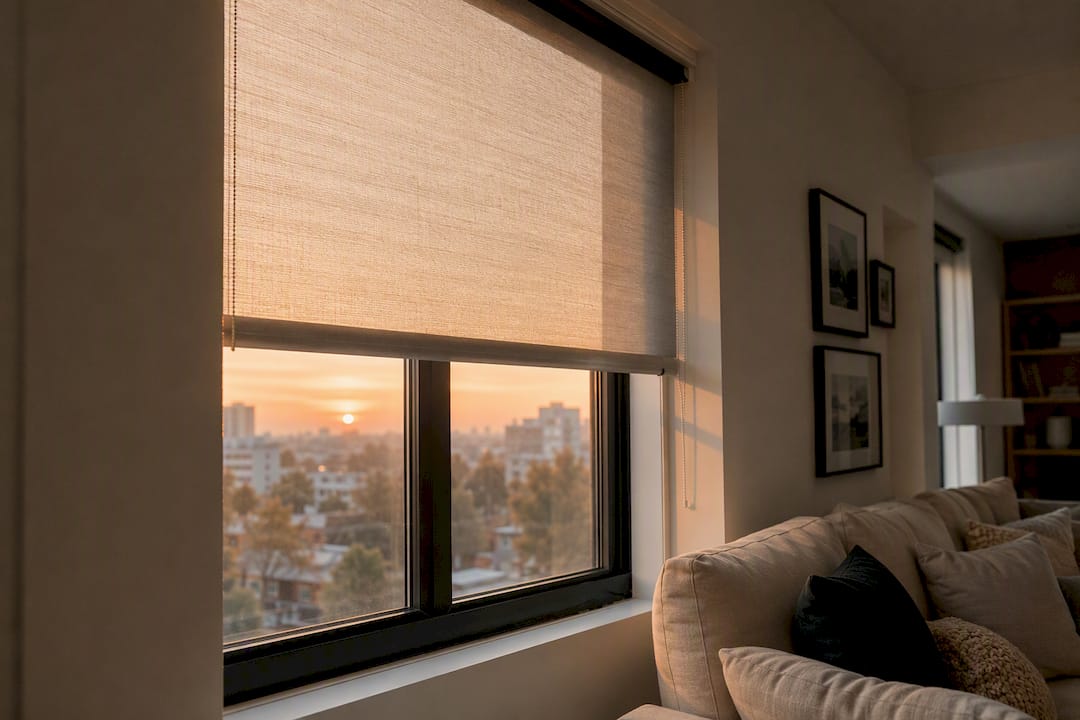
Double roller shades (also called dual roller or day and night shades) use two separate fabric rolls mounted on one shared headrail. One roller sits toward the window, the other toward the room, and each holds its own fabric, its own opacity, and sometimes its own control mechanism.
Picture the headrail as a small horizontal box above your window. Inside, two independent tubes spin on their own brackets, each wrapped in a different fabric. Pull or motor one shade down for daytime privacy with a view-through fabric. Swap to the other for full blackout at night. Some systems use a single integrated clutch that raises both rollers together on a shared chain.
You’ll see a few naming variations depending on where you shop:
- Day and night shades — emphasizes the light-control switch between fabrics.
- Dual roller or double roller — the most literal description of the two-fabric setup.
- Zebra or banded shades — a related but different product using alternating sheer and solid stripes on one fabric, not two separate rolls.
Double roller headrails work with both cassette valances (a fabric-covered box that hides the hardware) and exposed metal headrails for a more industrial look.
Choosing Fabrics and Opacities for Light Control
Fabric choice determines whether your double roller shades actually solve your light and privacy problem, or just look nice while doing half the job. Three opacity classes cover almost every use case:
- Light-filtering: softens glare, keeps some view-through, good daytime privacy.
- Solar/screen: cuts UV and heat while preserving outward visibility, ideal for sunny exposures.
- Room-darkening/blackout: blocks nearly all light, best for sleep or screens.
Matching fabric to room makes the difference between a shade that works and one you regret. Bedrooms usually want blackout on the rear roller and light-filtering on the front. Living rooms often do better with solar on the outside and light-filtering behind it, since you still want to see the yard during the day. Media rooms and home theaters benefit from blackout on both rollers for near-total darkness. Kitchens tend to favor light-filtering pairs since privacy needs are lower and natural light is a bonus.
Combining two opacities on one headrail is what makes double roller shades earn their name. Pairing a solar front layer with a blackout rear layer, for example, lets you dial in daytime glare control, then switch to full privacy at night without touching a second treatment. Keep in mind that heavier blackout fabrics add weight to the roller, so check that the mounting brackets and clutch are rated for both fabrics combined, and confirm the fabric cleaning method before you order dual layers in different weights.
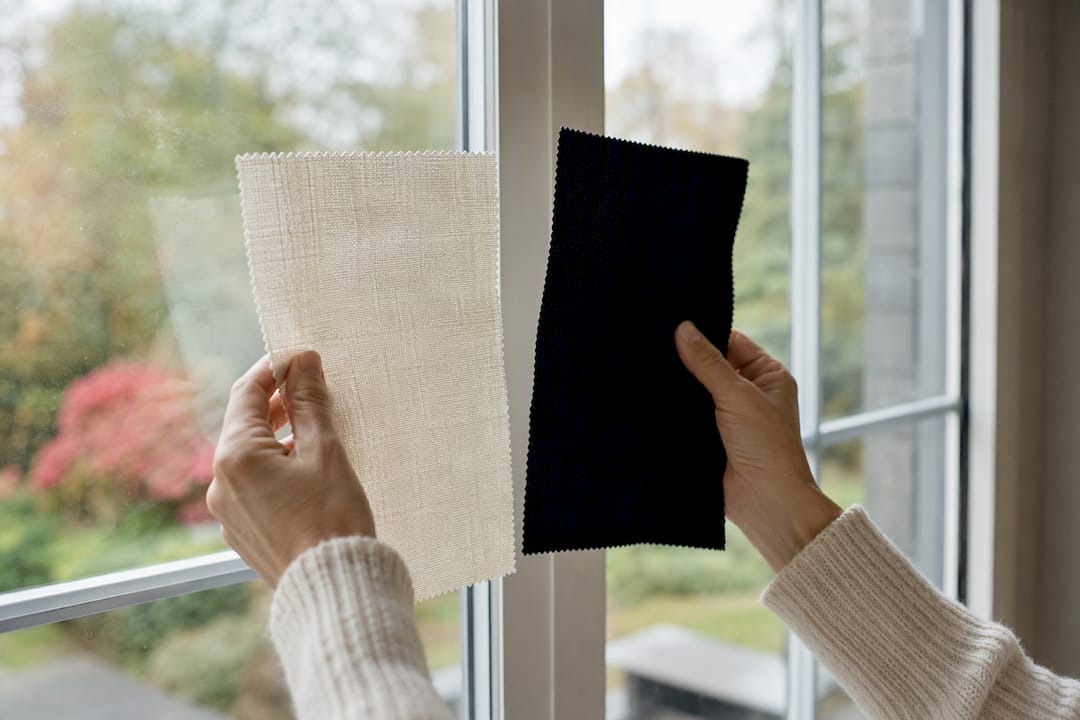
Pro Tip: Hold your fabric swatches up against your actual window at different times of day. Solar fabric that looks great in a showroom can read very differently against west-facing afternoon sun.
Cordless, Chain, or Motorized: Which Control Fits Your Home?
Control type affects daily convenience as much as safety, and dual-roller shades add a wrinkle because you’re often operating two fabrics instead of one.
- Cordless (spring or clutch): no dangling cords, simple push-up or pull-down operation, best default for most households.
- Chain/cord loop: affordable and durable, but exposed cords are a hazard around young kids and pets.
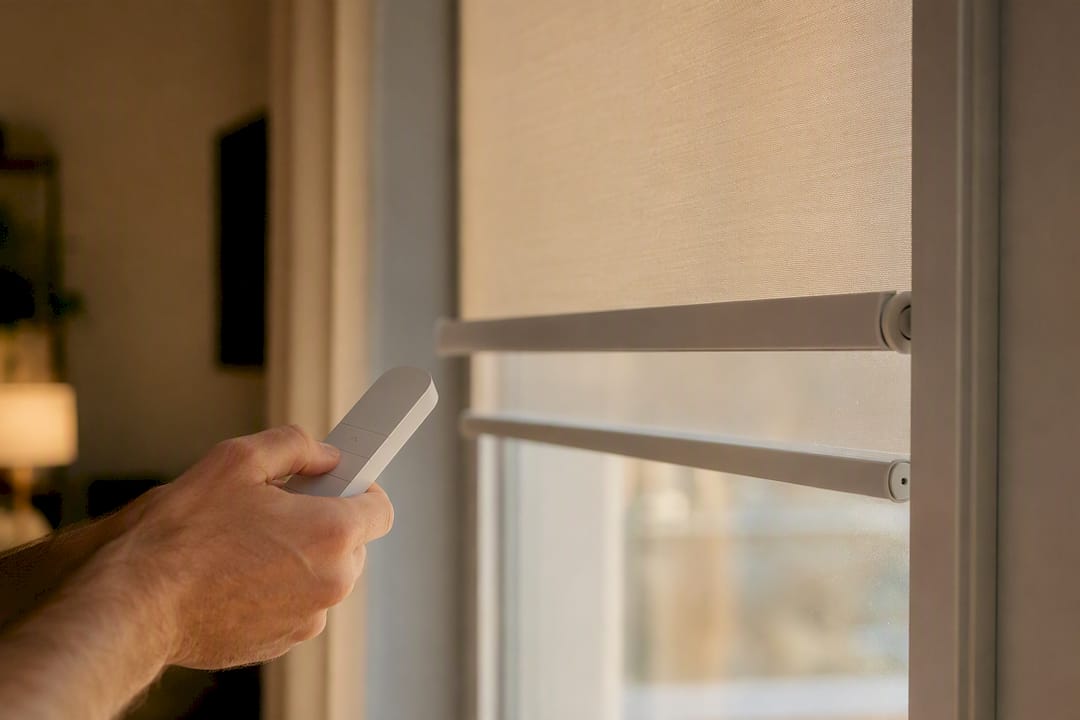
- Motorized (battery or hardwired): app or remote control, works with smart home hubs, and can raise or lower each roller independently or together.
Cordless and motorized options are the safer picks in homes with children or pets, aligning with widely recommended child-safety guidance that favors cordless window coverings. Chain loops remain a solid budget option in adult-only spaces, and they tend to hold up well over years of daily use.
Motorization on a double-roller setup can mean two separate motors, one for each fabric, or a linked system that runs both from a single hub. Before you buy, ask the manufacturer whether each roller motorizes independently and whether the motors integrate with the smart home platform you already use.
How to Measure and Install Double Roller Shades
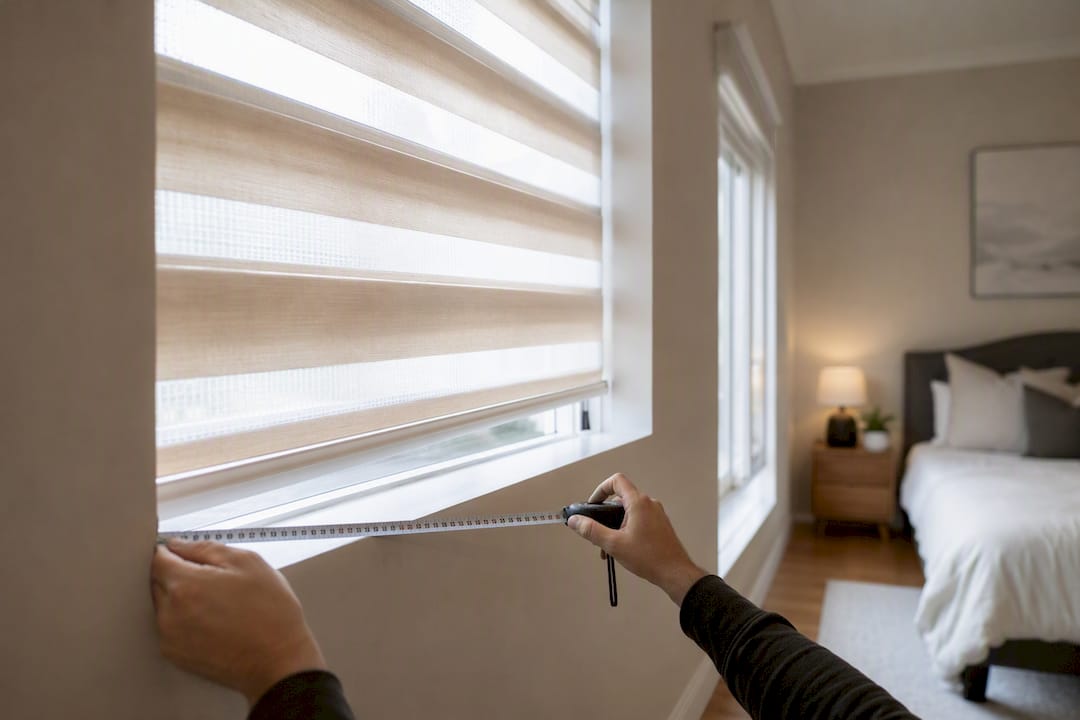
Getting your measurements right is the single biggest factor in whether your double roller shades hang straight and operate smoothly. Start by deciding between inside mount (fits inside the window frame, cleaner look) and outside mount (covers the frame, blocks more light, forgives uneven openings).
For inside mounts, measure the width at the top, middle, and bottom of the opening and use the smallest number. For outside mounts, measure your desired fabric overlap beyond the frame on each side, and leave room for the shade to stack without hitting sills or handles.
Installation tools and materials to gather:
- A level, drill, and pencil for marking bracket positions.
- Drywall anchors for hollow walls, wood screws for solid trim.
- Shims for out-of-square frames.
For outside mounts, place brackets roughly 2 to 4 inches above the window casing so rolled fabric clears the trim, a standard baseline echoed across roller shade installation guidance. Wider double-roller headrails often need a center support bracket to stop the tube from bowing.
Common pitfalls include mounting brackets slightly out of level, which causes fabric to track sideways instead of rolling straight, and skipping pilot holes, which can crack trim on tight installs. Working through a full roller shade measuring guide before you order avoids most of these headaches.
Pro Tip: Order your free swatches and hold them against the window at the time of day you care most about, morning light in the bedroom, afternoon glare in the living room, before locking in your final fabric choice.
How to Choose the Right Dual-Roller Setup and Place Your Order
Your buying checklist boils down to five decisions: room use, fabric pairing, control type, mount type, and any extras like a cassette valance or motor hub.
Price on double roller shades moves with a few clear factors:
- Width and height: larger windows cost more per shade.
- Fabric grade: blackout and specialty solar fabrics run higher than basic light-filtering.
- Motorization: adds cost per roller, more if each layer gets its own motor.
- Professional measure and install: worth it for tricky openings or multi-window projects.
Once you’ve settled on a configuration, expect a sample-first process: request free fabric swatches, confirm opacity and color against your actual window light, then place your order with exact measurements. Lead times vary by fabric and motorization complexity, so ask upfront rather than assuming a standard turnaround. Reputable vendors also spell out their return policy on swatches versus finished custom shades, since custom-cut fabric typically isn’t returnable once cut.
Before you buy, ask the vendor directly: What’s the fabric care and cleaning method? What does the motor warranty cover, and for how long? What’s the process if a roller jams or tracks unevenly after installation? Clear answers here save you a frustrating call later.
Recommended Double Roller Setups by Room
A bedroom setup does best with blackout fabric on the rear roller and light-filtering on the front, giving you a soft daytime glow and full darkness at night. Cordless control works well here, and either inside or outside mount is fine depending on your frame depth.
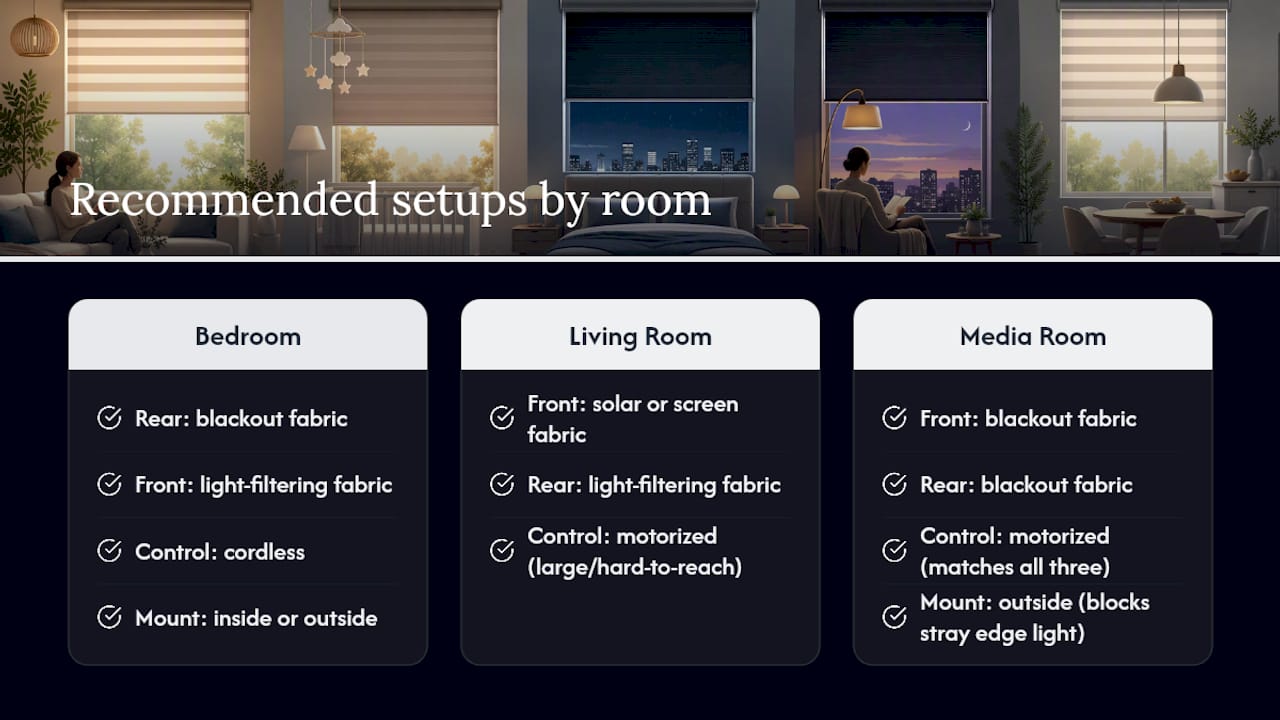
A living room setup favors solar or screen fabric up front with light-filtering behind it, so you keep your view and cut glare during the day. Motorized control is a nice upgrade if the window is large or hard to reach.
A media room benefits from blackout on both rollers for maximum darkness during movie nights. Outside mount is usually the better call here since it blocks more stray light around the frame edges.
Value Blinds’ motorized day and night cellular shades match all three setups, and ordering free swatches first lets you confirm fabric opacity before committing.
What to Expect From Order to Installed Shade
Ordering custom double roller shades isn’t an instant process, but it’s a predictable one once you know the stages. Most buyers move through four phases: measuring and sample selection, order placement, fabrication and shipping, then installation.
The measuring and swatch stage is the part you control most. Take your time here, since exact widths and heights determine everything downstream. Once you submit your order with confirmed dimensions, fabric choices, and control type, the shade goes into fabrication. This is where blackout and solar fabrics get cut to your exact roller length and paired onto the shared headrail.
Shipping timelines depend on fabric availability and whether you’ve added motorization, which sometimes takes longer since motors and batteries or hardwired kits are built to spec. Standard cordless or chain-loop double roller shades tend to ship faster than motorized versions with custom hub pairing.
Installation itself, once the shades arrive, is typically a same-day project for a single window if you’re comfortable with a drill and a level. Multi-window jobs or oddly shaped openings often benefit from professional measure and install, which also covers you if something doesn’t fit quite right. Ask your vendor whether professional installation is bundled with a workmanship guarantee separate from the product warranty, since these are sometimes handled differently.
Setting expectations early, especially around motorized lead times, prevents the most common frustration buyers report: assuming a custom dual-fabric shade ships like an off-the-shelf blind.
A Practical Note From Valueblindsdirect
Most buyers agonize over the fabric pairing, but the real trade-off is usually mount type versus stack clearance. We’ve seen plenty of installs go sideways from a skipped level check, so lean on the swatch samples, the measurement guide, and our warranty support before you order. Help is always a message away.
Ready to Order? Here’s How Valueblindsdirect Makes It Easy
Choosing between fabric pairs and control types is a lot easier when you can hold the actual swatches in your hand instead of guessing from a screen. That’s the real advantage here: you’re not locked into a single fixed configuration, you build the exact dual-roller shade your window needs, then get it measured and installed by people who do this daily.
Start with the Window Treatment Design Studio to configure your fabric pairing, opacity, and control type in one place. From there:
- Order free fabric swatches to check color and opacity against your real window light.
- Browse cordless and no-drill options if child safety or a rental property is a factor.
- Check the motorized day and night cellular shades if you want app-based control on both layers.
- Request a professional measure and install if your windows are large, numerous, or oddly shaped.
Every order is backed by warranty support and a measurement guide built specifically for custom dual-roller shades, so you’re never ordering blind. Visit the design studio today to get your exact configuration started.
Frequently Asked Questions
Can I put two different fabric opacities on the same double roller shade? Yes, that’s the whole point of the design. Most buyers pair a light-filtering or solar fabric on one roller with a blackout fabric on the other, switching between them depending on the time of day.
Are double roller shades hard to install myself? A single window is usually a manageable DIY project with a level, drill, and the right anchors. Wider windows, multiple rooms, or motorized setups are where professional measure and install starts to pay off.
Do motorized double roller shades need two separate motors? It depends on the manufacturer. Some systems use one motor per roller for independent control, while others link both rollers to a single motor and hub. Ask this directly before ordering if smart home integration matters to you.
How long does it take to get double roller shades installed after ordering? Standard cordless or chain-loop shades typically ship faster than motorized versions, since motorized units are often built to your exact specs. Installation itself is usually a same-day job once the shades arrive.
Are double roller shades safe for homes with young kids? Cordless and motorized control types are the safer choice, since they eliminate the exposed cord loops that pose a hazard. Chain-loop controls are fine in adult-only spaces but aren’t ideal where kids or pets are present.