


How to Measure for Venetian Blinds: Get It Right
Getting the right fit for your Venetian blinds starts with one thing: accurate measurements. Skip this step (or rush it), and you could end up with blinds that are too wide, too short, or impossible to operate. Here’s how to measure for Venetian blinds the right way, before you order a single thing.
What you’ll need: a steel tape measure, a pencil, and paper (or your phone’s notes app).
- Width: Measure horizontally inside the window recess at the top, middle, and bottom. Use the narrowest of the three measurements. Frames are rarely perfectly even, and the narrowest reading keeps your blind from jamming.
- Height: Measure vertically at the left, center, and right. Use the tallest measurement to make sure the blind covers the full drop.
- Depth: Measure from the front edge of the frame to the glass (or the first obstruction). You need at least 2–2.5 inches of clearance for the headrail and slats to tilt freely.
- Record everything: Write down each measurement clearly and label which window it belongs to if you’re measuring more than one.
- Check for obstructions: Window cranks, handles, locks, and mullions can all block slat movement. Note them before you order.
- Avoid measuring over trim: For inside mounts, measure inside the recess only, never over decorative molding or protruding hardware.
Table of Contents
- How to measure width, height, and depth for a perfect fit
- Inside mount vs. outside mount: which one fits your window?
- Expert tips for accurate Venetian blind measurements
- Common mistakes that lead to ill-fitting blinds
- Valueblindsdirect makes ordering custom Venetian blinds straightforward
- Key Takeaways
How to measure width, height, and depth for a perfect fit
Venetian blinds are less forgiving than fabric shades, so each dimension carries real weight. Here’s what to focus on for each one.
Width
- Place your steel tape measure flat against the inside of the frame on one side.
- Extend it to the opposite inside edge. Repeat at the top, middle, and bottom of the opening.
- Record all three numbers, then use the smallest. That’s your ordering width.
- Never round up for an inside mount. Even a 1/8-inch overage can prevent the blind from fitting into the recess.
Height
- Measure from the top of the inside frame down to the sill at the left, center, and right.
- Use the tallest of the three measurements. This covers any dip or unevenness in the sill.
- Record to the nearest 1/8 inch.
Depth
- Measure from the front edge of the frame straight back to the glass or the nearest obstruction (handle, latch, mullion).
- Venetian blinds need a sufficient depth for the headrail and to allow slats to tilt without hitting the glass.
- If your recess is too shallow, an outside mount is a better option.
Pro Tip: Measure every window individually, even if they look identical. Frame variations in older homes especially mean that two side-by-side windows can differ enough to matter.

Inside mount vs. outside mount: which one fits your window?
Your mount choice changes how you measure, so it’s worth getting clear on this before you pull out the tape. The decision usually comes down to window depth, frame condition, and how much light control you want.
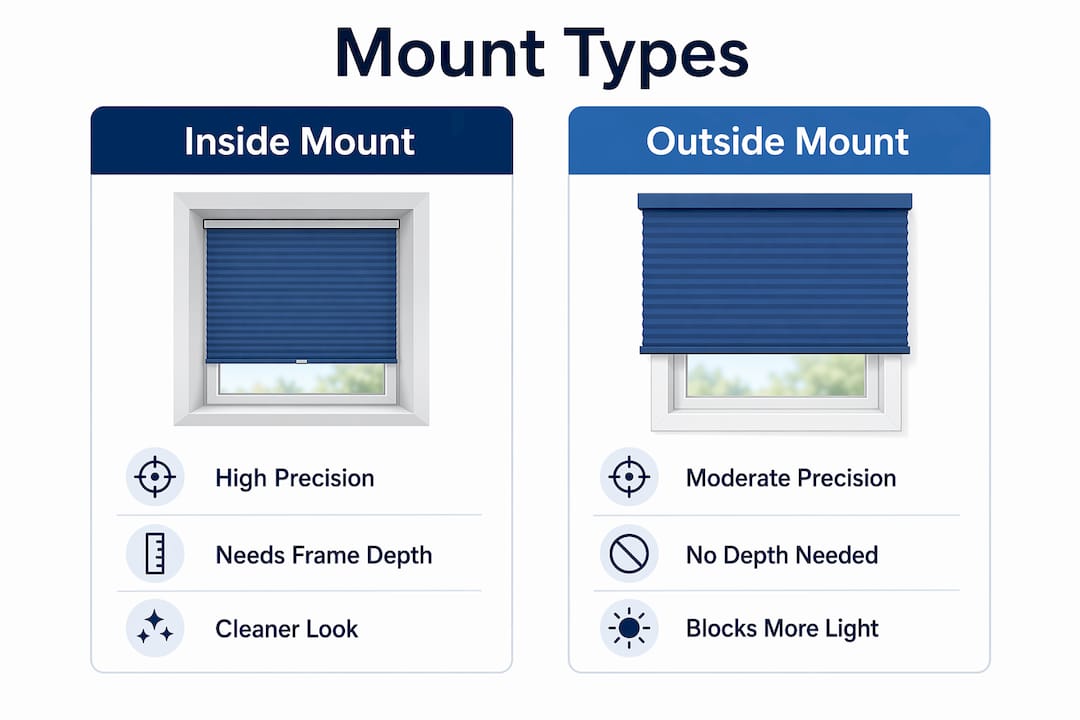
- Inside mount sits within the window recess for a clean, built-in look. It requires precise width, height, and depth measurements. The recess must be deep enough (at least 2–2.5 inches) for the blind to operate without slats scraping the glass or hardware blocking movement.
- Outside mount installs on the wall or trim above and around the window frame. It’s the go-to when your recess is too shallow, your frame is damaged, or you want maximum light blocking.
| Feature | Inside mount | Outside mount |
|---|---|---|
| Measurement precision | Very high | Moderate |
| Depth requirement | 2–2.5 inches minimum | No depth restriction |
| Width measurement | Narrowest inside recess width | Full window width + overlap |
| Height measurement | Tallest inside recess height | Top of mount point to sill + extra |
| Light control | Some gaps at edges | Better coverage with overlap |
| Best for | Clean, recessed look | Shallow frames, maximum coverage |
For outside mounts, add 2–4 inches of overlap on each side of the full window width to block side light and create a finished look. That overlap blocks side light and gives the window a more finished appearance. For height, add some extra length above the frame for mounting hardware, and extend past the sill if you want full coverage.
Expert tips for accurate Venetian blind measurements
These are the habits that separate a blind that fits perfectly from one that has to go back.
Pro Tip: Label each set of measurements with the window’s location in your home (e.g., “living room left,” “bedroom right”) and snap a photo of each window for reference when ordering.
- Always use a steel tape measure. Cloth and plastic tapes stretch and sag, which throws off your numbers. Steel tapes stay rigid and give you a true reading inside a recess.
- Measure to the nearest 1/8 inch. That level of precision is what blind manufacturers use when cutting your order. Rounding to the nearest inch is too loose.
- Check depth with obstructions in mind. Open your window fully and note where the handle or crank sits. That’s the real depth limit for your blind.
- Measure each window separately. Even in new construction, frame dimensions vary enough to matter. Never copy one window’s measurements to another.
- Double-check before you submit your order. Re-measuring takes five minutes. Reordering takes days and costs money.
- Write measurements as width × height. Blind orders are always listed width first, then height. Keeping that format in your notes prevents mix-ups at checkout.
Common mistakes that lead to ill-fitting blinds
Ugh, there’s nothing worse than waiting for your new blinds to arrive, only to find they don’t fit. Most of these problems are totally avoidable.
- Rounding up the width for an inside mount. Even a small overage means the blind won’t slide into the recess. Always round down or use the exact measurement.
- Using a cloth or flexible tape. Flexible tapes can sag across a wide window opening, adding false length to your measurement. Stick with steel.
- Measuring only one point. Windows aren’t perfectly square. A single width or height reading misses the variation that causes fitting problems.
- Ignoring window hardware. A crank handle that sticks out 1.5 inches into the recess effectively reduces your usable depth. Always check for obstructions before ordering.
- Skipping labels on multiple windows. If you measure six windows and don’t label them, you’ll be guessing which number goes where by the time you get to the order form.
- Forgetting the depth check entirely. Ordering an inside-mount blind for a recess that’s only 1.5 inches deep means the slats will press against the glass and won’t tilt properly.
- Not converting measurements correctly. For inside mounts, record to the nearest 1/8 inch and never round up. For outside mounts, add your overlap before you write down the final number.
Valueblindsdirect makes ordering custom Venetian blinds straightforward
You’ve done the hard part. Now you need a place that actually uses those measurements to build something that fits.
Valueblindsdirect is built for exactly this moment. Once you have your width, height, and depth numbers in hand, you can plug them directly into the custom blind design studio and see your options come to life. The site’s measurement guides walk alongside the ordering process, so there’s no guessing about deductions or rounding rules. Every blind is made to your exact specs, whether you’re going inside mount, outside mount, or somewhere in between. Browse the full blinds collection to find the style, slat size, and finish that works for your space, and take advantage of free swatches before you commit. Expert support is available if anything in your measurements feels uncertain.
Key Takeaways
Accurate measurements, taken at multiple points with a steel tape measure and recorded to the nearest 1/8 inch, are the single most reliable way to get Venetian blinds that fit and operate correctly.
| Point | Details |
|---|---|
| Use a steel tape measure | Steel tapes stay rigid and accurate; cloth or flexible tapes stretch and produce false readings. |
| Measure at three points | Take width at top, middle, and bottom; take height at left, center, and right to catch frame irregularities. |
| Depth matters for inside mounts | Venetian blinds need at least 2–2.5 inches of recess depth for the headrail and slat tilt clearance. |
| Outside mounts need overlap | Add 2–4 inches of overlap on each side of the window width for proper light blocking and coverage. |
| Valueblindsdirect | Enter your exact measurements into the design studio to order custom Venetian blinds built to your specs. |




,%20and%20you%20could%20end%20up%20with%20blinds%20that%20are%20too%20wide,%20too%20short...)