
Article: Tilt Turn Window Blinds: What Works and How to Fit Them
Tilt Turn Window Blinds: What Works and How to Fit Them
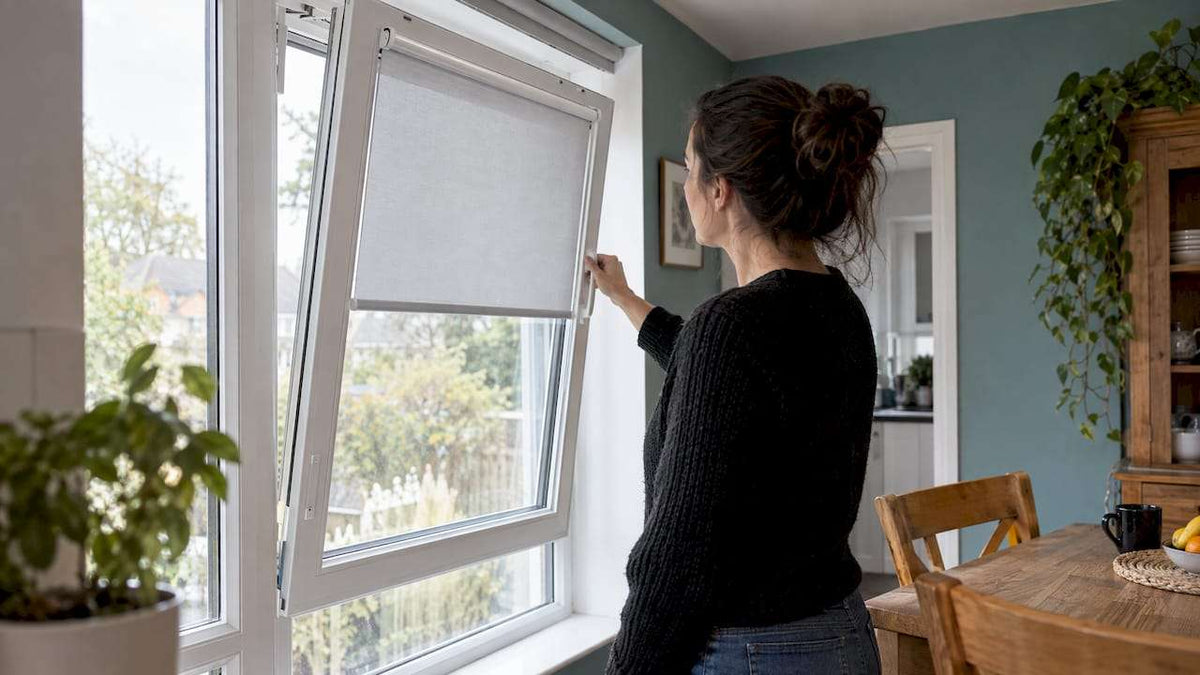
Yes, you can put blinds on tilt and turn windows. The trick is choosing a style and mount that leave room for the sash to tilt in at the top and swing in like a door, and that sit neatly behind the handle. 😊 Get the measurements right and you keep your privacy, your light control and your fresh-air tilt setting. We make custom blinds and shades, and we also offer professional measuring and installation, which is handy on a window this fussy.
TL;DR
- Tilt and turn windows open inward, so any covering has to clear both the tilted sash and the fully open sash.
- Blinds can go above the frame, inside the recess, or on the sash, as long as the window moves freely in both positions, according to GEALAN.
- Slim, light-weight styles such as cellular, zebra and roller shades are the easiest to fit. Deep, heavy headrails are the hardest.
- Measure depth as carefully as width and height, and check the handle, vents and anything in the sash’s swing path.
- Not sure about your window? Our pro measure and install service takes the guesswork out.
Table of Contents
- First, how a tilt and turn window moves
- Can you use regular blinds, or do you need something special?
- Which blinds and shades suit tilt and turn windows
- What about “tilt turn window shades” versus blinds?
- How to choose for privacy, light, airflow and insulation
- Check these before you order
- Measuring: where tilt and turn windows trip people up
- Practical tips for living with them
- Our view
- Ready to dress your tilt and turn windows?
- FAQ
- Sources
First, how a tilt and turn window moves
A tilt and turn window is the European-style window you see more and more in American homes. One handle controls two ways of opening. Eurocell’s guide explains that the handle selects either an inward top-tilt for ventilation or an inward side-hinged opening.
That is the whole problem for window coverings. Whatever hangs in front of the glass has to deal with three positions:
- Closed and locked. Handle down. Nothing moves, so almost any blind works.
- Tilt. Handle up. The top of the sash leans into the room, and the bottom stays put. The covering has to leave a gap at the top.
- Turn. Handle sideways. The whole sash swings into the room like a door, so the covering and everything near it has to be out of the way.
Eurocell notes that inward-opening windows need clear space for the sash and that coverings must not obstruct the tilt or turn movement. That single rule decides everything below.
Can you use regular blinds, or do you need something special?
It depends on your window, not on the label on the box. Regular blinds can work when two things are true: the recess (the depth of the opening in the wall, called the reveal) is deep enough, and there is real clearance between the moving sash, the handle and the blind.
GEALAN, a maker of tilt and turn windows, says blinds can be installed above the frame, inside the recess, or directly on the sash, with the key being a choice that lets the sash move freely in both positions. So you have three mounting routes, and each suits a different room.
Mounting above the frame
The covering sits on the wall or ceiling above the window, outside the opening. It clears the sash entirely, so the window moves however it likes. This suits shallow reveals and rooms where you want the window to look as tall as possible. The catch is the handle: a covering that hangs straight down in front of the glass may sit proud of the frame and rub the handle, so plan the projection (how far the headrail and fabric stick out from the wall).
Mounting inside the recess
This is the cleanest look and the one most people want. It only works with a deep enough opening and a slim covering. The headrail must clear the top of the sash as it tilts in, and the bottom of the covering must clear the handle and sill. If the recess is shallow, go for a different mount rather than forcing it.
Mounting on the sash
Here the covering moves with the window. It never gets in the way of the tilt or turn because it travels with the sash. It also needs to be made for that job, with precise sizing to the sash itself, so it is the most exacting of the three and the one where professional measuring pays off most.
Which blinds and shades suit tilt and turn windows
Here is a practical comparison of the styles we offer, judged on how easy they are to live with next to an inward-opening sash.
| Style | Fit with inward-opening windows | Best for |
|---|---|---|
| Cellular shades | Slim profile, soft fabric, no slats to catch on the handle | Insulation, quiet rooms, bedrooms |
| Zebra shades | Compact headrail, alternating sheer and solid bands | Adjustable light and privacy |
| Roller shades | Flat, simple, small headrail | Clean modern look, glare control |
| Roman shades | Fabric stacks when raised, so allow stack depth | Warm, tailored rooms |
| Faux wood blinds and solid wood blinds | Bulkier headrail and slats, need a deeper recess | Classic look, bigger windows with room to spare |
| Vertical blinds | Hang off a headrail, vanes can swing into the sash | Tall doors and wide openings with space to spare |
Cellular shades
These are our pick when a tilt and turn window sits in a bedroom or living room. The honeycomb structure is made to be energy-efficient, and the slim profile helps you stay clear of the handle. Our Deluxe Light Filtering Cellular Shades soften daylight without turning the room dark, and there is a motorized version when you would rather not reach around a handle at all.
Zebra shades
They are a favorite for a reason. The alternating sheer and solid bands let you dial in light and privacy without raising the whole shade. Pair that with a tilted sash and you can have fresh air plus a diffused glow. Ours come in a motorized, smart-control option too.
Roller shades
A roller shade is a flat sheet of fabric on a tube. That simplicity makes it easy to fit around a handle and easy to keep tidy. Choose a light-filtering fabric to cut glare, or blackout for a bedroom.
Roman shades and wood blinds
Both look gorgeous, and both ask for more room. Roman shades fold into a stack at the top, and wood blinds have a chunkier headrail and slats. On a tilt and turn window, give them a deep recess or mount them above the frame so nothing meets the sash on its way in.
What about “tilt turn window shades” versus blinds?
In everyday shopping the words overlap. Blinds usually mean slats (wood, faux wood, aluminum, vertical). Shades mean a single piece of fabric (roller, cellular, zebra, Roman). Either can go on a tilt and turn window. The window’s movement is what matters, not the word on the product, so choose by the rules above: clearance, mount and how you like to control light.
How to choose for privacy, light, airflow and insulation
Think about what you do with the window, because a tilt and turn window is often used on purpose for fresh air.
Privacy. Zebra shades and cellular shades let you keep privacy while still letting daylight in. Blackout fabrics suit bedrooms.
Light and glare. Light-filtering roller or cellular fabrics soften the sun. Solar shades cut glare while keeping the view, handy in an office or a sunny living room.
Airflow. If you love your tilt setting, pick a covering that hangs freely enough to let the top of the sash lean in. A shade that is pinned tight at the bottom to the sill is a poor match, since you want air moving behind it without it flapping around.
Insulation. Cellular shades trap air in their cells, which is the idea behind them, and they are a good fit for rooms that run hot or cold.
Control. Cordless operation keeps things tidy near a handle. Motorization lets you open and close a shade by remote or app, without leaning across a sill or a radiator. ✨
Check these before you order
A quick walk around the window now saves a return later.
- Handle position. Look at how far the handle sticks out and where it sits. The covering must pass behind or beside it in every handle position.
- Reveal depth. Measure from the glass to the wall face. Compare that to the headrail depth of the covering you like.
- Tilt gap. Open the window in tilt mode and look at how far the top moves in. Your headrail needs to clear that arc.
- Full swing. Open the sash fully and trace its path. Radiators, valves, furniture and deep sills can all get in the way, and a blind adds depth to that path.
- Vents and sensors. Trickle vents, security contacts and sensors on the frame can collide with a headrail or a side channel.
- Wall or ceiling above. If you plan to mount above the frame, check there is solid, flat surface to fix into.
Try both tilt and full opening with the covering in mind before you commit. If any of those answers is unclear, that is the moment to have a professional take the measurements.
Measuring: where tilt and turn windows trip people up
Most blind mistakes happen at the tape measure. Inside mounts need exact width at the top, middle and bottom of the opening, plus a true depth reading. Outside mounts need extra overlap on each side. Our guides walk through each step: start with how to measure windows for custom blinds, then see how to measure for inside mount blinds if you are going inside the recess.
For a tilt and turn window, add two extra jobs to the routine: record the handle’s projection and note the clearance you need at the top for tilt mode. Write those numbers beside your width, height and depth, so you can match them against the headrail size of whatever you pick.
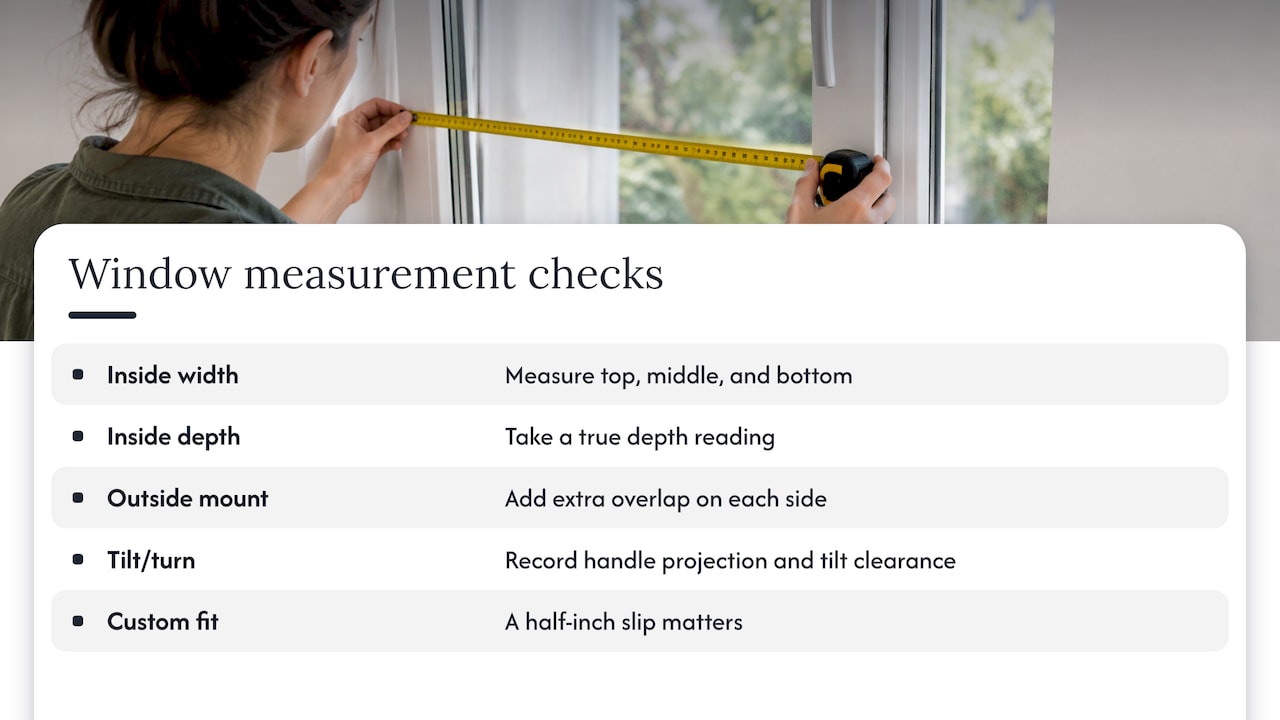
Because custom blinds are made to your numbers, a half-inch slip is not a small thing. That is why we offer free swatches to check fabric and color at home, and why professional measuring and installation is available when a window is tricky. Our measurement guides, design tools and satisfaction guarantee are there to back you up. 👍
Practical tips for living with them
- Keep the handle reachable. Choose a length or mount that leaves the handle free, so no one yanks a shade by accident.
- Pick cordless or motorized. Fewer cords means fewer things to snag on a handle.
- Think in rooms. Bedrooms usually want blackout. Kitchens and baths do better with moisture-friendly materials. Living rooms love light filtering.
- Match all the windows. Tilt and turn windows often come in sets with fixed panes. Using one style across them gives a calm, finished look.
- Plan for doors. Tilt and turn doors follow the same logic, with an even bigger swing. Give them extra clearance.
Our view
We think tilt and turn windows are some of the best windows you can have, and they deserve window coverings that respect how they move. 🌤️
Our advice is simple. Start with the window, not the product. Learn where the handle sits, how deep the recess is and how far the sash travels. Then choose the covering that fits that picture: slim and soft for tight recesses, richer textures where there is depth to spare.
That is where custom makes the difference. Our blinds and shades are made to order, in a wide range of styles, with options like cordless operation, motorization and energy-efficient fabrics. When the measurements are the hard part, our professional measuring and installation service is there so you do not have to second-guess a quarter inch.
Order free swatches, look at them in your own light, and pick the shade you will love opening every morning.
Sunny
Ready to dress your tilt and turn windows?
Browse our blinds and shades collection for cellular, zebra, roller, Roman, wood and more, all made to order, with motorized and cordless options. Add professional measuring and installation if you want an expert to handle the tricky parts.
Start from our home page to explore every style and order free swatches.
FAQ
Can you put blinds on tilt and turn windows?
Yes. Blinds can be mounted above the frame, inside the recess or on the sash, as long as the sash can still tilt and turn freely, as GEALAN explains. Your handle, reveal depth and room for the swing decide which mount is best.
What blinds are best for tilt and turn windows?
Slim styles are the easiest: cellular, zebra and roller shades. They have compact headrails and soft fabric that stays clear of the handle. Wood and vertical blinds can work too when the recess is deep and the swing path is clear.
Will blinds stop me from using the tilt setting?
Not if you plan for it. The headrail must clear the top of the sash as it leans in, and the covering should hang freely enough to let air pass. Check the tilt gap before you order and measure it along with your depth.
Should I measure myself or have it done for me?
Both work. Our step-by-step measuring guides cover the basics for DIY, and our professional measuring and installation service is there for windows with handles, vents or deep reveals where precision matters most.