


Stylish window coverings for sliding doors: A guide
TL;DR:
- Modern sliding door coverings offer improved privacy, insulation, and ease of use compared to outdated options.
- Choices include vertical blinds, panel track, roller shades, and cellular shades, each with customizable features.
- Proper measurement, installation, and small design customizations ensure optimal functionality and aesthetic appeal.
Sliding doors are one of the most dramatic architectural features in any home, yet many homeowners still assume their covering options are limited to old-school vertical blinds in beige. That assumption costs people both style and comfort. Modern window treatments have changed dramatically, and today’s sliding door solutions offer everything from motorized operation to bold custom graphics, all while improving privacy, insulation, and day-to-day ease of use. Whether you have a floor-to-ceiling patio door or a wide glass panel opening to your backyard, this guide walks you through every smart choice available in 2026.
Table of Contents
- Understanding sliding door challenges and requirements
- Exploring modern window covering options for sliding doors
- Design and customization: Matching style with your space
- Balancing energy efficiency, light control, and privacy
- Installation tips and maintenance for lasting performance
- A fresh perspective: Why small customizations make the biggest impact
- Customized solutions for every sliding door
- Frequently asked questions
Key Takeaways
| Point | Details |
|---|---|
| Sliding doors need special solutions | Accessibility, privacy, and energy savings are critical when choosing coverings for sliding glass doors. |
| Modern styles offer more choices | Homeowners can select from vertical blinds, panel tracks, cellular shades, and smart features for custom results. |
| Design and energy efficiency go together | The right covering enhances décor and comfort while reducing energy loss and glare. |
| Easy installation and upkeep | Many contemporary options are DIY-friendly and require minimal maintenance to look their best. |
Understanding sliding door challenges and requirements
Sliding doors are not just oversized windows. They serve as high-traffic passageways, light sources, and visual connections to outdoor spaces, all at the same time. That means any covering you choose has to do a lot of heavy lifting.
The core challenges homeowners face include:
- Accessibility: The covering must slide or stack out of the way cleanly so you can open and close the door without wrestling with fabric or cords.
- Coverage: Most sliding doors span six to twelve feet wide, so you need a treatment that covers the full opening without sagging or bunching.
- Privacy vs. light: Glass doors let in beautiful natural light, but they also put your living room on display for neighbors and passersby.
- Insulation: Large glass surfaces transfer heat and cold far more than insulated walls do, which directly impacts your energy bills.
- Durability: Coverings near sliding doors take constant handling, making cheap materials a real liability.
Outdated vertical blinds often fail on several of these points at once. Individual slats break or get bent, gaps form along the track, and the look quickly becomes dated. Many homeowners tolerate this for years because they believe there’s no practical alternative.
There is. Privacy options for sliding doors have expanded significantly, and as noted by Value Blinds, coverings must balance accessibility, light control, privacy, and durability. That balance is completely achievable with modern products.
The most common mistake homeowners make is choosing a sliding door covering based on looks alone, then discovering it doesn’t actually work with how they use the door every single day.
Before shopping, map out your priorities. How often do you open the door? Do you need full blackout at night? Is afternoon glare a problem? Answering these questions first saves you from a frustrating redo later.
Exploring modern window covering options for sliding doors
Once you know what you need, the variety of available solutions becomes exciting rather than overwhelming. Today’s options span a wide range of styles, mechanisms, and price points.
The four main categories to consider:
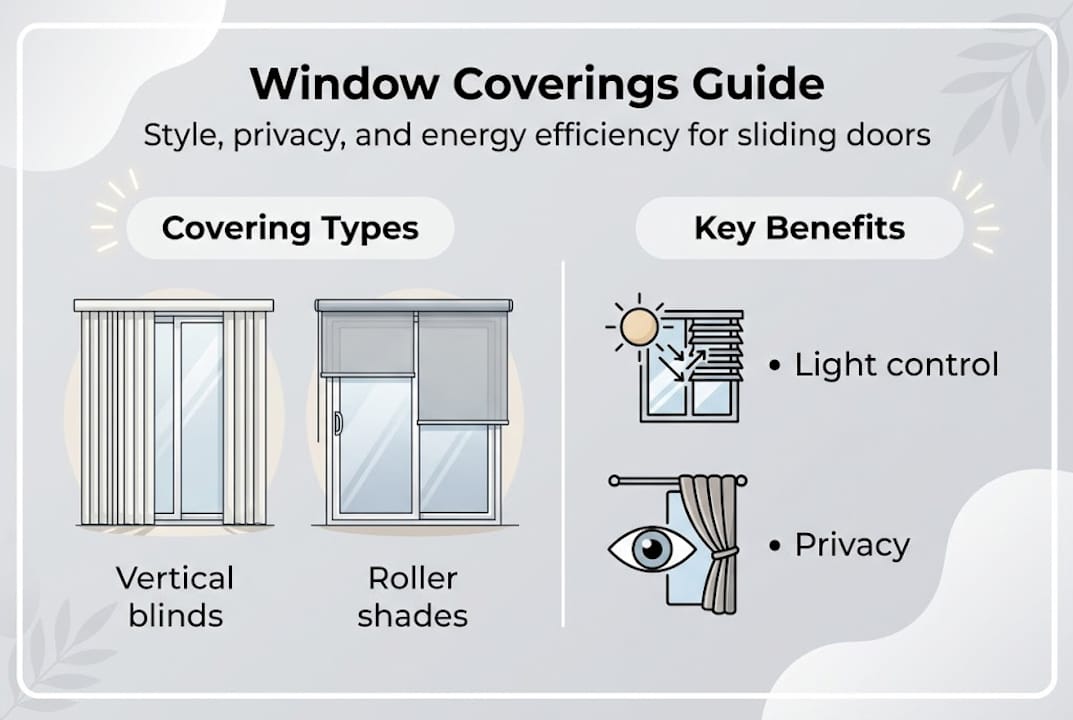
- Vertical blinds: Updated versions now come in fabric, faux wood, and textured finishes. They stack neatly to one side and allow precise light control through slat rotation.
- Panel track blinds: Wide fabric panels that glide along a multi-channel track. These offer a clean, modern look that works beautifully with contemporary interiors.
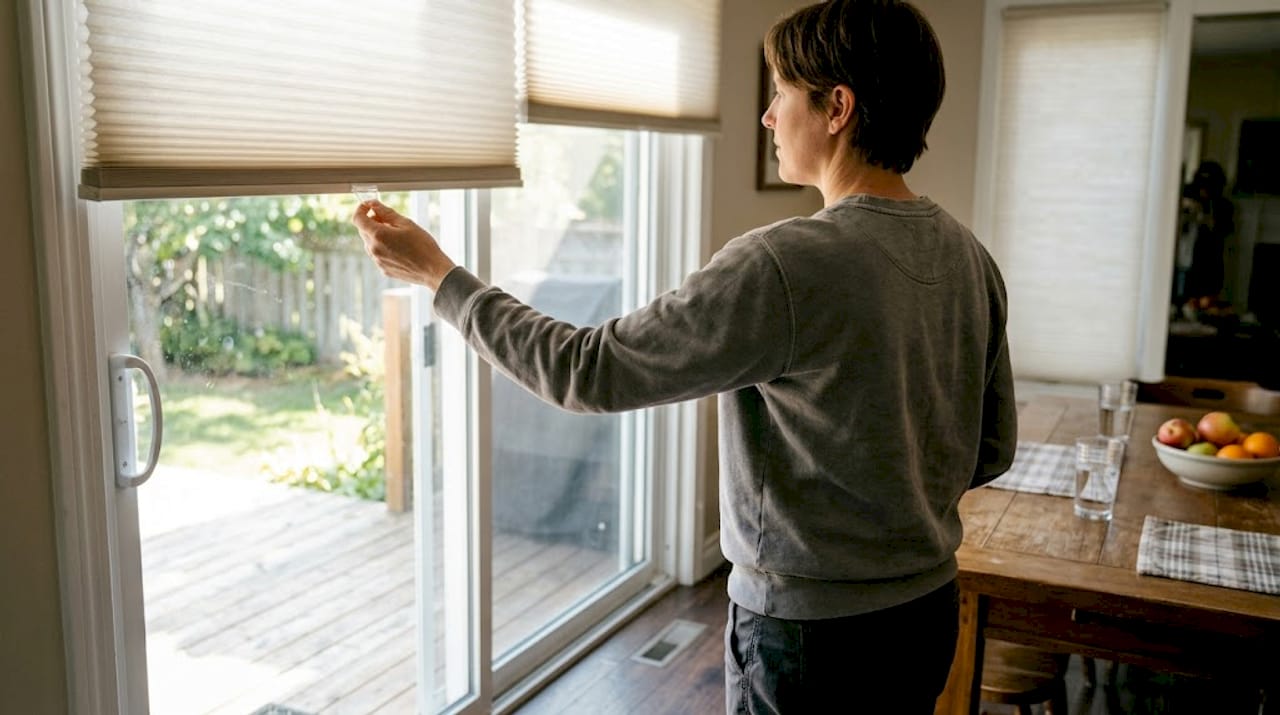
- Roller shades: A single piece of fabric rolls up cleanly. Paired with side-by-side mounting hardware, they work well on sliding doors and come in an enormous range of opacities.
- Cellular shades: Honeycomb-structured fabric that insulates while filtering light. They work on sliding doors when mounted in a bypass or bi-fold configuration.
Here’s a quick comparison to help you decide:
| Option | Style | Light control | Ease of use | Durability | Cost range |
|---|---|---|---|---|---|
| Vertical blinds | Classic | Adjustable | High | Moderate | Low to mid |
| Panel track | Modern | Good | High | High | Mid |
| Roller shades | Minimal | Excellent | High | High | Mid to high |
| Cellular shades | Clean | Excellent | Moderate | High | Mid to high |
For homeowners who want zero cords visible and a sleek finish, cordless and no-drill solutions have become a genuinely popular upgrade. As Value Blinds points out, today’s options include vertical blinds, panel tracks, cellular shades, and more, each with distinctive benefits.
Motorized and smart-home integrated options are also gaining ground fast. You can now control your sliding door shades with a phone app, a voice assistant, or a programmed schedule.
Pro Tip: If you have a sliding door that gets heavy afternoon sun, consider a dual roller shade setup. One side is a solar shade that reduces glare while keeping your view, and the other is a blackout panel you pull across at night. It gives you both without sacrificing anything.
For a particularly flexible and low-maintenance pick, cordless cellular shades offer a clean look with genuine thermal performance built in.
Design and customization: Matching style with your space
The functional side of window coverings matters, but so does the way they look in your home. A covering that clashes with your interior style will bother you every time you walk into the room.
Customization options today go well beyond picking a color. Consider the following dimensions of personalization:
- Fabric and texture: Linen weaves, sheer voiles, woven woods, and opaque fabrics all create very different visual moods.
- Pattern and print: Some homeowners go bold with geometric or botanical prints. Others prefer solid neutrals that blend quietly into the room.
- Hardware finish: Track systems and mounting brackets now come in matte black, brushed nickel, oil-rubbed bronze, and white. Hardware has a bigger visual impact than most people expect.
- Custom sizing: Off-the-shelf coverings rarely fit sliding doors precisely. Custom sizing eliminates gaps at the edges and ensures a finished, intentional look.
- Motorization: Automated operation is not just a convenience feature. For large, heavy panels, a motor actually extends the lifespan of the product by reducing wear on the tracks.
Here’s how different interior styles pair with covering types:
| Interior style | Best covering match | Recommended finish |
|---|---|---|
| Modern minimalist | Panel track or roller shade | Matte white or charcoal |
| Coastal or relaxed | Woven wood or bamboo shade | Natural, sand tones |
| Traditional | Fabric vertical or drapery panel | Warm neutrals, soft patterns |
| Industrial | Metal blind or roller shade | Black or gunmetal |
As Value Blinds has observed, homeowners increasingly choose custom fabrics and hardware for both aesthetics and performance. For outdoor-facing sliding doors or screened patios, custom graphic shades offer a remarkable way to bring your personality into the space while blocking UV and wind.
If you have a strong design vision, request fabric swatches before committing. Seeing and touching the material in your actual lighting conditions prevents a lot of regret.
Balancing energy efficiency, light control, and privacy
Sliding glass doors can account for a significant portion of heat gain and loss in your home. During summer, afternoon sun pouring through large glass panels raises indoor temperatures noticeably. During winter, cold radiates inward through the glass. Choosing the right covering is one of the most practical upgrades you can make.
Key ways window coverings improve energy performance:
- Cellular shades trap air inside their honeycomb cells, creating a thermal buffer between the glass and your room.
- Blackout linings block solar heat gain in summer and reflect warmth back into the room in winter.
- Layered treatments such as a sheer shade plus a heavier panel allow you to tune light and insulation throughout the day.
- Close-fitting tracks on roller or panel shades minimize air gaps at the edges, which is where most heat exchange actually happens.
The right covering can insulate your home and regulate lighting, improving efficiency in a meaningful way. For a deep look at what works best room by room, explore these energy efficiency strategies and choosing energy efficient coverings to find the right balance for your climate.
Pro Tip: In rooms that get heavy afternoon sun, a solar shade with a 5% openness rating cuts glare and UV by around 95% while still letting you see outside. You get the view without the heat spike.
Privacy is equally important. Sliding doors face backyards, patios, or sometimes neighbors at close range. Light-filtering shades give you daytime privacy without making the room feel dark. For complete privacy at night, pair them with a blackout layer or choose a dual-shade system.
Installation tips and maintenance for lasting performance
Even the best sliding door covering will underperform if it’s installed poorly. Getting the setup right from the start prevents annoying problems later.
Step-by-step installation guide:
- Measure carefully. Measure the width and height of your door frame at three points each, top, middle, and bottom. Use the smallest measurement to ensure proper fit.
- Choose inside or outside mount. Inside mount gives a clean, built-in look. Outside mount provides better light blocking and can visually enlarge the opening.
- Check your mounting surface. Sliding door frames are often aluminum or hollow vinyl, which require specific anchors or bypass mounting hardware.
- Install the track first. For panel tracks and vertical blinds, getting the overhead rail perfectly level is the most important step. Use a laser level if possible.
- Test before you fully commit. Hang the covering loosely and operate it several times before tightening all fasteners.
- Secure the cord or wand. If you use a corded version, anchor the safety cord away from reach of children and pets.
As Value Blinds confirms, modern sliding door coverings are designed for user-friendly installation and low maintenance. Most come with clear instructions and all necessary hardware.
Pro Tip: For easy installation options that skip the drilling entirely, look for no-drill tension systems or adhesive-mounted brackets. They work well on light to medium-weight treatments.
Maintenance routine to keep coverings looking great:
- Dust fabric panels weekly with a soft brush attachment on your vacuum.
- Wipe vinyl or aluminum slats with a damp microfiber cloth monthly.
- Clean roller shade fabric with a gentle upholstery cleaner twice a year.
- Inspect tracks and rollers every six months for debris or wear.
A fresh perspective: Why small customizations make the biggest impact
After years of working with homeowners on sliding door window treatments, one pattern stands out clearly. The people who are most satisfied with their choice almost never credit it to the big, obvious decision, such as the type of covering they picked. They credit the small ones.
The hardware finish they almost skipped. The upgrade to motorized operation they added at the last minute. The decision to order one extra inch of width so the covering overlaps the frame completely.
Conventional advice tends to focus on product categories and price tiers. But in real homes, the day-to-day satisfaction comes from whether the shade opens smoothly every morning, whether the color still feels right six months later, and whether the privacy insights you applied actually translate into a room that feels secure and comfortable.
In 2026, there is genuinely no reason to compromise between looks and usability. The technology, customization tools, and product quality are all there. The only question is whether you take the time to make the small choices thoughtfully.
Customized solutions for every sliding door
You’ve spent the time understanding what your sliding door really needs. Now it’s time to put that knowledge to work with products built to match.
At Value Blinds, we specialize in exactly this kind of tailored fit. Whether you’re looking for a sleek motorized panel track, a cordless cellular shade cut to your exact dimensions, or something bold and graphic for an outdoor patio door, our team is here to help you get it right. Explore our blinds collection to browse curated options, or visit our design studio for custom solutions to visualize how different styles, fabrics, and finishes work in your specific space. Expert support, free swatches, and precise custom sizing are all part of the process.
Frequently asked questions
What are the best coverings for sliding glass doors?
Vertical blinds, panel track shades, and cellular shades are top choices for sliding glass doors due to their durability, style, and ease of use. As Value Blinds notes, vertical blinds and cellular shades deliver a blend of utility and style for large doors.
How can window coverings improve energy efficiency for sliding doors?
Energy-efficient coverings like cellular shades and lined draperies help reduce heat transfer and lower utility bills. Cellular shades trap air and improve insulation, significantly reducing energy loss through large glass panels.
Can motorized shades be used for sliding doors?
Yes, motorized shades and blinds are increasingly popular for sliding doors, offering hands-free convenience and modern control features. Motorized shades are tailored for large openings like sliding doors, making operation effortless even on oversized panels.
How do you measure and install coverings for sliding doors?
Always measure the width and height of the door frame at multiple points and choose coverings designed for large openings. Many new window treatments are designed for simple DIY installation on sliding doors, complete with all mounting hardware included.
Recommended
- Custom window coverings: stylish, efficient choices for 2026
- Updating old window coverings: efficient solutions 2026
- Window coverings for privacy: enhance comfort and style
- Types of window coverings for style and function
- Aurinkosuojien suunnittelu kotiin: Tyylikäs ja toimiva lopputulos – Nordic Blinds Oy