
Commercial-Grade Blinds: What Facility Managers Must Specify
Commercial-grade blinds are purpose-built window treatments engineered for high-traffic commercial environments, where standard residential products simply cannot keep up with the demands of daily use, safety codes, and facility compliance. If you’re sourcing window coverings for an office, school, clinic, or hotel, here’s what separates a truly commercial product from a residential blind wearing a marketing label:
- Reinforced hardware — heavy-duty tubes, hembars, and mounting brackets rated for repeated daily operation
- Certified flame resistance — materials that meet NFPA fire standards, not just a vague “fire-treated” claim
- Cycle-tested mechanisms — documented test results proving the blind can handle thousands of open/close cycles without failure
- Serviceability and motorization options — ADA-compatible lift systems, cordless configurations, and motor-ready designs for large-bay or accessibility-critical installations
Valueblindsdirect carries commercial window coverings across all major types, with custom sizing, motorization, and spec support for procurement teams.
Table of Contents
- What types of commercial blinds suit each application?
- What materials and hardware actually make a blind “commercial grade”?
- What performance specs and safety standards should you request?
- How do you choose the right commercial blinds? A procurement checklist
- How do you maintain commercial blinds and plan for replacement?
- How do commercial blinds differ from residential products?
- What does the research say about energy savings and ROI?
- Key Takeaways
- The procurement mistake nobody talks about
- Valueblindsdirect makes commercial specification straightforward
- Useful sources and where to verify standards
What types of commercial blinds suit each application?
Picking the right blind type starts with the room’s job, not just its look. Here’s a quick map of the most common commercial window covering types and where each one shines
- Roller/solar shades — The go-to for perimeter offices and open-plan floors. Solar screen fabrics are typically specified with an openness factor of 1–10%; south- and west-facing facades usually call for 1–3% to cut glare without killing the view.
- Blackout roller shades — Presentation rooms, AV suites, and healthcare procedure rooms need 0% openness. True blackout installations also require side channels or cassettes to prevent light gaps at the edges (fabric alone won’t do it).
- Vertical blinds — Cost-effective for large glass spans, sliding doors, and floor-to-ceiling glazing. Check out large vertical blind options when you’re covering wide commercial openings.
- Aluminum venetian blinds — Ideal for individual offices where incremental light adjustment matters. Easy to wipe down, which makes them a practical pick for labs or kitchens.
- Faux-wood venetians — A warmer look for reception areas and conference rooms, with better moisture resistance than real wood in humid climates.
- Cellular (honeycomb) shades — Best for perimeter insulation in cold climates or buildings with high HVAC costs. The trapped-air cell structure adds a meaningful thermal buffer at the glass line.
- Motorized systems — Prefer motorized over manual when windows exceed reachable height, when synchronized zone control is needed across a floor, or when ADA pull-force limits make manual cords impractical. Low-voltage, cloud-ready systems can integrate directly with building management systems for automated scheduling.
What materials and hardware actually make a blind “commercial grade”?
This is where the marketing language gets slippery. “Commercial grade” means nothing without numbers behind it. Here’s what to look for in the spec sheet:
- Tube diameter and wall thickness — Wider blinds need larger-diameter tubes to prevent deflection and uneven rolling. Tube sizing requirements scale with blind width and fabric weight; confirm the manufacturer’s width-to-tube-diameter table before ordering.
- Hembar construction — A weighted, reinforced hembar keeps the fabric taut and prevents billowing in air-conditioned spaces. Thin plastic hembars are a residential tell.
- Cycle-tested mechanisms — Ask for the documented cycle count. Commercial-grade hardware is rated for many thousands of open/close cycles; a supplier who can’t produce that number is selling you a residential product with a commercial price tag.
- UV-stable fabrics — Fabrics that fade or degrade under direct sun within a year are not commercial grade. Request UV stability data, especially for south- and west-facing installations.
- Openness factor and blackout spec — These are measurable numbers, not marketing adjectives. Specify them in your RFQ.
- Antimicrobial and cleanable finishes — Healthcare and food-service environments need fabrics that meet infection-control standards. Look for documented antimicrobial coatings or vinyl-coated fabrics that can be wiped with hospital-grade disinfectants.
- Tamper-resistant fittings and cordless/ADA-compliant lift options — Schools and pediatric healthcare settings require cordless or inaccessible-cord designs. ADA-compliant pull-force limits apply to manually operated systems in accessible spaces.
- Motorization-ready design — If you’re phasing in automation, confirm the headrail accepts a motor retrofit without a full replacement.
Pro Tip: Ask every supplier for the numeric fabric weight (in grams per square meter) and the tube diameter spec for your specific blind width. If they can only offer “heavy-duty fabric” with no number, that’s a red flag worth acting on before you place a large order.

What performance specs and safety standards should you request?
Beyond the hardware, you need documentation. Here’s the compliance checklist to build into every commercial procurement:
- NFPA 701 flame-resistance test report — The standard for draperies and window treatments in commercial buildings. Request the actual lab report, not just a “fire-rated” label. More detail on what to look for is covered in this fire-retardant blinds guide.
- GREENGUARD or GREENGUARD Gold certification — Relevant for schools, healthcare, and any LEED-targeted project where indoor air quality is a documented requirement.
- Documented cycle test results — The supplier should be able to name the test standard and the cycle count achieved. No documentation = no verification.
- Cord safety compliance — WCMA (Window Covering Manufacturers Association) and CPSC guidelines govern cord accessibility. Cordless or motorized options eliminate the risk entirely.
- ADA pull-force documentation — Manually operated shades in accessible spaces must meet pull-force limits. Commercial hardware platforms with managed pull-force algorithms, like those from Mecho commercial shade systems, are designed specifically for this.
- Warranty terms in writing — A commercial warranty should cover mechanism failure separately from fabric wear. Vague “limited warranty” language with no defined coverage period is a red flag.
- Installation instructions and load ratings — Confirm the mounting system’s load rating matches your wall or ceiling substrate. Drywall anchors alone are not adequate for wide, heavy commercial blinds.
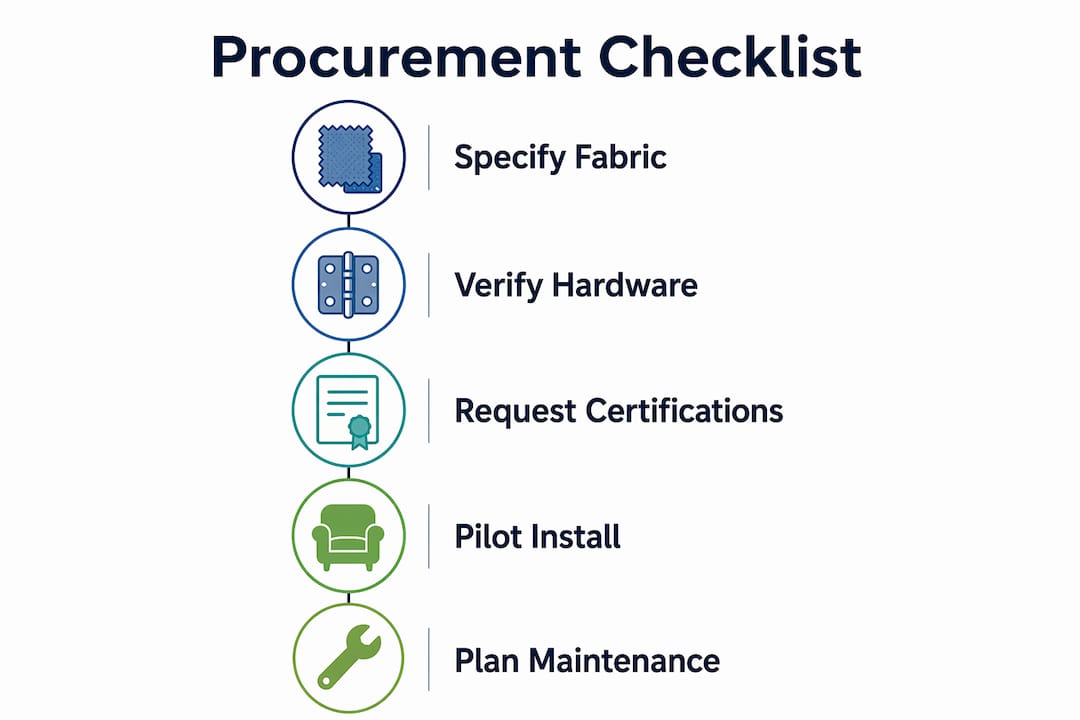
How do you choose the right commercial blinds? A procurement checklist
Use this list directly in your RFQ or purchase order. It turns vague “commercial-grade” claims into verifiable acceptance criteria.
- Specify fabric openness factor — State the required percentage (e.g., 3% openness for west-facing offices) and require the supplier to confirm the fabric’s tested value.
- Specify fabric weight in g/m² — Require a minimum fabric weight appropriate for the application. Heavier fabrics resist billowing and wear better in high-traffic zones.
- Request NFPA 701 test report — Include the line: “Provide lab-issued NFPA 701 test report for the specified fabric.” Accept no substitutes.
- Confirm tube diameter for each width range — Ask: “What tube diameter and wall thickness do you specify for blinds wider than [X] inches?” Match their answer to their published width-to-tube table.
- Request cycle-test documentation — Include: “Provide documented cycle-test results for the specified mechanism, including test standard and cycle count achieved.”
- Confirm motor control protocol if motorized — Specify the required protocol (e.g., Zigbee, Z-Wave, RS-485, or proprietary BMS integration) and confirm compatibility before ordering. Motorized options for large windows are worth reviewing for technical specs.
- Require written warranty terms — Specify: “Provide warranty documentation covering mechanism failure and fabric degradation separately, with defined coverage periods.”
- Ask about batch color consistency — For multi-floor or multi-room orders, request confirmation of color batch control. Inconsistent dye lots across a floor look unprofessional and are hard to fix after installation.
Common red flags: missing test reports, warranty language that says “at our discretion,” unspecified fabric weight, no tube-diameter table, and a supplier who can’t answer question 4 or 5 above.
How do you maintain commercial blinds and plan for replacement?
Good maintenance extends service life and keeps your facility looking sharp. Here’s a practical approach by material:
- Vinyl and coated fabrics — Wipe with a damp cloth or mild detergent solution. In healthcare settings, confirm the fabric’s compatibility with the disinfectant products your team uses before specifying.
- Aluminum venetians — Dust regularly; deep-clean with a mild soap solution. Avoid abrasive cleaners that scratch the finish.
- Cellular fabrics — Vacuum with a brush attachment to clear dust from the cells. Spot-clean only; submerging cellular shades damages the cell structure.
- Mechanisms and motors — Inspect quarterly for smooth operation. Lubricate chain mechanisms per manufacturer guidance. For motorized systems, check firmware and battery/charger status annually.
Suggested maintenance schedule for facilities teams:
- Monthly: Visual inspection for fabric tears, hardware looseness, or light leakage in blackout installations
- Quarterly: Operational check of all mechanisms; clean fabrics per material type
- Annually: Full mechanism inspection, motor firmware/charger check, and documentation update
Replacement triggers to watch for: visible fabric degradation or UV bleaching, repeated mechanism failures after adjustment, persistent light leakage in blackout rooms despite hardware fixes, and any hardware failure that creates a safety or accessibility issue. Energy-efficient window treatments for offices also have useful guidance on when aging solar fabrics stop performing thermally.
How do commercial blinds differ from residential products?
This comparison matters most when a vendor tries to sell you a residential product at a commercial price. Here’s what residential products typically omit:
- Limited or no cycle testing — Residential mechanisms are designed for occasional home use, not daily multi-cycle operation by dozens of users.
- Lighter hardware — Thinner tubes, lighter hembars, and lower-rated mounting brackets that deflect or fail under sustained load.
- Optional fire treatment — Residential fabrics may carry no flame-resistance certification at all, or only a topical treatment that washes off.
- Shorter warranties — Residential warranties often cover one to two years and exclude commercial use explicitly.
- No ADA or pull-force documentation — Residential products are not designed or tested to accessibility standards.
The performance gaps that matter most in practice: mechanism durability (residential blinds in a busy office can fail within months), UV stability (residential fabrics fade visibly within a year on south-facing glass), and mounting load ratings (residential brackets can pull out of walls under the weight of wide, heavy commercial blinds). Blinds for large windows covers some of these structural considerations in more depth.
What does the research say about energy savings and ROI?
The financial case for quality commercial shades is real. Commercial shade systems reduce HVAC reliance by controlling solar heat gain at the glass line, which stabilizes interior temperatures and cuts both behavioral and equipment-driven energy waste. Solar screen fabrics are the primary tool here: controlling solar heat gain at the source reduces cooling loads without eliminating daylight, which also lowers artificial lighting demand.
The openness factor is the key variable. Solar screen fabrics specified at 1–3% openness deliver the strongest heat and glare reduction for intense south- and west-facing facades, while 5–10% openness preserves more view and daylight in lower-solar-gain orientations.
For blackout or insulating cellular shades, the ROI case shifts to heating season: the trapped-air cell structure reduces heat loss through the glass, which is measurable in buildings with large glazed perimeters in cold climates.
Pro Tip: When building an internal capital request for commercial shades, document three inputs: glazing orientation (south/west vs. north/east), estimated HVAC load per zone, and the fabric openness factor you’re specifying. Those three numbers let your facilities or sustainability team model the expected reduction in peak cooling demand and build a credible payback period.
Key Takeaways
Commercial-grade blinds require certified flame resistance, documented cycle testing, specified fabric weight and openness factor, and written warranty terms — accepting vague “commercial-grade” claims without those numbers is the single most common procurement mistake.
| Point | Details |
|---|---|
| Certified flame resistance | Require a lab-issued NFPA 701 test report for every fabric specified in a commercial project. |
| Cycle-tested hardware | Ask for the documented cycle count and test standard; no documentation means no verification. |
| Fabric openness factor | Specify the exact percentage (e.g., 1–3% for south/west facades) in your RFQ, not a vague descriptor. |
| Written warranty terms | Confirm separate coverage periods for mechanism failure and fabric wear before placing any order. |
| Valueblindsdirect | Offers custom sizing, motorization options, and spec support to help procurement teams move from specification to order. |
The procurement mistake nobody talks about
Here’s something worth saying plainly: most procurement errors with commercial blinds happen before a single product ships. A facility manager accepts a quote that says “commercial-grade” on the cover page, skips the documentation request, and discovers six months later that the mechanisms are failing on a busy floor or that the fabric isn’t actually fire-rated for the jurisdiction.
The fix is almost embarrassingly simple. Require numeric data. Not “heavy-duty fabric” but “fabric weight of X g/m².” Not “fire-treated” but “NFPA 701 lab report attached.” Not “long warranty” but “five-year mechanism warranty, two-year fabric warranty, terms attached.” Suppliers who can deliver those numbers are selling you a real commercial product. Suppliers who can’t are selling you a label.
For large rollouts, a pilot installation on one floor before committing to a full building is worth every dollar. Run the pilot for 60–90 days, document mechanism performance, check for light leakage in any blackout rooms, and confirm color batch consistency. Scaling a proven spec across multiple floors is far less painful than replacing a building’s worth of wrong product.
Valueblindsdirect makes commercial specification straightforward
Specifying commercial window treatments doesn’t have to mean weeks of back-and-forth with vendors who can’t answer basic questions. Valueblindsdirect offers custom-sized blinds and shades across all major commercial types, including motorized cellular shades for energy-efficient automated installations, cordless options for accessibility-sensitive spaces, and a full range of roller and solar shades sized to your exact openings.
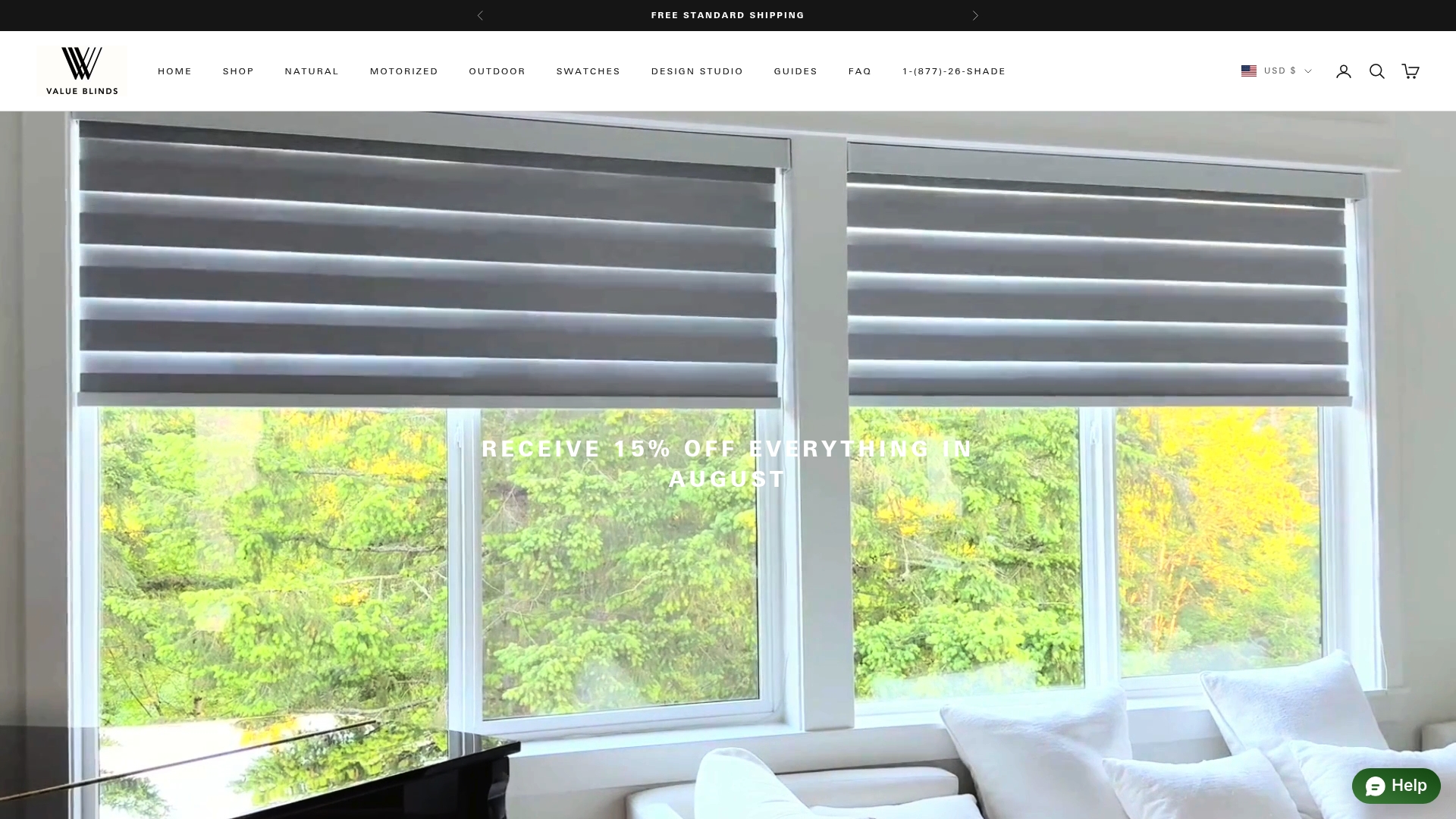
You get free swatches to verify fabric color and texture before committing, measurement guides to nail your specs the first time, and warranty support that’s clearly documented, not buried in fine print. The Window Treatment Design Studio is the fastest way to move from a spec list to a confirmed order, with expert support available for commercial projects of any scale. Start there, bring your RFQ checklist, and you’ll have what you need to make a confident, compliant purchasing decision.
Useful sources and where to verify standards
When you’re ready to verify claims or request documentation, these are the primary resources to work from:
- NFPA 701 — The standard for flame resistance of textiles and films used in commercial window treatments. Request the actual lab report from your supplier, not a self-certification. The NFPA publishes the standard at nfpa.org.
- GREENGUARD certification — Administered by UL, GREENGUARD and GREENGUARD Gold certifications verify low chemical emissions. Relevant for schools, healthcare, and LEED projects.
- Manufacturer cycle-test reports — Ask each supplier to name the test standard used and provide the documented cycle count. No third-party report = no verified claim.
- Valueblindsdirect design studio and spec resources — Custom sizing, swatches, measurement guides, and warranty documentation for commercial projects.
- Insolroll commercial window shades — A useful reference for solar screen fabric standards, healthcare-compliant fabrics, and fire-retardant specifications in commercial contexts.
- Lutron commercial shades — Technical documentation on low-voltage motorization, BMS integration protocols, and noise ratings for commercial motorized systems.