

Order custom blinds online: step-by-step guide 2026
TL;DR:
- Accurate measurements and choosing the right mount type are essential to prevent costly mistakes.
- Custom blinds offer better fit, durability, and functionality compared to ready-made options.
- Following detailed steps and possibly consulting professionals ensures a perfect window treatment fit.
Ordering custom blinds online sounds straightforward until your new shades arrive and don’t fit the window by a full inch. That single mistake can cost you weeks of waiting and hundreds of dollars in remakes. The good news is that most ordering disasters are completely avoidable. This guide walks you through every stage of the process, from deciding on mount type and materials to placing your order with confidence. Follow these steps and you’ll get blinds that fit perfectly, look great, and function exactly the way you need them to.
Table of Contents
- What to know before ordering custom blinds
- How to measure your windows accurately
- Selecting materials, features, and finishes
- Ordering and what happens next
- A pro’s take: the truth about custom blinds ordering
- Ready to transform your space? Your next step
- Frequently asked questions
Key Takeaways
| Point | Details |
|---|---|
| Preparation is key | Choosing mount type, style, and materials up front sets you up for a perfect custom blind order. |
| Measure with precision | Use a steel tape and follow three-point measuring guidelines to avoid costly fit mistakes. |
| Prioritize safety and function | Cordless and motorized features are worth the investment for child safety and everyday convenience. |
| Expect a process, not instant results | Customized blinds take 2 to 6 weeks to arrive, but offer long-term value and satisfaction. |
| When in doubt, get expert help | Professional assistance can prevent most errors and maximize your results, especially with complex windows. |
What to know before ordering custom blinds
Before you grab a tape measure, you need to make a few foundational decisions. Skipping this step is what leads most homeowners to order the wrong product entirely. Style, mount, and function are the three pillars of every successful custom blind order, and getting them right upfront saves you from expensive do-overs.
Custom vs. ready-made: is it worth it?
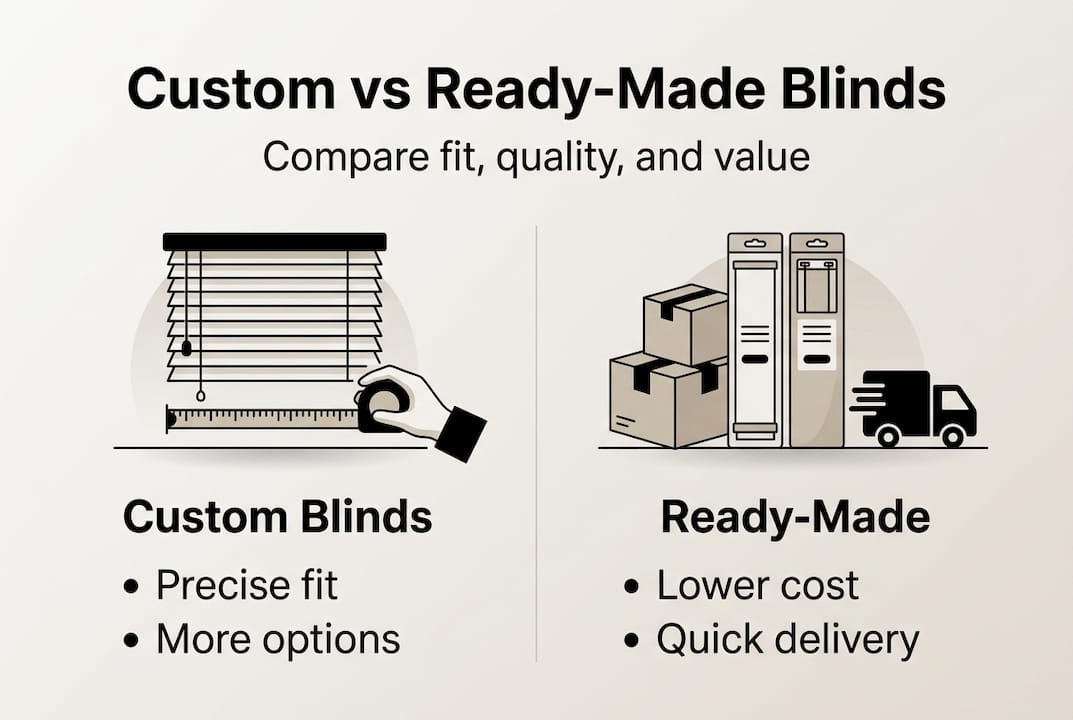
Ready-made blinds are tempting because they’re cheap and immediately available. But they rarely fit well, and poor fit means light gaps, privacy issues, and a look that feels unfinished. Custom blinds cost more upfront but deliver real returns in aesthetics, energy efficiency, and longevity. They’re built to your exact window size, so there’s no trimming, no guessing, and no awkward gaps.
Mount types: inside vs. outside
This is one of the most important decisions you’ll make. An inside mount sits within the window frame for a clean, recessed look. An outside mount attaches to the wall or trim above the window, which offers better light blockage and privacy. Outside mounts also make windows appear larger, which is a useful design trick for smaller rooms.
| Feature | Inside mount | Outside mount |
|---|---|---|
| Look | Sleek, minimal | Bold, room-defining |
| Light control | Moderate | Superior |
| Privacy | Good | Excellent |
| Best for | Deep frames | Shallow frames or max coverage |
Styles and materials at a glance
You have more options than ever. Here’s a quick breakdown:
- Wood blinds: Warm, classic look. Best for living rooms and bedrooms.
- Faux wood: Moisture-resistant version of wood. Great for kitchens and bathrooms.
- Roller shades: Minimal and modern. Easy to clean.
- Cellular shades: Honeycomb structure traps air for energy efficiency.
- Motorized blinds: Convenient, cord-free, and ideal for hard-to-reach windows.
Before you commit to any color or texture, check out the accurate measuring guide to understand how your material choice affects the final dimensions.
Pro Tip: Always order free fabric swatches before you finalize your choice. Screen colors are notoriously unreliable, and what looks like warm ivory on your monitor may arrive as stark white in your living room.
How to measure your windows accurately
Measuring is the most critical step in the entire process. One wrong number and the whole order is off. The good news is that with the right tools and a clear process, it’s completely manageable.

What you’ll need
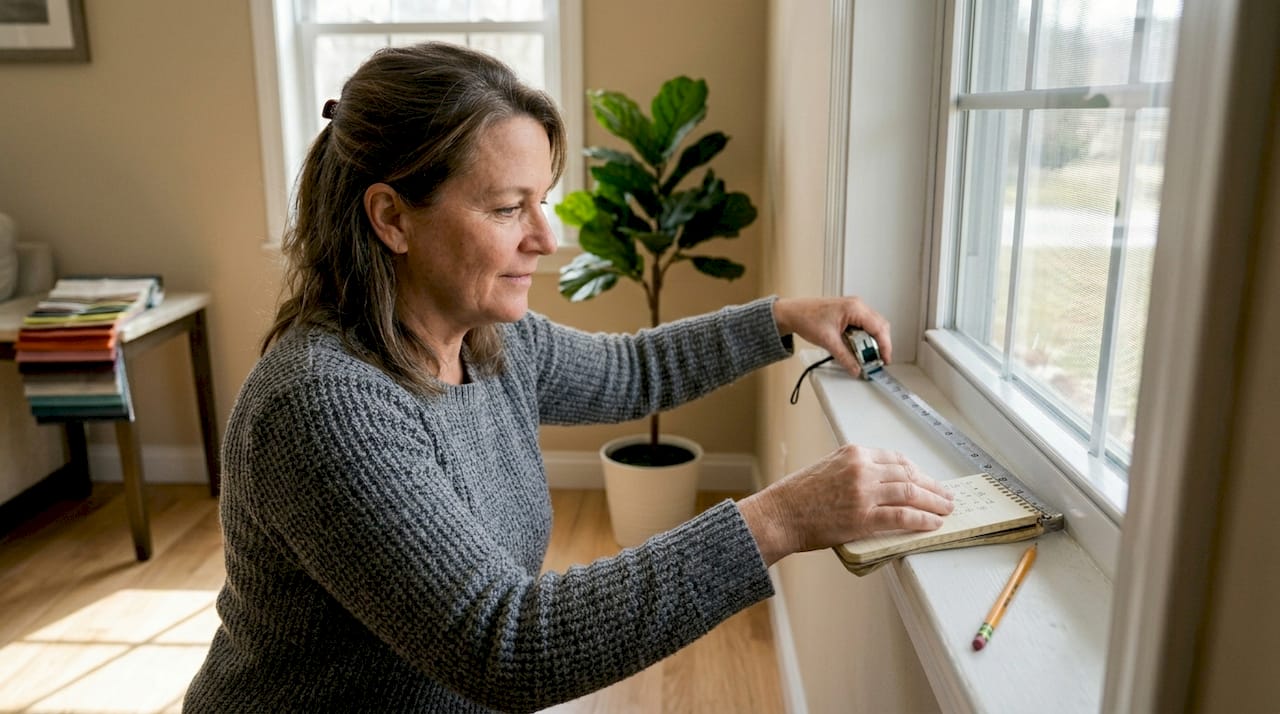
Use a steel tape measure, not a cloth one. Cloth tape stretches and gives inconsistent readings. A pencil and notepad (or your phone) for recording measurements are all you need beyond that.
Step-by-step measuring process
- Measure the width at three points: top, middle, and bottom of the window opening.
- For inside mounts, use the narrowest width measurement.
- For outside mounts, use the widest width and add 2 to 4 inches on each side for coverage.
- Measure the height at three points: left, center, and right.
- For inside mounts, use the longest height measurement.
- Check the depth of the window frame to confirm there’s enough clearance for an inside mount (usually at least 1.5 inches).
- Record all measurements in width x height format. Never swap them.
As Blinds.com recommends, always check three locations for both width and height, and record the smallest or largest as appropriate for your mount type.
“Never assume two windows are the same size, even in the same room. Measure every single one.”
Pro Tip: Measure twice, write it down once. It sounds obvious, but most errors happen when people trust their memory instead of their notes.
Handling tricky windows
Out-of-square windows and shallow frames complicate inside mounts significantly. If your window frame isn’t perfectly rectangular, an inside mount may leave visible gaps. Arched windows, bay windows, and skylights often require professional measurement. For standard rectangular windows, DIY is very realistic.
| Window type | DIY friendly? | Notes |
|---|---|---|
| Standard rectangle | Yes | Follow the 3-point method |
| Shallow frame | Caution | Check depth carefully |
| Arched or bay | No | Hire a pro |
| Out-of-square | Caution | Outside mount may be safer |
For more detailed guidance, read about inside mount measuring, measuring shades accurately, and the full step-by-step window measuring walkthrough.
Selecting materials, features, and finishes
With accurate measurements in hand, you can focus on the details that shape daily comfort and long-term satisfaction. This is where style meets function.
Material options and their best uses
- Wood: Rich look, but sensitive to humidity. Keep out of bathrooms.
- Faux wood: All the visual warmth of wood with moisture resistance. Works everywhere.
- Fabric shades: Soft, layered look. Great for bedrooms and living rooms.
- Blackout materials: Designed to block nearly all light. Perfect for nurseries and media rooms.
- Woven wood: Natural, textured aesthetic. Best in low-humidity spaces.
- Motorized: Any material can be motorized. Ideal for skylights or oversized windows.
Custom blinds last 10 to 15 years on average, which is two to three times longer than most ready-made options. That lifespan makes the upfront investment far more rational than it might first appear.
Lift systems: corded, cordless, or motorized
Cordless and motorized systems are safer and increasingly preferred, especially in homes with young children or pets. Corded systems cost less but come with safety risks and more visible hardware. Motorized options add convenience and a clean look, but they do require a higher budget.
For families with kids, explore the cordless blinds options available online. These remove cord hazards entirely while still offering smooth, reliable operation.
Room-by-room material guide
- Kitchen and bathroom: Faux wood or waterproof roller shades.
- Bedroom: Blackout cellular or fabric shades for sleep quality.
- Living room: Wood, faux wood, or light-filtering roller shades.
- Home office: Light-filtering options to reduce glare without full darkness.
One important note on blackout shades: true blackout performance requires both the right material and the right mounting technique. Even a blackout fabric will let light in around the edges if it’s inside-mounted with a shallow frame. Outside mounting with side channels gives you the best result.
Pro Tip: Order samples of your top two or three material choices and hold them against your wall at different times of day. Natural light changes how colors and textures read dramatically.
Ordering and what happens next
Once all your measurements and selections are finalized, placing the order is the easy part. Most online platforms walk you through a simple configuration process.
How to place your order
- Select your product type and style.
- Enter your measurements in the width x height format.
- Choose your mount type, lift system, and color or finish.
- Review the order summary carefully before checkout.
- Confirm your shipping address and any special instructions.
Double-check every field before you submit. A single transposed digit in the width field will send you back to square one.
What happens after you order
Your order goes into production almost immediately. Custom blinds are built to your specs, which means they can’t be restocked or resold. This is why accuracy matters so much at the input stage. You’ll receive an order confirmation with an estimated production timeline.
“Lead times for custom blinds typically run 2 to 6 weeks, and some brands offer remake guarantees if your measurements are off.”
Once production is complete, your blinds ship with tracking information. Prepare your installation space in advance so you’re ready to hang them the day they arrive.
Upon arrival: what to check
- Verify the product matches your order confirmation.
- Check for any shipping damage before opening fully.
- Confirm dimensions match what you ordered.
- Test the lift mechanism before installation.
- Read the installation instructions fully before drilling anything.
Professional installation reduces costly mistakes, especially for complex or oversized windows. For most standard windows, however, DIY installation is manageable with basic tools.
Use the measurement unit converter if you need to switch between inches and centimeters during the ordering process.
A pro’s take: the truth about custom blinds ordering
Here’s something most guides won’t tell you: measurement errors are the number one cause of returns and frustration, even among experienced interior decorators. It’s not a beginner problem. It’s a rushing problem. The people who get it wrong are almost always the ones who measured once, trusted their memory, or assumed all windows in a room were identical.
Custom blinds genuinely add value to a home. Better insulation, cleaner aesthetics, and a precise fit that off-the-shelf products simply can’t match. But that value only materializes when the order is right.
Know when to call in help. If you’re dealing with arched windows, bay configurations, or you’re just feeling anxious about the process, a professional measurement service is worth every penny. For standard rectangular windows, a careful DIY approach works well.
Treat this as an investment, not a weekend project. Plan extra time, measure every window individually, and double-check before you submit. The reward is window treatments that look custom because they are.
Ready to transform your space? Your next step
Putting all of this into practice is easier than you might think when you have the right tools and support behind you. At Value Blinds, the entire ordering experience is built around making customization simple, accurate, and stress-free.
Start by browsing the full range of custom blinds to find styles that match your home. If cord-free living is a priority, the cordless and no-drill blinds collection is a great starting point. Not sure where to begin with design? The design studio lets you visualize options for your space before you commit. Free swatches, expert support, and satisfaction guarantees make it easy to order with confidence.
Frequently asked questions
What are the most common mistakes when ordering custom blinds online?
The most common mistakes are inaccurate measurements, mixing up width and height, and choosing the wrong mount type for your window depth. These errors account for the vast majority of returns and remakes.
Why choose custom blinds over ready-made options?
Custom blinds fit precisely, last longer, and provide better light control, privacy, and insulation. Ready-made blinds rarely match window dimensions exactly, which leads to light gaps and a less polished look.
Do I need a professional to measure and install my blinds?
It’s not required, but professional measurement reduces errors significantly, especially for complex windows like arches, bays, or out-of-square frames. For standard rectangular windows, careful DIY is very achievable.
How long does it take to receive custom blinds after I order?
Most custom blinds arrive within 2 to 6 weeks after ordering, depending on the style, material, and manufacturer’s current production schedule.
Are cordless blinds really better for homes with children?
Yes. Cordless blinds eliminate the strangulation hazard posed by traditional corded systems and are now the recommended standard for any home with young children or pets.